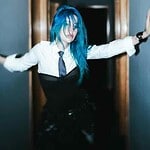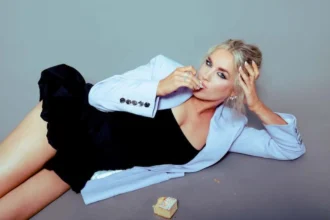
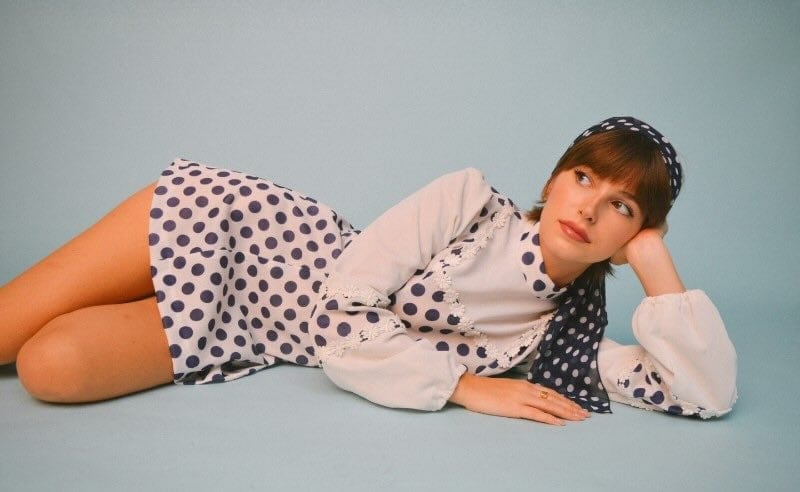
London singer-songwriter v officially enters her cosmic era with the release of her cinematic six-track EP, First Girl On The Moon. Known for her “world-building” approach to alt-pop, Manzoli pairs radical honesty with a retro-futurist aesthetic that has already captured the attention of BBC Radio 1 and Spotify.
Stream First Girl On The Moon here
A Retro-Futurist Love Story
The EP’s title track and centerpiece, “First Girl On The Moon,” is a love song inspired by 1960s space-age optimism. Manzoli captures the “weightless” feeling of falling in love for the first time, using a sonic palette that pays homage to the BBC Radiophonic Workshop.
- The Sound: Playful, otherworldly textures featuring the theremin and omnichord.
- The Visuals: A “Hollywood on a Borehamwood budget” video that maintains Manzoli’s commitment to high-concept DIY artistry.
- The Narrative: The EP explores the contradictions of modern love—from the “Breakup Blues” to digital disillusionment in “Burn The Internet.”
Immersive Live Experience
Following a headline show at London’s The Grace, Manzoli is set to bring her theatrical stagecraft—including her signature six-foot moon—to audiences across the UK and Europe supporting Em Beihold and Eileen Alister.
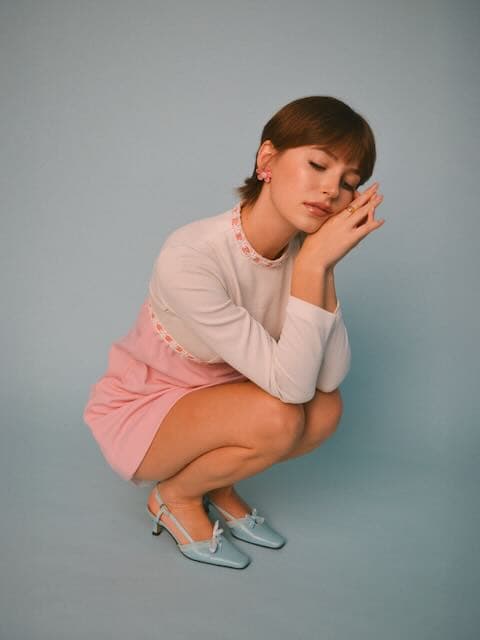
What first drew you into the world of music, and how would you define your unique musical style to someone stepping into your “world” for the first time?
I’d describe my world as nostalgic, colourful and cinematic. The flute was actually the first thing that got me into music. I remember seeing a YouTube video as a child and thinking how beautiful it looked.. A bit later on I became obsessed with singing. I’d sing constantly in private and I still have loads of old videos on my first phone of me secretly singing to the camera in my room.
You’ve described the title track of your new EP as capturing the exact second of falling in love and feeling the earth disappear. Does finally releasing this “painstakingly curated” collection feel like its own kind of weightlessness?
The collection doesn’t really feel painstakingly curated to me. My songs tend to be quite themed naturally, and those six just happened to be the ones that made the most sense together at the time. They each capture slightly different emotions and moments, but they all sit in the same world. Releasing the EP has felt really special though. I’ve been holding onto these songs for a while, so it’s lovely that people can finally hear them together as one story.
First Girl On The Moon leans heavily into 1960s space-age optimism. What is it about that specific era’s blend of hope and “retro-futurism” that felt like the right “suit” for your first experience of falling in love?
I think part of it was finding a way to be a little bit silly and tongue-in-cheek. Love songs will always have an element of cheesiness, so leaning into that with very on-the-nose theremin sounds and spacey textures felt like a fun way to embrace it rather than shy away from it. I’ve always been drawn to the sound of the 1960s anyway, so that influence naturally found its way into a lot of the EP.
You mentioned using the theremin and omnichord to nod to the BBC Radiophonic Workshop. How did you find the balance between these “silly and kitsch” textures and the “radical honesty” of your lyrics?
Humour is quite important to me when I’m writing. Some songs on the EP, like Dear Other Woman, came from a very vulnerable place, so pairing those with lighter or more playful moments felt like a natural way to keep the project dynamic. I like the idea of the EP feeling like a personality, where different emotions can exist side by side without cancelling each other out.
Your visual style—especially for Suzy Loves Sam—is often compared to Wes Anderson’s offbeat symmetry. When you’re writing, do you see the “red gingham” and cinematic framing in your head before the melody is even finished?
Suzy Loves Sam was directly inspired by the film Moonrise Kingdom by Wes Anderson, so the visuals were definitely part of the writing process. The song and the aesthetic go hand in hand. We were referencing specific scenes while writing it, and we played the trailer over the track just to make sure the feeling matched the world of the film.
From a six-foot fiberglass moon to a “Hollywood on Borehamwood” budget, you’ve pushed past the typical limits of an independent artist. What is the biggest “creative fire” you’ve had to put out while trying to fulfill these ambitious visions?
I always have a million ideas, but realistically I can only create what’s possible at the time. I love pushing things as far as I can within those limits though. When the budgets get a bit bigger I can’t wait to fully dive into the scale of some of the ideas I have. One slightly chaotic moment was filming the video for Burn The Internet. We had a real fire and I ended up burning a computer in my friend’s garden, which was a bit silly and slightly terrifying in the moment.
Tracks like Burn The Internet explore the contradictions of the digital age. As an artist who builds such immersive, tactile worlds, how do you protect your own creativity from the “hollowness” of the online world?
Most of what I make is very physical and handmade, and it all comes from a place of genuine love for creating. Because of that I don’t worry too much about the “hollowness” of the online world. The creative process still feels very real and tactile for me.
You’ve been very open about writing from a place on the asexual spectrum, particularly on Princess Prudence. How has the fan response to that specific honesty changed the way you view your role as a songwriter?
It hasn’t really changed the way I see my role as a songwriter, but it has reaffirmed how important it is to talk about things that genuinely matter to you. I personally hadn’t heard many songs or seen many artists speaking openly about the topic, so it felt like an important thing for me to write about.
You’re heading out with Em Beihold and Eileen Alister across the UK and EU. What’s the one item—besides the moon!—that you absolutely have to bring with you to make a tour bus feel like home?
I always bring a hot water bottle and lots of herbal tea. Staying cosy is essential when you’re travelling around a lot.
As you celebrate your headline show at The Grace, what is the one thing you hope listeners feel when they reach the end of the EP’s final act?
By the end of the EP, I hope listeners feel both happy and understood, like they’ve been invited into the little world the songs live in.
| Date | City, Country | Venue | Support For |
| Mar 24 | Lisbon, Portugal | Musicbox | Eileen Alister |
| Mar 25 | Madrid, Spain | Sala Villanos | Eileen Alister |
| Mar 26 | Barcelona, Spain | Sala Razzmatazz 3 | Eileen Alister |
| May 12 | London, UK | Garage | Em Beihold |
| May 16 | Amsterdam, Netherlands | Tolhuistuin | Em Beihold |
| May 18 | Paris, France | La Machine du Moulin Rouge | Em Beihold |
| May 20 | Cologne, Germany | Luxor | Em Beihold |
https://linktr.ee/ericamanzoli
https://www.instagram.com/erica.manzoli