The smartphone landscape in 2026 has genuinely moved past the standard slab. Alongside the usual flagship refresh cycle, this year brought a real triple-folding device to market and an ultra-thin “Air” category that’s reshaped what people expect to carry in a pocket.
- The 2026 Heavyweight Champions
- 1. Apple iPhone 17 Pro Max (The Video King)
- 2. Samsung Galaxy S26 Ultra (The Productivity Beast)
- 3. Google Pixel 11 Pro XL (The AI Visionary)
- 2026 Market Disruptors: The New Form Factors
- 2026 Flagship Comparison Table
- Smart Buyer’s Guide for 2026
- FAQ: Smartphone Questions for 2026
Ecosystem loyalist or spec-hungry power user, these are the phones actually defining the 2026 market — all currently shipping, not speculative.
The 2026 Heavyweight Champions
1. Apple iPhone 17 Pro Max (The Video King)
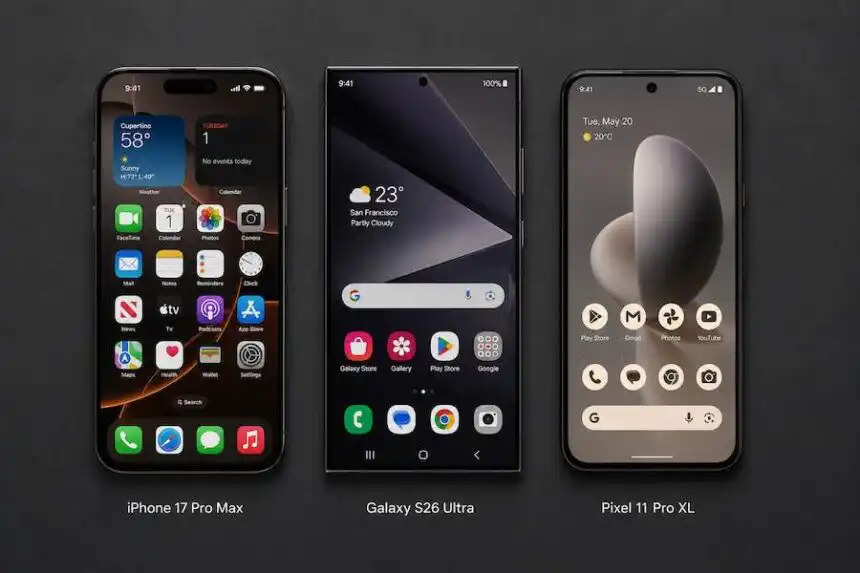
Launched in September 2025 and still Apple’s flagship through 2026, the 17 Pro Max brought a genuinely significant redesign — a heat-forged aluminum unibody with an internal vapor chamber, delivering roughly 40% better sustained performance under heavy load. The triple 48MP camera system (Fusion Main, Ultra Wide, and a new Telephoto) pushes optical-quality zoom out to 8x, the longest ever on an iPhone.
- Key Feature: The A19 Pro chip paired with vapor chamber cooling, letting sustained gaming and video work run without the thermal throttling older iPhones were known for.
- Why it wins: Genuinely unmatched video consistency and the most polished Apple Intelligence integration on the market. Starts at $1,199.
2. Samsung Galaxy S26 Ultra (The Productivity Beast)
Released in March 2026, the S26 Ultra remains the gold standard for Android power users. Built around the Snapdragon 8 Elite Gen 5, it handles multitasking and on-device AI translation better than any other Android device currently shipping.
- Key Feature: A 200MP main sensor with a wider f/1.4 aperture, alongside a 50MP ultrawide and a 50MP periscope telephoto with 5x optical zoom.
- Why it wins: S-Pen integration and the most versatile quad-camera system on the market. Genuinely worth noting: Samsung dropped the titanium frame this generation in favor of aluminum, and there’s still no Qi2 magnetic charging — a real gap next to Apple and Google’s latest. Starts at $1,299.
3. Google Pixel 11 Pro XL (The AI Visionary)
Google’s newest flagship, announced August 12, 2026 and hitting shelves August 20, runs on the Tensor G6 — a 2nm chip paired with a new Titan M3 security coprocessor, delivering roughly 4.5x faster Night Sight processing and 20% better power efficiency over last year’s model.
- Key Feature: Magic Capture, a one-tap mode that shoots a short burst of photos and video, then uses on-device AI to pick and lightly edit the best frames automatically. Zoom now reaches 120x with the new Pro Zoom mode.
- Why it wins: A redesigned 48MP main sensor capturing 56% more light, a new HiLight LED ring on the camera bar for glanceable notifications, and Qi2.2 charging up to 29% faster than before. Starts at $1,299 — up $100 from the Pixel 10 Pro XL.
Worth noting for anyone shopping right now: the Pixel 10 Pro XL remains genuinely excellent and is already seeing real discounts as retailers clear stock — a strong budget-flagship pick for anyone who doesn’t need this year’s camera upgrades specifically.
2026 Market Disruptors: The New Form Factors
The “Wide Foldable” Shift
Samsung’s Galaxy Z Fold 8 and Z Fold 8 Ultra launched August 7, 2026, and marked a genuine first: two Fold-line phones sold side by side for the first time. The standard Z Fold 8 introduces a new “Wide” form factor — shorter and wider than a traditional book-style fold, closer to a passport shape — while the Fold 8 Ultra keeps the familiar tall, narrow silhouette Samsung fans expect. Both run the Snapdragon 8 Elite Gen 5 and ship with Android 17 out of the box, backed by a genuine 7-year update commitment.
The Z Fold 8 starts at $1,899 (256GB); the Fold 8 Ultra starts at $2,099. Both are genuinely current and widely available right now — a real, more practical alternative to the short-lived TriFold experiment above.
The “Tri-Fold” Experiment
Samsung genuinely made history with the Galaxy Z TriFold, the world’s first mass-market triple-fold smartphone, launching in the US on January 30, 2026, at a striking $2,899. It unfolds twice into a full 10-inch display — a real workstation-in-your-pocket moment. The catch: Samsung quietly discontinued it just three months later, and a rumored Galaxy Z TriFold 2 isn’t expected until sometime in 2027. Worth knowing before hunting one down — it’s a genuinely fascinating device, but no longer a current, actively sold flagship.
The “iPhone Air” Aesthetic
Apple’s iPhone Air, launched alongside the iPhone 17 series in September 2025, set a genuine trend toward ultra-slim devices. At just 5.64mm thin, with a titanium frame and the same A19 Pro chip found in the Pro models, it prioritizes style and pocketability over the bulkier camera hardware — appealing to a real “minimalist luxe” audience willing to trade a triple camera for a single 48MP one. Starts at $999.
2026 Flagship Comparison Table
| Feature | iPhone 17 Pro Max | Galaxy S26 Ultra | Pixel 11 Pro XL |
| Main Sensor | 48MP (Fusion, ƒ/1.78) | 200MP (ƒ/1.4) | 48MP (Redesigned) |
| Display | 6.9″ Super Retina XDR ProMotion | 6.9″ Dynamic AMOLED QHD+ | 6.8″ Super Actua |
| Chip | A19 Pro | Snapdragon 8 Elite Gen 5 | Tensor G6 |
| Best For | Creators & Video | Power Users & S-Pen | Photographers & AI Fans |
| Starting Price | $1,199 | $1,299 | $1,299 |
Smart Buyer’s Guide for 2026
- Don’t just chase megapixels: A 50MP sensor with strong computational software often produces better real-world results than a 200MP sensor leaning entirely on raw resolution. Software tuning matters more than the number on the spec sheet.
- Check the nits: Outdoor visibility remains a genuine priority — the iPhone Air alone hits 3,000 nits peak brightness, and most 2026 flagships now sit in that same range or close to it.
- Software longevity: Samsung and Google both now commit to 7 years of OS updates on their flagship lines. If a 3+ year hold is the plan, that support window makes a genuine difference to long-term value.
FAQ: Smartphone Questions for 2026
Q: Is 8K video worth it in 2026?
A: For most people, genuinely no. 4K at 60-120fps remains the sweet spot for a high-end cinematic look without burning through storage in minutes flat.
Q: Are physical SIM cards gone?
A: Mostly, at least on the newest devices — iPhone 17 Pro, Pro Max, and Air all ship eSIM-only in the US, and most 2026 flagships across Apple, Samsung, and Google follow the same trajectory. Some markets outside the US still get physical SIM trays, so it’s worth checking regional availability before buying.
Q: Does Apple have a foldable yet?
A: Not yet as of mid-2026, though leaks — including reported details on crease design — suggest an iPhone Fold is genuinely getting closer, with a possible unveiling alongside the iPhone 18 lineup this September. Nothing official from Apple yet.
Q: Is the Galaxy Z TriFold still worth buying?
A: Only if found at genuine clearance pricing. Samsung discontinued it a few months after launch, and no software or accessory support roadmap has been confirmed going forward. For a foldable that’s actually current and fully supported, the new Galaxy Z Fold 8 or Z Fold 8 Ultra is the far safer pick — a Z TriFold 2 isn’t expected until 2027 at the earliest.
Q: Should I buy the Pixel 11 Pro XL or wait, since it just launched?
A: Wide retail availability lands August 20, 2026, so early buyers may see a short wait or limited stock in the first week or two. If the camera upgrades and Tensor G6 speed genuinely matter, it’s worth the short wait. If not, the Pixel 10 Pro XL is already seeing real discounts and remains a genuinely strong phone for $100+ less.
109 views