







Some of the most effective training doesn’t require a single piece of equipment — just gravity, discipline, and a little floor space.
Bodyweight training has quietly become one of fitness’s most enduring habits — no gym membership, no equipment bag, no excuses about travel or time. It works at home, at the office, outside, or in a hotel room between flights. Celebrity fitness trainer Christopher Clarke, whose client roster spans executives, diplomats, musicians, and athletes, breaks down three foundational movements that build real strength using nothing but your own body.
Three movements, full-body impact
These three exercises cover the essentials: pushing strength, lower-body power, and core stability. According to the American Council on Exercise, bodyweight training builds functional strength that translates directly into everyday movement — lifting, climbing, carrying, twisting — making it as practical as it is efficient.
Push-ups
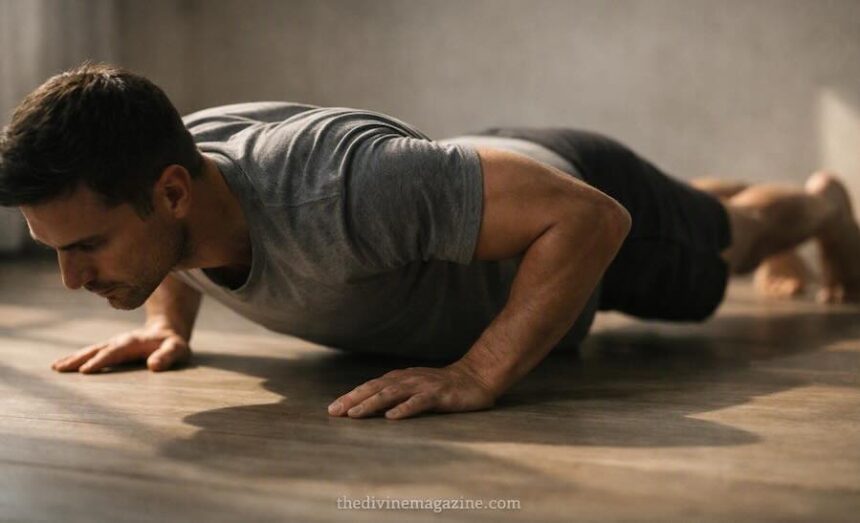
Few exercises do more with less. Push-ups build strength through the chest, shoulders, triceps, and core simultaneously, reinforcing the same pushing mechanics used in countless daily movements — from carrying groceries to catching your balance.
- Start on hands and knees, hands slightly wider than shoulder-width.
- Straighten your body into a plank, core engaged.
- Lower until your elbows reach roughly a 90-degree angle.
- Pause briefly, then press back to the starting position.
Squats
Often called the foundation of lower-body training, squats work the quads, hamstrings, glutes, and calves in a single fluid motion. The Mayo Clinic notes that compound movements like squats improve balance and coordination alongside raw strength — benefits that show up in everyday tasks like climbing stairs or lifting with proper form.
- Stand with feet shoulder-width apart.
- Sit back as though lowering into a chair.
- Lower until thighs are roughly parallel to the floor, knees tracking over ankles.
- Pause, then rise back to standing.
Crunches
A core exercise in every sense — crunches target the abdominal muscles that support balance, posture, and rotational control. A strong core isn’t just aesthetic; it’s the stabilizing base for nearly every other movement in a workout.
- Lie on your back, feet planted on the floor.
- Cross your hands lightly over your chest.
- Curl your shoulders and head up and forward.
- Hold briefly at the top, then lower with control.
About Christopher Clarke
Born in Jamaica and based in Palm Beach, Florida, Christopher Clarke has spent more than a decade building tailor-made training programs for clients across the Caribbean, Europe, the Middle East, and the United States. Alongside his work as a trainer, he has appeared in billboards, music videos, and fashion campaigns, and remains active in charitable work recognized both nationally and internationally.
For more on his work, visit christopherclarke.info, or follow him on Instagram and Twitter @jacelebtrainer.
The takeaway
Strength doesn’t require a gym membership or a rack of equipment — just consistency, good form, and a willingness to start where you are. Push-ups, squats, and crunches remain foundational for a reason: they work every major muscle group with nothing but your own bodyweight, wherever you happen to be.
Frequently Asked Questions
How often should I do bodyweight exercises?
Most fitness guidelines suggest strength training two to three times per week, with rest days between sessions to allow muscles to recover. Beginners can start with two sessions weekly and build up as strength and confidence grow.
Can bodyweight training build real muscle, or just tone?
Bodyweight training can build genuine strength and muscle, particularly for beginners and intermediate exercisers. Progression — through more reps, slower tempo, or more challenging variations — keeps the muscles adapting over time, much like adding weight would in traditional strength training.
What if I can’t do a full push-up yet?
Modified versions — such as push-ups from the knees or against an elevated surface like a wall or bench — build the same muscles while reducing the load. Progressing gradually toward a full push-up is a normal and effective approach.
Do I need to warm up before bodyweight training?
Yes. A few minutes of light movement — brisk walking, arm circles, or gentle dynamic stretches — helps prepare muscles and joints, reducing the risk of strain even in equipment-free workouts.
Is bodyweight training enough on its own, or should I add weights?
For many people, bodyweight training alone provides substantial strength benefits, especially when movements are progressed thoughtfully. Adding weights later can help continue building strength once bodyweight exercises start to feel too easy.