
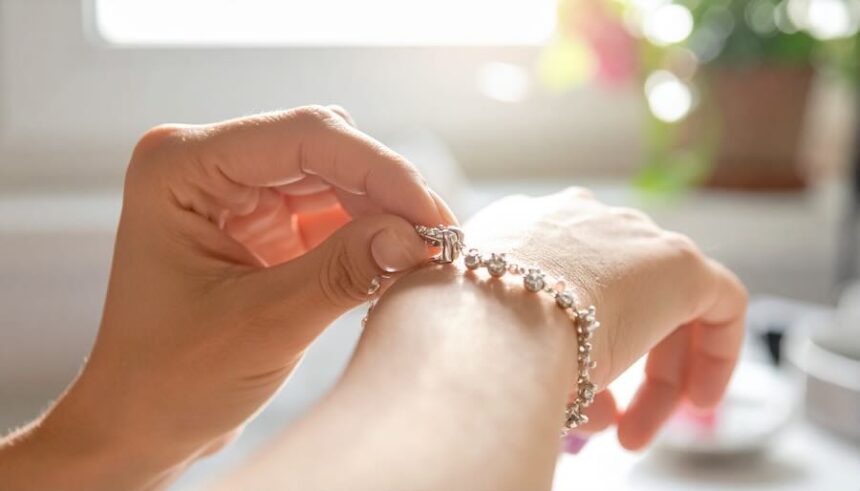
Bracelet Doesn’t Fit? Here’s How to Fix It
A few simple fixes before you write off a piece you actually love.
A bracelet that’s slightly wrong on the wrist has a way of ending up in a drawer rather than on your arm — too loose to trust, too tight to wear for more than an hour, or just off in a way that’s hard to name. Before it gets retired for good, most fit problems have a straightforward fix, and most of them don’t require a jeweler.
If It’s Too Loose
A bracelet that slides around or spins constantly is usually a sizing problem, not a design flaw. For chain-link styles, most jewelers can remove a link or two in a few minutes — a small, inexpensive adjustment that makes a real difference. For bangles and cuffs, a light reshaping by hand (or a jeweler’s gentle touch, for anything precious or delicate) can bring the curve in slightly without leaving a visible mark. The GIA’s jewelry care guide covers how different metals respond to this kind of adjustment, if you’re unsure what your piece can handle.
If it’s a beaded or cord bracelet, resizing is often even simpler — a matter of retying the closure a few millimeters shorter, something you can usually do yourself with a bit of patience.
If It’s Too Tight
The opposite problem is just as fixable. Adding a link, an extender chain, or swapping in a slightly longer clasp are all standard, low-cost adjustments. extender chains in particular are worth knowing about — they let you keep the piece as-is most days and add a bit of room when your wrist swells slightly with heat or activity, without any permanent alteration.
For a cuff that’s pinching rather than clasping, gentle widening is usually possible — but this is one to hand to a professional rather than attempt yourself, since metal that’s bent too far can crack or lose its shape permanently. Jewelers of America’s care resources are a good starting point for finding a trustworthy local jeweler for this kind of work.
When the Clasp Is the Real Problem
Sometimes the bracelet fits fine and the clasp is what’s failing — hard to close one-handed, prone to popping open, or simply worn out from years of use. Swapping to a magnetic or toggle clasp solves most of this in one move, and it’s one of the more affordable jewelry repairs there is. If a piece has real sentimental value, this is often the fix that actually gets it back into rotation.
Know When to Let a Professional Handle It
DIY fixes work well for cord, beaded pieces, and minor bends. Anything involving soldering, precious metals, or a piece with real monetary or sentimental value is worth taking to a jeweler rather than risking with pliers at your kitchen table. Most resizing and clasp work is quick and inexpensive — often less than you’d expect for the years it adds back to a piece you’d otherwise stop wearing.
Conclusion
An ill-fitting bracelet is rarely a reason to give up on it entirely. A link removed, a clasp swapped, a small reshaping — most of the time, the piece you love just needs a small adjustment to actually get worn again.
FAQ: Fixing a Bracelet That Doesn’t Fit
Can I resize a bracelet myself?
Cord and beaded bracelets, yes, usually. Chain, cuffs, and anything with precious metal or sentimental value are safer left to a jeweler.
How much does it cost to resize a bracelet?
Removing or adding links is typically one of the more affordable jewelry repairs — often a quick, low-cost adjustment rather than a major expense.
What’s an extender chain, and do I need one?
A short additional length added to a clasp, giving a bracelet a bit more room when needed without permanently altering the piece — useful if your wrist size shifts slightly day to day.
Should I bend a cuff bracelet myself to make it fit?
Small adjustments by hand are usually fine. Anything more than a slight reshaping is better left to a professional — metal bent too far can crack or lose its shape for good.