




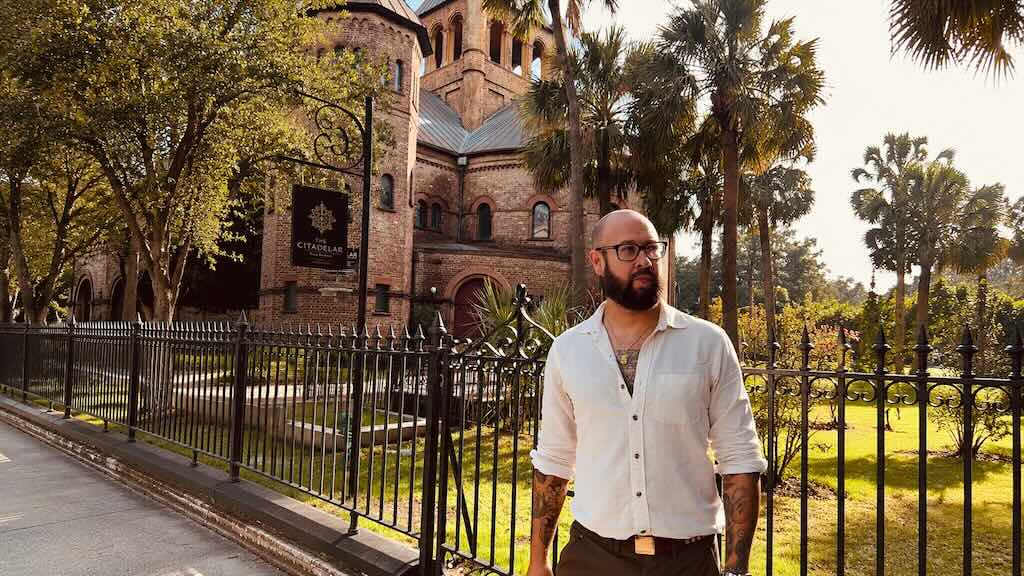
Spanish Castles is the solo music project of artist, tattooer, and musician Kirk Nilsen, where flamenco guitar, Mediterranean folk traditions, classical composition, gothic atmosphere, and traces of his punk and black metal past meet in an unusually tactile sound.
On the new EP Sombra Del Sol, those influences become part of a larger imagined world. Nilsen draws from his Portuguese ancestry, Norwegian family history, years of international travel, and a fascination with medieval music and architecture. The same attention to line, repetition, shadow, and craftsmanship that defines his large-scale Gothic and baroque tattoo work carries into the way he writes and records music.
There is a tension running through Spanish Castles: between old-world craft and digital culture, beauty and decay, history and the present. Sombra Del Sol — “shadow of the sun” — gives that tension a name, using instrumental music to suggest stories of love, conflict, loss, and imagined medieval worlds without spelling them out for the listener.
In this Q&A with Divine Magazine, Kirk Nilsen discusses how Spanish Castles grew from his tattoo work, why flamenco and medieval music connected with his earlier musical influences, the story behind Sombra Del Sol, and where he intends to take the project next.
SPOTLIGHT
MAGAZINE
Featured Artist
SPANISH CASTLES
Built from flamenco guitar, Mediterranean traditions, classical influence, and darker musical textures, Sombra Del Sol connects Kirk Nilsen’s music with the same medieval architecture, historical detail, and hand-drawn craftsmanship that shape his visual art.
Q&A — DIVINE MAGAZINE · 2026
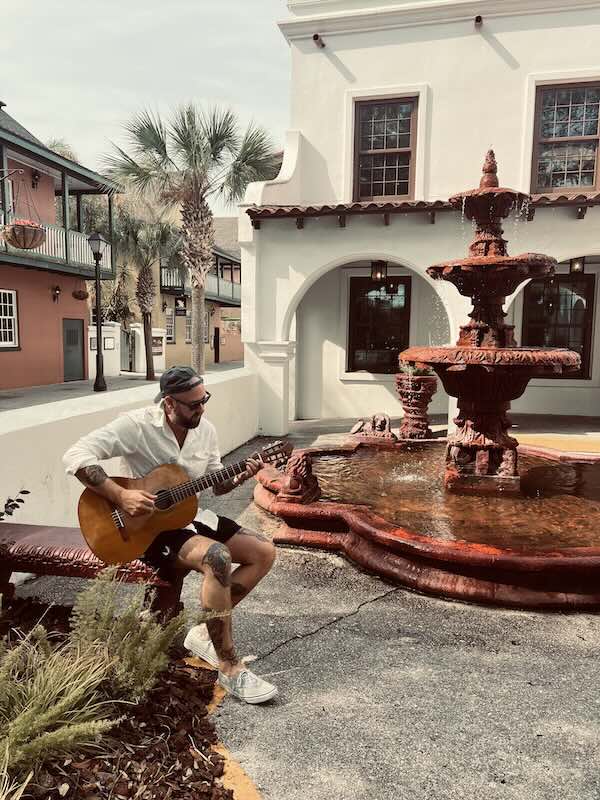
Kirk Nilsen on the sound behind Spanish Castles
Spanish Castles pulls from an unusually wide map — flamenco, Arabic, baroque, folk punk, Brazilian, gothic. Where did this specific mix start for you, and what made it feel like one project instead of five?
In my younger years, I had become immersed in much punk, hardcore, and black metal music. Unknown to me at the time, much of this music is actually centered around the Phrygian scales; which is widely used in various music centered around the Mediterranean. At one point I had heard a metal band even use some Arabic style scales on purpose in a song, and at one point in my early music career I had even myself included an Arabic oud in one of my bands songs. Something that has always stuck with me.
Later on, through the years, I had grown out of that music due to the negativity and self destructive nature of such music scenes. I no longer wanted to listen to loud, angry, screaming; nor was I ever fond of modern, manufactured corporate pop music; which also includes quite negative lyrics as well. I began a quest for instrumental music. I first went to classical and jazz; although much of it was either far too slow and sad, or far to upbeat and frantic.
Over time I began researching regional music from places that my clients in tattooing were requesting traditional folk patterns to be incorporated into their tattoos. I found the sitar, and then began looking up other Mediterranean folk music, and found quite an array of auditory excitement, and never stopped searching. At one point I even found medieval lute music, which was quite inspiring.
I then decided it would be great to meld all of this together into something new and unique that I had not heard. I took all the aspects I enjoyed about all these styles and combined a mix of cultures that do share many similarities and roots, making it flow in a way I would not have thought. That, and realizing the punk and black metal aspects would be a neat throw in based on the shared scales, a new style was born that pays homage to everything that influenced me.
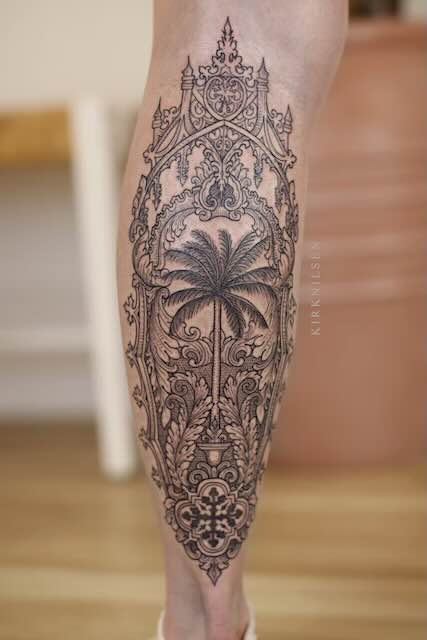
You’ve spent nearly two decades tattooing Gothic and baroque architecture onto skin. How much of Sombra Del Sol came out of that same visual language — and did you approach songwriting the way you’d approach a large-scale piece?
Interestingly enough, my songs were initially created as music to accompany the videos I posted of my tattoos on Instagram. This to me evokes an identical language, as the songs and the art co-inspire and complement each other in a way that gives the viewer and listener a window into the world I have created.
In a similar fashion to how I create art, my music starts with an idea. This idea with art will become a haphazard scribble on paper, denoting a general form — just as my music starts with a few notes on the guitar, freely creating until a sequence of notes interests me. I will then record just those few notes, and then completely freestyle for a few minutes straight until there is something more than those notes, yet following the same scale and rhythm.
After a few more listens to the recording, alterations, and changes — much like the multitude of redrawn sketches — I move into a final arrangement, which is then re-recorded a final time into one final piece; which is nearly identical to my drawing process.
Sombra Del Sol translates to “shadow of the sun.” What does that title mean to you, and how does it set the tone for the EP?
As with all my albums representing medieval tales of war, triumph and ancient mythologies, the title utilizes the idea of a mythical world where the sun represents glory, greatness, triumph and beauty, and a world that doesn’t exist but was in pure perfection; while the shadow represents the modern world that is decaying and in a shadow of its once great former self.
My fictional world, not too dissimilar from our real world, was ablaze with beauty, intelligence, artistry and profound wisdom, and as we slowly regress backwards into a dystopian digital hellscape filled with a monotonous global monoculture of sameness and nothing, as we fall into a new dark age, we are now in the shadow of our former glory, sombra del sol.
Your ancestry traces back to the Azores and to Larvik, Norway — two very different old-world traditions. How present is that dual heritage in this record, and did one side pull harder than the other?
There is so much influence from the Portuguese side which evolved into my love for the general Iberian peninsula; which is the major driving force for my music. As for the Norwegian traditions, there is a slight pull for some more classical, darker tones, more somber melodic and medieval efforts, as well as the slight black metal influence as well.
Both of these regions have always been of major influence and interest to me as I never want to step much into the territory of traditions from cultures which I am not a part of, although I do retain much worldly influence from many cultures due to my years of travel and belief that all culture is meant to be shared and collaborated on.
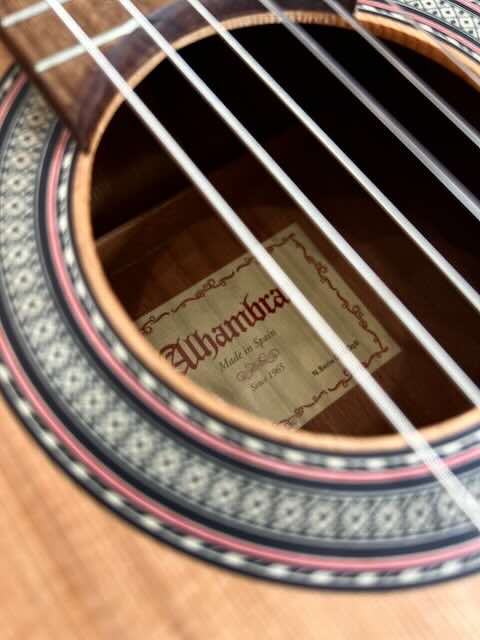
You’ve described Spanish Castles as music that feels like it exists outside of modern time. In practice, how do you keep a song from sounding contemporary — is it the instrumentation, the structure, something else?
Modern music, especially pop music, has a very distinct, manufactured, and soulless corporate sound, in my opinion. I think by just not having an interest in it, not listening to it, and even having an extreme dislike for most of it allows me to create music outside of that realm without trying to do so on purpose.
I also am heavily influenced by old world music, especially listening to renditions of pieces written in the middle ages; which the world has steered ever so far away from such masterpieces that even having that as an influence will greatly reduce your similarity to contemporary musicians.
Although the song structures are slightly more contemporary, with some structure that is also not found in anything else, the instruments and the recording style of purposely using outdated equipment for a warmer analog sound, instead of a modern digitized one is also worth noting.
Is there a specific track on Sombra Del Sol that best represents where you want to take this project next — and what’s the story behind it?
I really enjoyed writing the song “Mi Amor.” I want to add more tremolo and almost an Italian feel to the songs, and generally do enjoy slightly more somber and darker tones. I am actually writing some more songs similar to this track, but also many that are much slower, more classical guitar influenced and much more somber.
The song “Mi Amor” though is about the chaos surrounding a medieval warrior sea captain that is falling in love, and the duality of the good times and bad, losing and finding, and the dance that is life. The song follows the journey of this Spanish captain at sea, finding the one he loves and leaving her behind, and the juxtaposition of the intensely emotional scales that flow directly into the dark chorus of the war being fought to create the grandiose world he wants to create for her, so they may finally live together in harmony — yet this love and this world has been created through sheer destruction and sacrifice, as an emotional tale of what ends man will go for true love.
You’ve tattooed across New York, Berlin, Amsterdam, Milan, and beyond, and appeared on Paramount’s The Art of Ink. Has touring and working internationally as a tattoo artist shaped the sound of Spanish Castles more than you expected?
Absolutely. Learning so much about different cultures, becoming immersed in their traditions, language, food, art, architecture and music was the greatest thing to experience. Every time I traveled to a new place, I would learn the language, try the food and spend hours listening to their traditional music and instruments. This extreme plethora of musical language has influenced so much of my music it is hard to see how I could have gotten here without it.
Between tattooing UFC fighters, jazz musicians, and other tattooers, you’ve built work around very different personalities and stories. Does that same instinct — building something around someone else’s story — show up in how you write music?
Definitely. My first entire album was actually fully written around a story. I actually wrote a short novel about an usurped knight who loses his throne and kingdom, and has his people nearly all eliminated; only to return with a vengeance and retake his kingdom — only to yet again be ousted and eventually killed as his kingdom and people returns to ruin.
The novel and words, characters and entire story line was written first, and then the music was written around it. The entire idea was for it to be the soundtrack for a novel with no words. The song titles are the chapters of the book, and the listener is to listen in order, full length songs end to end, and imagine their own story based on the song titles.
You can hear in the intense emotional changes of each track when there is a war, a calmness, rejoice and sadness. This is how many classical songs used to be written, but now songs are spelled out for you. I want my music to be thought evoking, and you need to really listen and use your brain to feel the music properly.
Your work, in tattooing and now in music, leans hard into “no shortcuts” craftsmanship at a time when a lot of creative work is fast and disposable. Why does that matter to you, and do you think listeners can actually hear the difference?
Absolutely. I believe that the world is being destroyed intentionally and I do not think those responsible are even planning on the rest of society making it through the other side into the new digital world they are creating. We are all being massively de-intellectualized to such an extreme degree there will soon be no return. I find it a priority for all who have influence to make and promote any and all attempts to reverse course immediately; lest we be solely reliant on technological and government intervention eternally for our survival.
As for listeners noticing a difference, for sure. There is a sort of soulful, emotional response when a real human is performing music vs. a machine. The imperfections, the slight embellishments and flourishes. These are profoundly human, more natural, and very noticeable.
Someone schooled in music and well versed can easily spot the difference. Other listeners will be able to tell something sounds stiff, robotic, and non-lifelike, although maybe they do not understand why. But, I think it gives the music a soul, in an otherwise empty digital world.
What’s next for Spanish Castles after Sombra Del Sol — more EPs, a full-length, live shows, or is the project staying a private, studio-built world for now?
I do plan on live performances in the future, and am working on another album. I want to create one more slower, more somber classical styled flamenco album; and then I have a few more songs that I never finished which I will later on be adding into a new collection that will revisit some of the old songs, and pressed finally onto a vinyl. I will be announcing that soon, and am very excited for live performances.