






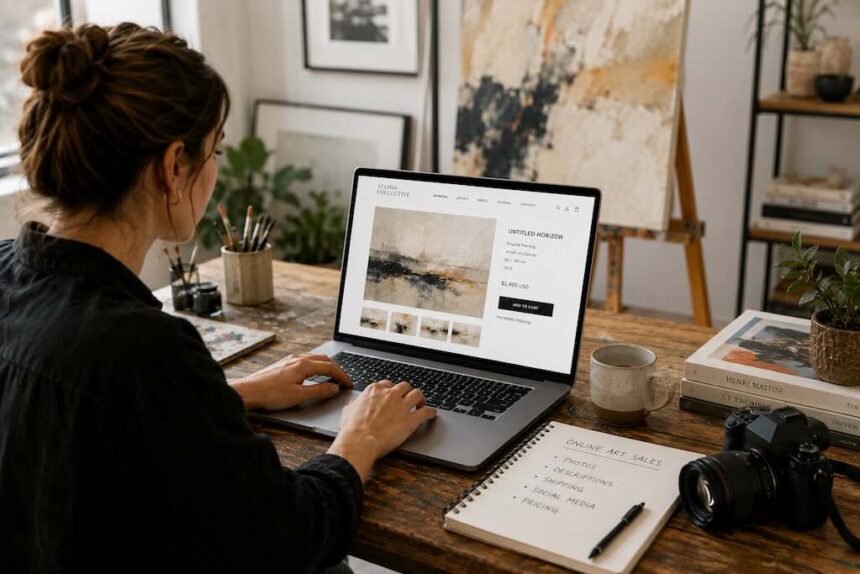
Selling art online presents an unusual challenge: you’re asking someone to fall in love with a physical object they may never see in person before buying it.
- 1. Photograph the Artwork Properly
- 2. Give Buyers the Details They Can’t See
- 3. Make the Artist Part of the Story
- 4. Use Social Media to Build an Audience, Not Just Advertise
- 5. Don’t Hide the Price Without a Reason
- 6. Make Your Website Feel Trustworthy
- 7. Treat Shipping as Part of the Sale
- 8. Think About International Buyers
- 9. Keep Talking to Collectors After the Purchase
- The Art Still Has to Come First
That makes presentation, trust and information especially important. A beautiful painting photographed badly can disappear into a crowded feed, while an impressive product page can still lose a buyer if dimensions, materials or shipping details are difficult to find.
Whether you’re an independent artist selling your own work or managing a small gallery, the goal isn’t simply to put art online. It’s to make buying it feel considered, transparent and surprisingly easy.
1. Photograph the Artwork Properly
Online, photography becomes part of the artwork’s sales presentation.
Your primary image should reproduce the piece as accurately as possible, with even lighting, good focus and minimal distortion. Avoid aggressive filters or editing that changes the colours of the original work.
One photograph usually isn’t enough. Consider including a straight-on image of the entire piece alongside close-ups that reveal brushwork, texture, surface details, signatures and framing.
Scale can be surprisingly difficult to understand from dimensions alone. An additional photograph showing the artwork displayed in an interior can help buyers imagine how large the piece will actually feel on a wall.
2. Give Buyers the Details They Can’t See
A photograph creates desire. The description removes uncertainty.
For each work, clearly provide the artist’s name, title, year, medium, dimensions and whether the piece is framed. State whether it’s an original, limited edition or open edition and explain what’s included with the purchase.
If you’re selling a limited edition, specify the edition size and how the work is numbered or signed.
Descriptions can also provide context that specifications cannot. A concise note about the work, series, technique or artist can help a potential collector understand what they’re looking at without drowning the page in art-world jargon.
3. Make the Artist Part of the Story
People don’t necessarily buy art in the same way they buy a lamp or a pair of shoes. The person behind the work can matter.
Create a useful artist profile with a biography, selected exhibitions or achievements where relevant, an artist statement and photographs of the artist or studio.
Behind-the-scenes material can be particularly effective online. A short video showing a work taking shape or photographs from the studio give viewers something they couldn’t discover from a conventional product listing.
4. Use Social Media to Build an Audience, Not Just Advertise
A social feed consisting entirely of “available now” posts quickly begins to resemble a catalogue.
Instead, use social media to tell the larger story around the work. Share studio details, works in progress, finished pieces, exhibition installations, inspiration and occasional glimpses of the creative process.
Instagram can be particularly useful for visual discovery, while short-form video gives artists another way to show texture, scale and process that static photographs cannot always communicate.
Social media may introduce someone to your work, but your own website should ideally give them somewhere reliable to learn more about it.
5. Don’t Hide the Price Without a Reason
Few things create unnecessary friction quite like finding a piece you love and discovering that the only purchasing information is “price on request.”
There are parts of the art market where private pricing remains conventional, but independent artists and smaller galleries shouldn’t assume mystery automatically creates prestige.
If a work can be purchased directly online, transparent pricing makes the buying process considerably simpler. Clearly explain currency, taxes where applicable, payment options and whether shipping is included or calculated separately.
6. Make Your Website Feel Trustworthy
A collector considering an expensive purchase needs more reassurance than someone ordering a inexpensive household item.
Your website should make it easy to determine who is selling the work, how to make contact, how payment works and what happens after an order is placed.
Include clear shipping, return and privacy information. Make contact details easy to find. If you provide certificates of authenticity for eligible works, explain that too.
The objective is simple: eliminate the little moments that make a buyer wonder whether they should trust the transaction.
7. Treat Shipping as Part of the Sale
The transaction isn’t finished when someone clicks Buy.
Artwork can be fragile, unusually shaped and difficult to replace. Packaging and shipping should therefore be considered before a piece is listed rather than improvised once somebody purchases it.
Choose packaging appropriate to the particular work and carrier requirements, and consider insurance and tracking for valuable shipments. Larger, particularly fragile or unusually valuable pieces may warrant specialist art-handling services.
Tell customers what to expect. Provide realistic dispatch estimates, explain how the work will be shipped and send tracking information when available.
8. Think About International Buyers
One of the great advantages of selling online is that your next collector could be thousands of miles away.
It also introduces additional complications.
Before offering international delivery, understand your carrier’s restrictions and determine how customs documentation, import charges and taxes will be handled. Requirements vary by destination, artwork and value, so avoid making universal promises about duties or delivery times.
Make your international shipping policy clear before checkout so the buyer isn’t surprised later.
9. Keep Talking to Collectors After the Purchase
A first purchase doesn’t need to be the end of the relationship.
Send an order confirmation promptly and keep the buyer informed about packing, dispatch and delivery. Afterward, occasional updates about new work, exhibitions or releases can keep interested collectors connected — provided they’ve chosen to receive them.
A thoughtful buying experience can be especially valuable for an independent artist. Someone who purchased one small work today may become a long-term collector tomorrow.
The Art Still Has to Come First
There is no social-media strategy, product description or beautifully designed website that can manufacture a genuine connection between a person and a work of art.
What good online selling can do is remove everything standing between that connection and a purchase.
Show the work accurately. Tell its story. Give buyers the information they need. Be transparent about the price and make delivery feel dependable.
The internet may have changed where people discover art, but the reason they buy it remains wonderfully familiar: they found something they want to keep looking at.