






Three objects on a coffee table. Five pieces across a mantel. Seven smaller items distributed through a bookshelf.
- What is the 3-5-7 decorating rule?
- Why do odd numbers look better in interior design?
- The real secret is not three. It is the triangle.
- The Divine 3-2-1 formula
- How to use three objects on a coffee table
- When five works better than three
- Seven is for editing, not adding
- The seven-object bookshelf test
- Why varying height matters so much
- Texture keeps an odd-number grouping from looking staged
- How to use the 3-5-7 rule with throw pillows
- How to use odd numbers with wall art
- When you should ignore the 3-5-7 rule completely
- The most common 3-5-7 decorating mistake
- The 10-second phone-camera test
- The practical takeaway
- Conclusion
- Frequently Asked Questions
Nothing about those numbers sounds particularly luxurious. Yet arrange the same objects in pairs or neat rows and a room can suddenly feel more formal, flatter, even slightly staged.
This is the idea behind the 3-5-7 decorating rule: group decorative objects in odd numbers to create arrangements that feel balanced without becoming perfectly symmetrical.
Interior designers have used versions of the rule of three for years. More recently, the expanded 3-5-7 method has become a useful shorthand for shelves, coffee tables, mantels, pillows and other places where a collection needs structure without looking overly calculated.
But there is an important detail missing from most explanations of the rule.
The number alone does almost nothing.
Three identical candles lined up at exactly the same height can still look rigid. Seven unrelated objects squeezed onto a shelf can still look cluttered. What makes 3-5-7 useful is the combination of odd-number grouping, variation, visual hierarchy and empty space.
What is the 3-5-7 decorating rule?
The basic principle is simple:
- Use three when you want one compact focal grouping.
- Use five when you have a wider surface or want more layering.
- Use seven when working with smaller objects or a larger composition.
The numbers are not meant to dictate how many possessions belong in a room. They are better understood as styling units.
Three objects might form one vignette on a console. Five cushions could work across a large sectional. Seven small pieces might be distributed across several sections of built-in shelving rather than crowded together in one cluster.
Interior designers interviewed by Homes & Gardens about the 3-5-7 method describe it as a way of creating rhythm and visual interest through odd-numbered arrangements, particularly when objects also vary in height, texture and function.
Why do odd numbers look better in interior design?
First, a qualification: there is no universal law of human vision stating that three vases are objectively more beautiful than four.
What odd-number arrangements do particularly well is make perfect symmetry harder to achieve.
With two identical objects, the eye immediately understands the relationship: left and right. Pair and pair.
Add a third object and something changes.
There can now be a center, a high point, a low point, an overlap or a triangle. The eye has more than one relationship to process. That slight asymmetry can make the composition feel active without making it chaotic.
Designers regularly exploit precisely this effect. Architectural Digest’s guidance on styling surfaces recommends varying heights and scales to create movement and notes designers’ preference for odd-number groupings when they want arrangements to feel less predictable.
The real secret is not three. It is the triangle.
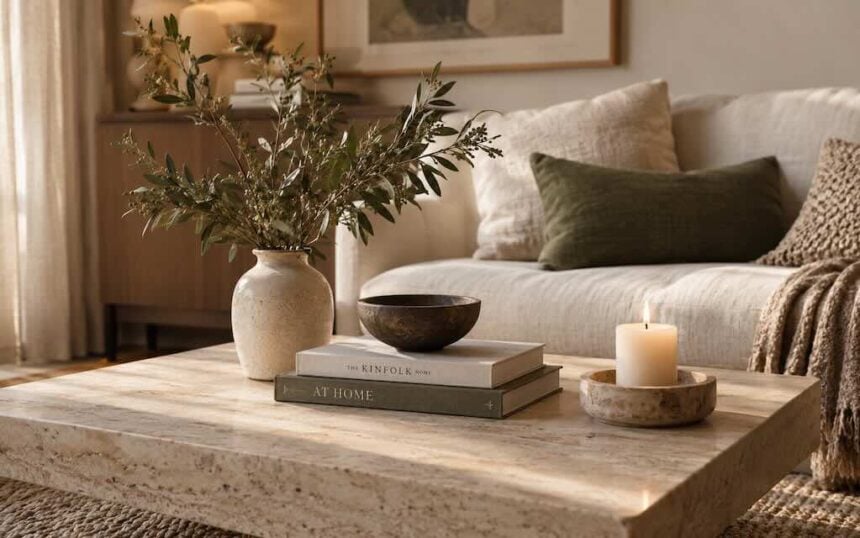
Imagine three objects on a coffee table.
One is a tall ceramic vase. Beside it sits a medium stack of books. In front is a small sculptural bowl.
Trace an imaginary line across their highest points and you create a triangle.
That diagonal movement gives the eye somewhere to travel.
Now replace those pieces with three identical vases placed in a straight line.
Technically, you have obeyed the rule of three. Visually, you have created repetition.
That’s why designers often combine odd-number styling with changes in height. Guidance on styling collections in odd numbers and triangular compositions recommends beginning with a larger piece and building around it with objects of different heights and textures.
The Divine 3-2-1 formula
Here is the version we would actually use at home.
When creating a three-object vignette, think 3-2-1:
- 3 heights — tall, medium and low.
- 2 textures — perhaps ceramic and glass, or wood and metal.
- 1 visual connection — a shared color, material, era or mood.
This is a Divine editorial framework rather than an established interior-design rule, but it solves the most common problem with 3-5-7 styling: people count objects without considering their relationship.
Picture a travertine coffee table with a smoked-glass vase, two linen-covered books and a shallow stone bowl.
Three objects. Three heights. Two dominant textures. One muted palette.
The arrangement reads as a composition rather than three things you forgot to put away.
How to use three objects on a coffee table
The coffee table is the easiest place to learn the rule.
Start with one anchor. A vase, substantial candle or sculptural object works well.
Add something horizontal, such as two or three books treated visually as one stack. Finish with a lower object: a bowl, small candle or unusual piece collected while traveling.
Do not space the three objects equally.
Bring them close enough that the eye reads them as one group, while leaving enough table exposed for the surface itself to remain visible.
That last part matters. Interior designer Molly Torres Portnof told Architectural Digest that negative space should receive as much consideration as the objects occupying a shelf or surface.
The empty part of your coffee table is not unfinished.
It is part of the composition.
When five works better than three
Three objects can look lost on a long sideboard, wide mantel or substantial dining table.
This is where five becomes useful.
But resist arranging five separate objects like soldiers.
Instead, think of five as 3 + 2.
On a sideboard, for example, place a lamp, framed artwork and small bowl toward one side. Then balance them loosely with two related objects toward the other.
The composition remains asymmetrical, but the visual weight travels across the furniture.
For a mantel, five might mean a leaning artwork, two candlesticks of different heights, a small ceramic object and a branch in a narrow vessel.
Not evenly spaced.
Not perfectly mirrored.
Connected.
Seven is for editing, not adding
This sounds contradictory, but seven objects can actually make a cluttered shelf look calmer.
The trick is not to add objects until you reach seven.
Take everything off first.
Then return only seven visual elements, remembering that a stack of books can function as one element and a pair of related pieces can sometimes read as one visual unit.
Spread them through the available space. Vary the heights. Leave gaps.
Designers interviewed about making living-room shelves look less cluttered similarly emphasize odd-number groupings, different shapes and heights, and sufficient negative space.
The seven-object bookshelf test
Try this on one section of shelving that never looks quite right.
Remove everything and choose only:
- one framed artwork or photograph,
- one vertical group of books,
- one horizontal book stack,
- one ceramic vessel,
- one organic object such as a plant, branch or stone,
- one small personal object,
- one contrasting sculptural piece.
Now resist filling the remaining holes.
Step back three meters.
If your eye can identify a few clear focal points instead of scanning dozens of equally important objects, the shelf is beginning to work.
Why varying height matters so much
Height creates rhythm.
A tall lamp beside a medium frame and low bowl creates a descending line. A plant can lift one side of a bookshelf. A vertical vase beside horizontal books creates immediate contrast.
The principle is simple enough that designers discussing the 3-5-7 method repeatedly emphasize varying height, shape and texture rather than merely counting pieces.
If every object is approximately the same size, the eye has no obvious starting point.
Give it one.
Texture keeps an odd-number grouping from looking staged
Now imagine three white ceramic vases.
Beautiful, perhaps. But if their finishes, proportions and heights are similar, the arrangement can still feel like a retail display.
Change one vase to smoked glass and replace another with a rough stone bowl.
Suddenly light behaves differently across the group.
Matte absorbs it. Glass catches it. Stone introduces grain.
That material contrast creates depth without requiring additional color.
How to use the 3-5-7 rule with throw pillows
Pillows are where odd-number styling becomes particularly practical.
On a standard sofa, three can be enough: two larger pillows and one contrasting lumbar or smaller cushion.
A large sofa may comfortably hold five. A sectional can support five or seven if the cushions vary in size and are distributed rather than packed into every corner.
The 3-5-7 principle works here because perfect matching pairs tend to create formality. Breaking that symmetry can make seating look softer and more collected.
There is also a practical advantage.
You can still sit down.
How to use odd numbers with wall art
Three artworks can create a strong triptych-like rhythm. Five pieces can form a compact gallery wall. Seven can work beautifully when frames differ in scale.
But the rule becomes less important as a gallery wall grows.
Once you have 12, 15 or 20 pieces, viewers are more likely to perceive the entire arrangement as one composition than consciously register whether the frame count is odd or even.
At that scale, spacing, outer silhouette, visual weight and alignment matter more than arithmetic.
When you should ignore the 3-5-7 rule completely
Symmetry is not a decorating mistake.
Two lamps flanking a bed can create calm. Matching chairs opposite a sofa can make conversation areas feel deliberate. Two large artworks can bring architectural order to a dining room.
Traditional, classical and highly formal interiors often benefit from precisely the symmetry the 3-5-7 method disrupts.
Odd numbers are particularly useful when you want a room to feel relaxed, collected and slightly organic. Pairs are useful when you want stillness and structure.
A good room can contain both.
The most common 3-5-7 decorating mistake
Counting everything.
A lamp, six books, vase, candle and bowl do not necessarily read as ten separate objects.
The eye groups things.
A stack of books often reads as one mass. Flowers and their vase become one silhouette. Three tiny objects sitting together on a tray may register as one cluster.
Think in visual units, not inventory.
This single shift makes the rule considerably easier to use.
The 10-second phone-camera test
If an arrangement feels wrong but you cannot identify why, photograph it.
Do not edit the image. Do not post it.
Look at the photograph for ten seconds and ask three questions:
- Where does my eye land first?
- Do all the objects appear approximately the same height or visual weight?
- Is there enough empty space to see the grouping clearly?
A photograph flattens the room into a composition, which can make awkward spacing and competing focal points much easier to notice.
If you cannot tell what the focal point is, remove something before adding anything.
The practical takeaway
The 3-5-7 decorating rule is useful because it gives you somewhere to begin when a shelf, table or mantel feels unfinished.
But do not decorate by calculator.
Start with three. Change the heights. Mix two or three textures. Create one dominant object. Pull the pieces close enough to form a relationship. Then protect the empty space around them.
If the surface is larger, move to five. If you are styling a broad collection, experiment with seven.
Then stop counting.
Step back and look.
Conclusion
The best interiors rarely feel as though somebody finished them with a ruler.
There is order, but also interruption. A tall vase beside a low stack of books. Three cushions instead of four. A ceramic object sitting slightly off-center beneath a painting.
The 3-5-7 rule gives that apparent effortlessness a structure.
Use the numbers to build the arrangement.
Then let your eye decide when it is finished.
Frequently Asked Questions
What is the 3-5-7 rule in decorating?
The 3-5-7 decorating rule is a styling guideline based on arranging decorative elements in odd-numbered groups, commonly three, five or seven. It is frequently used for shelves, coffee tables, mantels, pillows and decorative displays.
Why do designers decorate in odd numbers?
Odd-number groupings naturally discourage perfect symmetry and can create more varied relationships between objects. Designers often combine them with different heights, shapes and textures to create rhythm and visual movement.
Is three always the best number for decorating?
No. Three works particularly well for small vignettes, while five or seven may suit larger surfaces and collections. Pairs and symmetrical arrangements can be preferable when a room needs formality, calm or architectural structure.
How do you arrange three decorative objects?
Try using three different heights rather than placing three similar objects in a straight line. A tall vase, medium stack of books and low bowl can create a triangular composition that guides the eye through the arrangement.
Does the 3-5-7 rule work for pillows?
Yes. Three pillows can work on a standard sofa, while five may suit larger sofas and five or seven can work across a sectional. Varying size, texture and shape generally creates a more relaxed result than using identical cushions.
How do I make shelves look styled instead of cluttered?
Group smaller items into visual units, vary object heights and leave deliberate negative space between compositions. Start with larger anchor pieces and remove unnecessary objects before adding new ones.

25s2qw
o9g0gl
vfvz7k
az3hpv
klwcyw
qg70l0
z936r5
e1fa41
v9erkj
cjik68
q6zxdq