




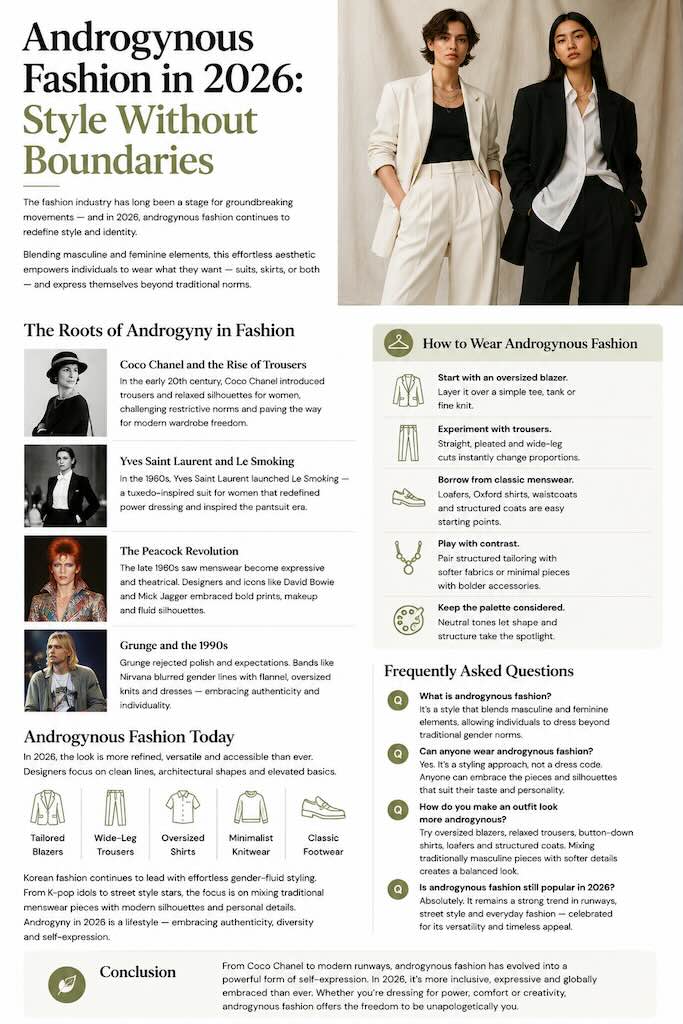
The fashion industry has long been a stage for changing ideas about how we dress — and in 2026, androgynous fashion continues to blur the traditional boundaries between menswear and womenswear.
- What Is Androgynous Fashion?
- The Roots of Androgyny in Fashion
- Coco Chanel and the Rise of Trousers for Women
- Yves Saint Laurent and Le Smoking
- The Peacock Revolution
- The 1990s Made Androgyny Effortless
- What Androgynous Fashion Looks Like in 2026
- Korean Fashion’s Influence
- How to Wear Androgynous Fashion
- Why the Look Keeps Returning
- Frequently Asked Questions
From sharply tailored suits worn with softer accessories to oversized shirts, wide-leg trousers and minimalist knitwear, androgynous style borrows freely from both sides of the traditional wardrobe. The result is less about following rules and more about proportion, silhouette and personal style.
And while the look may feel particularly contemporary, designers and cultural figures have been experimenting with masculine and feminine dress codes for more than a century.
What Is Androgynous Fashion?
Androgynous fashion combines elements traditionally associated with menswear and womenswear to create a look that doesn’t fit neatly into either category.
Think an oversized blazer over a delicate shirt, tailored trousers with statement jewelry, a crisp button-down paired with flowing pieces, or a minimalist suit styled without the accessories traditionally associated with formal menswear.
The appeal is its versatility. Instead of dressing according to a predetermined formula, the wearer can concentrate on shape, texture, color and proportion.
The Roots of Androgyny in Fashion
Fashion has repeatedly borrowed from the opposite side of the wardrobe, particularly during periods when designers were questioning established ideas about how men and women were expected to dress.
Coco Chanel and the Rise of Trousers for Women
Coco Chanel helped popularize a more relaxed approach to women’s clothing during the early 20th century, incorporating pieces and silhouettes influenced by menswear.
Trousers, sailor-inspired pieces and less restrictive clothing became part of a broader change in women’s fashion that would continue throughout the century.
Yves Saint Laurent and Le Smoking
Few garments illustrate the crossover between menswear and womenswear better than Yves Saint Laurent’s Le Smoking.
Introduced in the 1960s, the tuxedo-inspired look translated one of the most recognizable pieces of men’s eveningwear into women’s high fashion. Its influence can still be seen whenever a sharply tailored trouser suit appears on a runway or red carpet.
The Peacock Revolution
Fashion experimentation wasn’t limited to womenswear. During the late 1960s and early 1970s, menswear became dramatically more expressive.
Bright colors, floral prints, velvet, scarves, dramatic tailoring and increasingly elaborate silhouettes challenged the conservative men’s wardrobe of previous decades. Musicians including David Bowie and Mick Jagger helped bring this more theatrical approach into popular culture.
The 1990s Made Androgyny Effortless
By the 1990s, androgyny often looked much less polished.
Grunge favored oversized cardigans, loose jeans, thrifted clothing, simple T-shirts and deliberately undone styling. Musicians such as Kurt Cobain occasionally incorporated dresses and other unexpected pieces into their stage wardrobes, while fashion increasingly played with deliberately ambiguous silhouettes.
What Androgynous Fashion Looks Like in 2026
Today’s version of androgynous dressing can be surprisingly understated.
Rather than requiring an obviously experimental outfit, the aesthetic can be created through a few carefully chosen pieces: oversized blazers, relaxed tailoring, straight or wide-leg trousers, crisp shirts, structured coats, loafers, minimal sneakers and uncomplicated knitwear.
Neutral palettes work particularly well because they place the emphasis on silhouette. Black, charcoal, cream, navy, camel and white can be mixed easily while allowing an unusual cut or oversized proportion to become the focal point.
That doesn’t mean color has disappeared. A vivid shirt, patterned jacket or unexpected accessory can provide contrast without changing the overall aesthetic.
Korean Fashion’s Influence
Contemporary Korean fashion provides plenty of inspiration for anyone interested in this style.
Oversized tailoring, layered shirts, wide trousers, statement outerwear and accessories frequently cross traditional menswear and womenswear boundaries. K-pop fashion has helped bring many of these combinations to a global audience, with performers such as G-Dragon becoming known for mixing classic tailoring with more experimental pieces.
How to Wear Androgynous Fashion
You don’t need to rebuild your wardrobe to experiment with the look. Start with one element and build around it.
- Try an oversized blazer. Wear it over a simple T-shirt, tank or fine knit.
- Experiment with trousers. Straight, pleated and wide-leg cuts can immediately change the proportions of an outfit.
- Borrow from classic menswear. Loafers, Oxford shirts, waistcoats and structured coats are easy starting points.
- Play with contrast. Pair structured tailoring with softer fabrics or minimal clothing with more expressive accessories.
- Keep the palette simple. A restrained color scheme can make experimenting with unfamiliar silhouettes much easier.
Why the Look Keeps Returning
Androgynous fashion survives because it offers something fashion does particularly well: the opportunity to reinterpret familiar clothes.
A blazer doesn’t have to be styled like a business suit. A silk shirt doesn’t need to look traditionally feminine. Wide trousers, loafers, jewelry, oversized coats and tailoring can all change character depending on what they’re paired with.
More than a century after designers first began seriously challenging conventional wardrobes, that freedom to mix influences remains one of fashion’s most interesting ideas.
Frequently Asked Questions
What is androgynous fashion?
Androgynous fashion combines elements traditionally associated with menswear and womenswear. Tailoring, oversized silhouettes, shirts, trousers, knitwear and accessories can all be mixed without following conventional styling rules.
Can anyone wear androgynous fashion?
Yes. Androgynous fashion is a styling approach rather than a dress code. Anyone can incorporate its silhouettes, tailoring or combinations into their wardrobe.
How do you make an outfit look more androgynous?
Start with classic pieces such as an oversized blazer, straight or wide-leg trousers, a button-down shirt, loafers or a structured coat. Mixing traditionally masculine tailoring with softer fabrics and accessories can create a balanced look.
Is androgynous fashion still popular in 2026?
Androgynous influences remain visible in contemporary fashion, particularly through relaxed tailoring, oversized silhouettes, minimalist dressing and the continued crossover between traditional menswear and womenswear.