






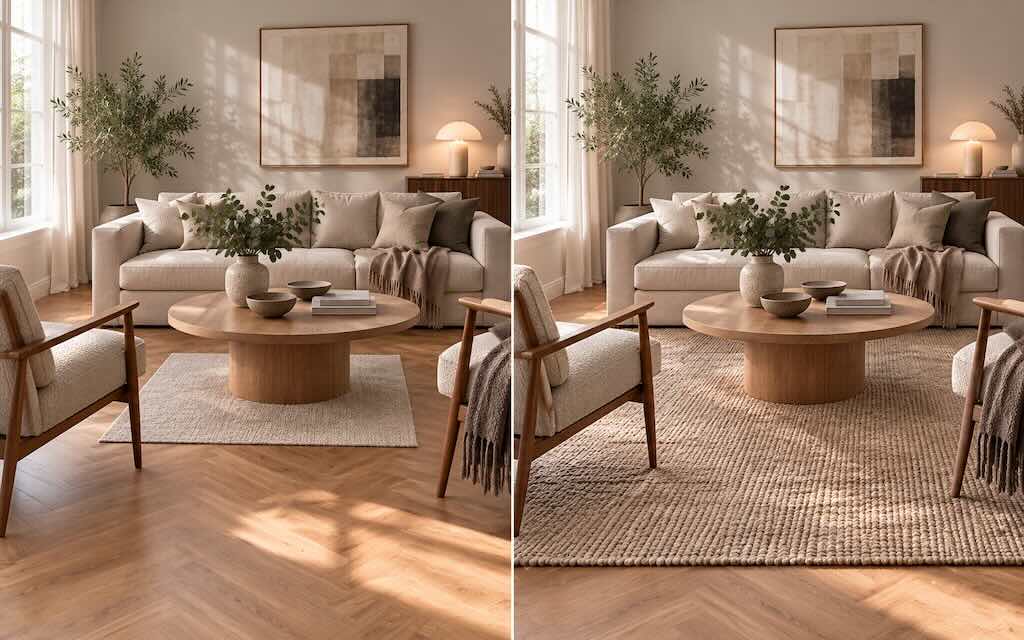
You can have the right sofa, a beautiful coffee table and carefully chosen lighting, yet still feel that something in the living room isn’t quite settled.
- The rug should connect the furniture, not sit between it
- The coffee-table island is usually the problem
- A larger rug can make a small room feel more generous
- How far should a rug extend beyond the sofa?
- Should all four furniture legs be on the rug?
- Dining-room rugs have a different job
- Bedroom rugs should be felt when you get out of bed
- Don’t trust the rug size until you’ve seen it on the floor
- What if you already own a rug that’s too small?
- The rule is really about proportion
- FAQ
Look down.
A rug that floats beneath the coffee table without reaching the surrounding furniture can make everything around it appear strangely disconnected. The sofa seems heavier. Chairs look as though they belong to another arrangement. Empty strips of flooring break the seating area into separate pieces.
Going larger can change the room without changing a single piece of furniture.
The rug should connect the furniture, not sit between it
Think of a living-room rug as part of the furniture plan rather than decoration added after everything else.
In most seating arrangements, the rug works best when it reaches beneath the sofa and chairs. At minimum, getting the front legs of the main seating onto the rug creates a visual connection between pieces that would otherwise appear to be floating independently.
Interior designers interviewed by Architectural Digest recommend choosing a rug that either accommodates furniture completely or allows the front legs of primary pieces such as sofas and chairs to rest on it. The same guidance warns that undersized rugs can disrupt the proportions of a room and make the surrounding furniture appear oversized.
That explains a familiar decorating puzzle: the individual objects look good, but the room doesn’t.
The coffee-table island is usually the problem
Picture a sofa facing two armchairs. Between them sits a coffee table on a small rectangular rug. None of the seating touches it.
The rug now outlines the coffee table rather than the seating area.
That can work when a small rug is intentionally being used as an accent, but it rarely creates the grounded, generous look people expect from a full living-room rug. The exposed floor around it becomes a visual border, separating the sofa and chairs from the center of the arrangement.
Replace it with a rug wide enough to slip beneath the front legs of those same pieces and the geometry changes immediately. Sofa, chairs and table begin reading as one group.
A larger rug can make a small room feel more generous
Buying a smaller rug for a smaller room sounds logical. It also explains why this mistake is so common.
But shrinking every object in a compact room can exaggerate its limitations. A little sofa paired with a little table on a little rug creates several visible boundaries, each reminding you of the available floor area.
Designers frequently take the opposite approach. Professional stager Andrew Bowen told Architectural Digest that a rug that’s too small can make a room read smaller, and that he prefers most of the furniture to sit on the rug.
A larger rug gives the eye a broader uninterrupted plane. Instead of spotlighting the limited patch of floor in the middle of the room, it establishes the seating area as a single composition.
You still need some exposed flooring. A rug that nearly touches every wall can begin to resemble fitted carpet rather than an area rug. The useful distinction is scale: large enough to relate convincingly to the furniture, with enough floor visible around it to give the arrangement some breathing room.
How far should a rug extend beyond the sofa?
There isn’t one measurement that works in every room. Architecture, furniture placement and the size of the seating group all matter.
As a starting point, avoid a rug that ends noticeably inside the width of a large sofa. It can make the sofa look disproportionately broad. Letting the rug extend beyond both ends creates a more comfortable visual frame.
Designers cited by Architectural Digest suggest extending a rug at least eight inches beyond the sides of large furniture pieces, while recommendations for the amount of visible floor around a large rug vary according to the room.
Treat those numbers as a diagnostic tool, not a law. An old apartment with an irregular fireplace, a narrow townhouse and a broad open-plan living room won’t respond to exactly the same proportions.
Should all four furniture legs be on the rug?
They can be, particularly in a spacious room where a large rug can contain the entire seating arrangement. This often creates the most unified look.
It isn’t the only successful layout.
Putting the front legs of the sofa and armchairs on the rug is a practical alternative when the room or budget doesn’t justify an especially large rug. It preserves the visual connection without requiring the rug to disappear almost completely beneath the furniture.
Designers don’t entirely agree on this point. Some prefer furniture to sit completely on a rug rather than straddling its edge, while others routinely use the front-legs-on arrangement. That disagreement is useful: it shows why the familiar “rug rule” should be understood as a principle of proportion rather than an absolute formula.
The question to ask is simpler: does the rug make the furniture look connected?
Dining-room rugs have a different job
Under a dining table, furniture movement matters more.
A rug can look perfectly proportioned while the chairs are tucked in and become irritating the moment someone sits down. If the back legs leave the rug when a chair is pulled out, they can catch against its edge when the chair moves forward again.
Choose a rug that extends substantially beyond the tabletop so chairs remain comfortably supported during normal use. One designer guideline published by Architectural Digest suggests approximately three feet beyond the table on each side.
Before buying, pull one of your dining chairs back as though you’re getting up from dinner and measure the actual space it uses. Your room may tell you more than a standard rug-size chart will.
Bedroom rugs should be felt when you get out of bed
A bedroom rug has a more tactile purpose. On a cold morning, you want your feet to land on wool or another soft surface rather than miss the rug by a few centimeters.
A small rug disappearing beneath the bed wastes much of its useful area. Instead, size and position it so a meaningful amount remains visible along the sides and foot of the bed.
For rooms where one large rug doesn’t make sense, runners beside the bed can create the same softness without pretending to anchor the entire room.
Don’t trust the rug size until you’ve seen it on the floor
An 8-by-10-foot rug sounds large when you’re reading the dimensions on a screen. In a room with a substantial sofa and two chairs, it can look surprisingly modest.
Before ordering, mark the proposed dimensions directly on the floor with painter’s tape. Architectural Digest’s rug-sizing guidance also recommends using tape or string to test scale and placement before committing.
Then walk around the room.
Look at the taped outline from the doorway. Check whether the sofa feels connected to it. Pull out the dining chairs if there’s a table nearby. Make sure doors can open and important pathways still feel natural.
Do the same exercise with the next size up.
That second outline is often the revealing one.
What if you already own a rug that’s too small?
A beautiful rug doesn’t become useless because its proportions are wrong for the room.
One solution is layering. Place the smaller rug over a larger, quieter foundation such as a plain wool, jute or sisal-style rug. The lower layer establishes the correct scale while the smaller piece supplies color, pattern or history.
Designers have used exactly this approach when incorporating rugs that clients already own. In one example published by Architectural Digest, an undersized collected rug was layered over a larger sisal to give it more appropriate proportions within the room.
You can also move the rug somewhere that suits its scale: beneath a small desk, beside a bed, in an entryway or under a compact reading chair. Sometimes the rug isn’t wrong. It’s simply in the wrong room.
The rule is really about proportion
Interior design rules are most useful when they explain why something looks awkward.
A rug doesn’t need to reach a prescribed number of centimeters from every wall, and furniture doesn’t always have to sit on it in exactly the same way. Rooms are too varied for that.
But a rug should look intentional in relation to the objects around it. In a living room, that usually means making it large enough to visually gather the seating rather than leaving a small rectangle stranded beneath the coffee table.
Try the larger outline before you buy. Let it slip beneath the sofa. Give the chairs somewhere to land.
The furniture hasn’t moved very far. Somehow, the whole room has come together.
FAQ
How can you tell if a living-room rug is too small?
A common sign is a rug that sits entirely beneath the coffee table while none of the surrounding seating touches it. If the rug looks disconnected from the sofa and chairs or makes those pieces appear unusually large, testing the next rug size up is worthwhile.
Should a rug go under a sofa?
Usually, yes. Depending on the room, either the entire sofa or its front legs can sit on the rug. Both arrangements can visually connect the sofa with the rest of the seating area.
Does a large rug make a small room look smaller?
Not necessarily. An undersized rug can create additional visual boundaries and make the furniture feel disconnected. A larger rug that relates properly to the furniture can make the seating area appear more unified and generous.
What can you do with a rug that’s too small?
Try layering it over a larger neutral rug or moving it to a smaller area where its proportions make more sense. A small rug can work beautifully beside a bed, beneath a desk or as part of a compact reading area.