





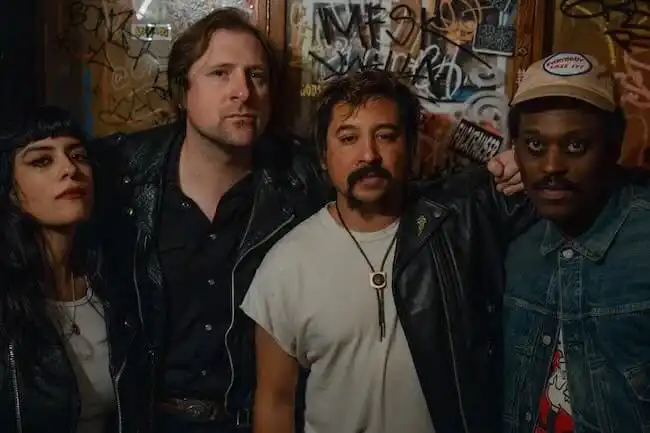
From the “beloved hellhole” of East Hollywood, J MAU & THE KISS OFF emerge with their debut single, “Poison,” released March 25, 2026. Founded by punk lifer Justin “J Mau” Maurer (Clorox Girls, L.A. Drugz), the project is a cinematic, dust-caked “honky tonk murder ballad” that marks a dark and brilliant evolution for one of the West Coast’s most storied songwriters.
Stream here: https://distrokid.com/hyperfollow/jmauandthekissoff/poison
Order J Mau & The Kiss Off Music and Merchandise here
Between Two Worlds: The ASL Punk
Maurer’s life has always moved between distinct cultures. A CODA (Child of Deaf Adults) who speaks American Sign Language as his first language, he has balanced a career as a world-class interpreter for figures like Michelle Obama and Joe Biden with a life spent in the global punk underground.
The Background: From booking shows at fifteen to interpreting Troy Kotsur’s historic Oscar speech, Maurer’s perspective is rooted in real-world grit and high-stakes communication.
The Catalyst: After a divorce and a period of isolation in Pico Union, Maurer found solace in the “poetry of failure” found in old Hank Williams and Townes Van Zandt records.
“Poison”: A Slow-Burning Reckoning
Recorded at Savannah Studios in Boyle Heights, “Poison” is a haunting track that feels like a spaghetti western fever dream.
The Sound: Acoustic strums and restrained rhythms support a vocal performance that is equal parts confession and warning.
The Lyric: Inspired by watching a schoolyard from his window while feeling like a man on the run, the refrain—“It’s got the final say”—is a hard truth that refuses to comfort the listener.
The Visual: The single is accompanied by an 8mm-shot video co-directed by Zache Davis and Marta Ribate Gracia-Davis, capturing a sun-bleached, grainy “corrido” atmosphere.
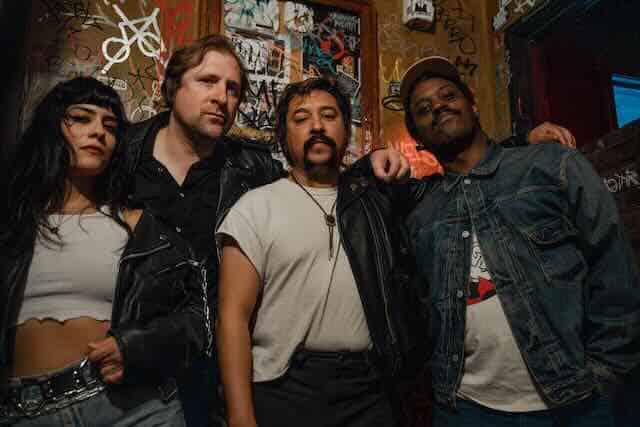
The Kiss Off: An L.A. Supergroup
The band captures the “different histories” of Los Angeles, blurring the lines between punk, ranchera, and surf:
Cynthia “Mickie Splits” Herrera (The Sacred): Elegant, melodic bass.
Jairo Gabriel (The Zinfandels): Lead guitar weaving honky tonk and OC surf flourishes.
Christopher “Crux” Michael (Guantanamo Baywatch): Instinctive drumming and cutting harmonies.
What first got you into music, and who inspired you to make music?
JUSTIN: My mother is Deaf, and so that makes me a CODA, a child of a deaf adult. My first language was sign language. Growing up in the 80s and 90s, my mom relied on me as her interpreter. I interpreted when someone called on the phone, when someone knocked on the door, for my own parent teacher conferences, in the kitchen as my mom chatted with the other moms at friends’ birthday parties, in car dealerships, banks, doctors offices, in Catholic church on Sundays, and when my mom wanted to flirt with Father Chuck on the way out of the church. Also interpreted for my mom’s lawyer when my parents were getting divorced. I was about ten years old. We would spend summers in Washington State at my grandma’s house, and for a while my Uncle John was also living there. He is a leftist factory worker, a rocker, a fisherman, a crabber, a basketball player, a Seattle Supersonics fan, a pothead, a dad, an animal lover, and a total nutjob. I love him. Total legend. Uncle John taught me the basics on guitar when the weather wasn’t great for fishing or basketball. I started to write my own songs. Music became my own language, a private outlet where I could express how I felt.
When I was eleven, my parents divorced. My mom, sister, brother, and I moved from Los Angeles, California, to Washington State because my mom’s side of the family lived up there. Before we moved, I had started listening to cassettes with my skater friend Brandon Carlson. He played me all kinds of early grunge, skate punk, stuff that excited us. It was like the appetizer to the main course. When I got up to Bainbridge Island, Washington, I met these punk rock kids, Conor Kiley and Jakes Bayley, at St. Cecilia’s Catholic Church where my mom forced me to go to church. These kids were into cool music, as was another kid named Kelley Swenson who lived up my street on Rose Avenue. Kelley started making me mix tapes of stuff like Minor Threat and The Buzzcocks. He loaned me his homemade guitar tablature three ring binder with a bunch of songs by The Ramones and the Sex Pistols. I found out that Larry, the drummer of local punk band The Rickets, also lived up the street. I moved to the Pacific Northwest in 1994, the summer that Kurt Cobain died, and the whole middle school was in mourning. I was sent to this Catholic summer camp where Conor Kiley and I played Sex Pistols and Ramones songs and changed the lyrics to be about Jesus and God. One church lady accused us of playing the devil’s music. I was hooked.
One day, Conor invited me to see his band, Matrix, play at the Bainbridge Teen Center. Matrix had the coolest and cutest punk girls playing in the band, their lead singer and rhythm guitarist. They blew my preteen mind. But what was to follow would blow my mind even more. The high school bands that played after were The Displacements, The Cleavers, and PUD. All three of these bands were like the best punch in the gut. Kids had mohawks, chains, and black leather jackets. There was this tiny dark circle pit where I got a cut on my arm by a skanking kid wearing a spiked bracelet. When kids were pogoing, their heads almost hit the ceiling. I can still smell the Aquanet hairspray, the leather, and the sweat. The bands were not only musically great but witty too; they had a great sense of humor and were totally anti-establishment/anti-authoritarian. I can only describe it as a religious experience. It felt like freedom. I instantly knew that punk was my thing and exactly what I wanted out of life. It opened my mind to leftist politics, environmentalism, and the do-it-yourself work ethic. It was time to make our own music, start our own bands, make our own flyers and cover art, and release our own records. I started going to shows in Seattle every weekend. To feed my new rock n roll drug habit, I began working a dishwashing job so that I’d have money to spend on punk records, t-shirts, live shows, and beer. I started my own band and started writing my own songs. I began publishing my own fanzine and throwing shows for local and touring bands. The punk scene was thriving and alive in 1990s Seattle, and we were determined to also have a vigorous punk scene on Bainbridge Island, too. It wasn’t only a style of music or fashion, it had its own ethos that was constantly in debate. All Ages venues like RKCNDY, Velvet Elvis, and Second Time Around hosted local, national, and international touring bands. The scene was strong. We frequented Singles Going Steady and Fallout Records and as many shows as we could. When our bands began playing in Seattle it was a major event and we’d load our gear into shopping carts we stole from Safeway and wheel them onto the ferry boat with a huge entourage of kids.
When I was fifteen, my punk band started playing shows in other places like Aberdeen, Shelton, Olympia, and Bremerton. Larry Rickets asked me to play drums in his solo project, and when I was sixteen, we toured the West Coast playing bars and clubs. Owen Straw from the Trots was on bass, and Jonny from Jonny Cat Records and Creep Zine was our driver and roadie. Being on tour was the most liberating experience, like being pirates in a pirate ship, except that we were punks in a Ford Econoline van. Our other bands from Bainbridge would soon head down the West Coast, too. San Francisco was our mecca and we loved playing 924 Gilman, Mission Records, Geek Fest, generator shows, We threw a fundraiser at the local gas station to raise money to release our first seven-inch record. We lied and said that we were a co-ed softball team. We threw a couple of car washes and then had enough money to press 500 records with United Record Pressing. I made the covers on a copy machine, cutting and pasting band photos into collages.
When we graduated high school, my bandmates and I all put $250 into a $1000 van, and we booked a national tour using Maximumrocknroll’s guide “Book Your Own Fucking Life.” It took us from Bainbridge to New Orleans to Barnesville, Georgia, and back home through Tennessee, Ohio, and Wisconsin. We were broke and malnourished, living off of boxes of Zatarains red beans and rice cooked on a camp stove. Our band fund was loose change in a Tupperware bowl. But we made it back home (in part thanks to the drummer’s parents’ credit card they gave him for emergencies).
Then I got in trouble with the cops. After a long trial with my public defender not showing up and the court dates being continually extended, I got a letter in the mail from Larry Rickets asking me to join a band with him and Tina from The Bobbyteens and The Trashwomen down in San Francisco. I said yes and, with $600, took a Greyhound bus down there as soon as I could. That band was Deadly Weapons, and that led me to start Clorox Girls with Clay Silva, living together in his van for a while before moving up to Portland, Oregon. Then Clorox Girls toured the world.
What’s the funniest thing that’s ever happened at one of your shows?
JUSTIN: Back when Clorox Girls were touring Europe a lot, we played a show in Gothenburg, Sweden, and at the time, there was a guy who would dance completely buck naked onstage; it was his thing. I made him part of our show and played a guitar solo with his flaccid penis. The Swedes loved it. Another time in La Roca, Catalunya, Spain, we played a venue where there was another local eccentric, this time he was called El Gusano, the worm. He had long hair and a beard and looked like Jesus. At one point in our show, he was touching my face, and everyone started taking photos. I went along with it, and as I played guitar, he kept blessing me or whatever he was doing. After the show, someone asked me if I was ok. I said that I was fine. They told me to go into the bathroom and look in the mirror. I was covered in blood, all over my face and arms. It was El Gusano’s blood, and he was smearing it all over me, which was why the crowd was taking so many pictures. I turned on the water in the bathroom sink, and both the cold and hot water worked; nothing came out. I tried to clean the blood off with bottled water but it didn’t really work, there was too much blood. The promoter said not to worry, I could shower at his apartment after the show. We went back to his place and his water didn’t work either. Apparently he forgot to pay the water bill and they shut it off. I fell asleep covered in El Gusano’s blood. Not a funny story, but a true one.
How would you describe the music that you typically create?
JUSTIN: J Mau & the Kissoff is the name of our latest project. We play music influenced by 1960s and 1970s Los Angeles, including Masque-era punk, Palomino-era honky tonk, and 1970s outsider troubadours. We have just released our debut single, a murder ballad corrido called “Poison.”
Is there a city or venue that holds special significance to you, and can you share a memorable experience from there?
JUSTIN: I have been fortunate enough to tour Europe quite a bit, and The Vera in Groningen, Netherlands, was always one of my favorites. They respect musicians a lot more over there. At The Vera, they have a small private garage for your tour van, and your hotel room is just up the stairs backstage, with clean bedsheets, towels, and a shower. The Vera is mostly funded by the Dutch Government, and I believe it’s volunteer-run since the 1980s. Nirvana, Dead Moon, and a lot of the Pacific Northwest bands from that era played there. They have a team who silkscreens posters, another team who cooks dinner and breakfast for the bands, and bands meet their sound and lighting people at soundcheck – and they are actually friendly and open-minded to your suggestions. Downstairs, they have a smaller bar where bands can also play. I heard they now have a backstage area dedicated to Dead Moon. I haven’t been in a while and would love to check it out. Two of my other favorites, Bottom Of The Hill and Thee Parkside, both in San Francisco, look like they will be closing soon. What a shame. Up with independent music venues, down with luxury apartment buildings. Blackwater in Portland, Oregon, is fantastic. They recently moved to a larger space, and I had the opportunity to play there with Clorox Girls in January for JonnyFest. It was a blast.
What is your creative process like?
JUSTIN: The atmosphere has to be conducive for creativity. Songs usually come to me in my living room at night. Or some lyrics for a chorus might come to mind. If I’m not at home, I sing them into my voice notes on my phone and save them immediately. If I’m at home, I grab the acoustic guitar and start working out the choruses, the versus and making sure it has the right feeling. When David Lynch was in art school studying painting, his professor told his class that he needed four hours of doing nothing in order to have one good hour of painting. I can completely relate to that. With four calm hours, I can definitely get one good hour of songwriting in if the mood strikes. Sometimes after a couple of drinks, I can write 2 or 3 songs in a night.
What is one message you would give to your fans?
JUSTIN: Music is more about feeling than knowing. We explore music because we’re trying to understand the tragedy of the human condition. It’s the same reason we enjoy storytelling, movies, the theater, literature, and poetry. As humans, we attempt to understand who we are and why we are here, and cope when tragedy strikes. I hope that people find solace in my music. A few years back, I released a song called “Don’t Take Your Life,” with my band Clorox Girls. I wrote it as an tongue in cheek ode to the main character in the Sofia Coppola movie, “The Virgin Suicides.” After the song was released, I had a couple of people approach me and thank me for the song, saying that it convinced them not to commit suicide. So music does save lives. Someone else came up and told me that they played one of my songs when they walked down the aisle to get married. I’m content that my music has brought some people joy in an often cruel and unjust world. I hope to continue bringing people music and joy, and, as Ferlinghetti said, “be the voice of collective joy in the face of collective gloom.”
What would you be doing right now if it weren’t for your music career?
JUSTIN: Without music I would probably be in prison or the insane asylum. Since we no longer have insane asylums, I would probably be on the street or living in my Honda Civic. Or maybe living down in Baja California.
How do you feel the Internet has impacted the music business?
JUSTIN: I was in a working, touring band around the same time Napster and iTunes came into the picture. Now the rate per stream on a platform like spotify is $0.003 cents. So for 300 streams, I earn one cent. And that one cent I have to split with everyone who played on the recording and often 50% goes to the record label that released the song. I get a check for about $40 every six months and that is my royalty for writing songs, releasing records, and touring in bands for over twenty years. The current music streaming model has made music into a even more of a commodity that people take for granted and have made it nearly impossible for most musicians to earn a living or even some small amount of income as a side hustle. Pair that with inflation, the cost of gas, hotels, food, it also makes touring prohibitively expensive. I suggest paying one cent per stream. I suggest buying music directly from bands off of BandCamp or at their shows. Buy tshirts and vinyl from bands, especially if they are touring. If one beer in a venue costs $9, consider spending $9 on the merch of the bands that are playing. Also, why do bars only give bands 2 drink tickets per member, but expect the band to load in at 7pm then play at 10 or 11pm. So we are supposed to hang around for five hours and drink only two beers? Or you want us to spend more money than you are paying us on food and drink in your bar plus the cost of parking. Remind us why we are playing your bar again? That said, playing music is a gift and a blessing and I’m so grateful to be given the opportunity to make music with beautiful people and record and tour the world. It’s not about the money, but it does cost money to do it. The universe will provide.
What would you do if you were the only survivor of a plane crash?
JUSTIN: Make a one-man cannibal BBQ fiesta. Carne asada humano. Hopefully some booze from the plane mini bar would still be intact.
What do you think of garden gnomes?
JUSTIN: I find them equally creepy and amusing. My sixty seven year old Deaf mom got into these stuffed gnomes she puts on the mantle above her fireplace in rural Connecticut. I do not know where she buys them or why she’s into them. I should ask her.
What two nonessential items would you want if you were shipwrecked on a deserted island?
JUSTIN: I would bring a pair of fingernail clippers because it would drive me insane if I didn’t have them. I would also bring my acoustic guitar. Non-essential, but I might think up some stranded-on-a-deserted-island hits.
What actor would play you in a movie about your life?
JUSTIN: Young Jeff Daniels or old Ryan Gosling.
What’s your favorite sports team and why?
JUSTIN: The Seattle Supersonics in the 90s had the triple all star trifecta of Gary Payton, Shawn Kemp, and Detlef Schrempf. They were one of the only teams to give Jordan’s Chicago Bulls a run for their money. I loved them to death. And then they disappeared forever. Long Live The Glove, Reign Man, The Big Smooth, and the 1990s Supersonics.
How would you sell hot chocolate in Florida in the summer?
JUSTIN: Mix it with crystal meth.
As a kid were you ever frightened of a monster under the bed or in the cupboard?
JUSTIN: I was scared of Catholic Priests.
J MAU & THE KISS OFF Online