







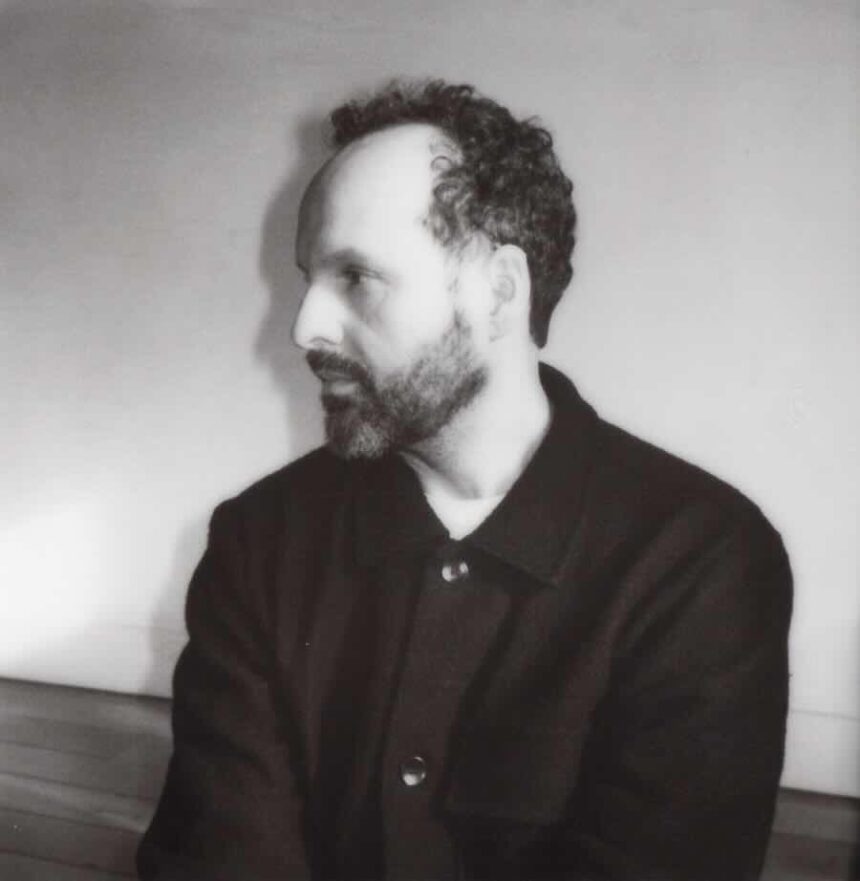
For MOMO., movement has never meant leaving one place behind for another. It accumulates. Brazil, Angola, the US, Spain, Portugal and London remain present in his music as fragments of rhythm, friendship and memory, folded into a language that has become quieter and more spacious with time.
Twenty years and eight albums into his recording life, the Brazilian-born, London-based multi-instrumentalist arrives at Tum Tum Tum with a different kind of confidence. Recorded live in South London and released via Agogo Records, the album is less concerned with filling every space than with listening closely to what happens inside it.
That instinct runs through our conversation. MOMO. speaks about the meaning of home after years of movement, the chemistry of a band that already knows how to listen, his friendships with Nina Miranda, Marcos Valle and Marcelo Camelo, and the moment when a song begins making its own decisions.
INTERVIEW
MAGAZINE
In Conversation
MOMO.
“Now I trust the space more. I care more about how musicians listen to each other than about packing in ideas.”
INTERVIEW — DIVINE MAGAZINE · 2026
In Conversation with MOMO.
We spoke with MOMO. about simplicity, belonging, musical trust and the relationships behind Tum Tum Tum.
Tum Tum Tum arrives twenty years and eight albums into your journey. What part of your musical language feels most refined — or most transformed — at this stage of your life?
MOMO.: Honestly, it’s simplicity. When I was younger I probably felt like I had something to prove, so I’d fill every gap. Now I trust the space more. I care more about how musicians listen to each other than about packing in ideas. Some of my favourite moments on this record are the ones where nothing much is “happening” — just people playing together.
You’ve lived in Brazil, Angola, the US, Spain, Portugal and now London. How does constant movement shape the way you understand “home” in your music?
MOMO.: I don’t think of home as one place anymore. It’s more about the people. Every place I’ve lived has left a mark — not always in an obvious way, but through the people I’ve met and the experiences I’ve had. I think my music reflects that mixture more than any single place.
This album was recorded live in South London with musicians deeply attuned to one another. What does recording live unlock in your sound that studio isolation never could?
MOMO.: The tour before it mattered a lot. By the time we got into the studio, we’d already learned how to listen and react to each other. A lot of the album comes from those real-time interactions. I wasn’t chasing a perfect take — I was more interested in capturing people responding to each other in the moment.
The rhythm section from your Gira tour forms the backbone of Tum Tum Tum. How did that shared history influence the openness and responsiveness of these sessions?
MOMO.: By the time we recorded, we’d already spent time playing together, so there wasn’t much that needed to be said. Everyone understood how to leave space, when to support a song and when to step forward. That familiarity meant we could trust each other and react instinctively instead of overthinking things.
“Canto de Aldeia,” co-written with Nina Miranda, unfolds as a bilingual dialogue. What conversations — musical or personal — shaped the emotional core of that track?
MOMO.: Nina and I have known each other in London for years — we’ve shared stages, conversations, and music together. The song grew out of that friendship rather than a plan to write something bilingual; it just reflects how we communicate. For me, it celebrates friendship and the London–Brazil musical conversation we’ve both been part of for years.
The imagery of sun, sand and breeze evokes a utopian childhood. How do memories of early life in Brazil continue to surface in your songwriting today?
MOMO.: Brazil is a huge part of who I am, so it shows up naturally. I’m not trying to recreate a specific memory — it’s more that those images are part of my vocabulary as a songwriter, and they surface when they’re needed.
“Morena” brings together Marcos Valle, Marcelo Camelo and your own understated bolero sensibility. What was it like weaving your voice into the lineage of these iconic Brazilian artists?
MOMO.: I first met Marcos around twenty years ago, when he invited a band I was playing with to take part in a DVD he was recording. We reconnected years later after both our albums appeared in MOJO’s Best World Music Albums of 2024. Marcelo Camelo is like a brother to me — we worked together on my album Voá in 2017, and I’ve always admired his work. It felt less like bringing together big names and more like being among friends.
You’ve said the album is about “playing together until the sound reveals itself.” How do you know when a piece of music has finally revealed what it wants to be?
MOMO.: Usually it’s when everyone stops trying to control it. There’s a point where the music starts making its own decisions, and you recognise that adding more wouldn’t necessarily make it better. I like records that leave some mystery rather than explaining everything.
Collaborators like Regis Damasceno, Caetano Malta and Rosie Turton add distinct textures across the album. What qualities do you look for in musicians who become long-term creative partners?
MOMO.: Trust, mostly — it develops through years of friendship and collaboration. People who’ve worked together a long time understand each other’s instincts, which lets everyone take more risks and contribute freely. Curiosity matters too, more than technical skill.
Your work is often praised for transcending place. Do you feel that your music is shaped more by geography or by the emotional states that movement creates?
MOMO.: Probably the emotional side. Brazilian music is a huge part of who I am, but I’ve never felt the need to choose one tradition over another. I’m more interested in finding connections between influences than drawing boundaries around them.
Tum Tum Tum carries a sense of assurance — a quiet confidence. What do you hope listeners understand about continuity, craft and the long arc of artistic practice when they hear this record?
MOMO.: I hope they feel a sense of movement and connection. The album is really about continuing to create, learn, and engage with the people around you. If listeners come away encouraged to keep moving forward, I’ll be very happy.
About the Record
Tum Tum Tum
“`MOMO. reconciles his Brazilian upbringing and identity with his more recent life in London on a record sung in Portuguese and English and built around continuity and forward momentum. Guest appearances include Brazilian and bossa nova legend Marcos Valle and Smoke City’s Nina Miranda.
Recorded live in South London with a close-knit band including long-standing collaborators and UK jazz trombonist Rosie Turton, Tum Tum Tum is warm, expansive and free-flowing. Across his eighth album, MOMO. sounds playful and fully at ease with the musicians and the space around him.
Morena — Track Credits
“Morena” feat. Marcos Valle
Marcelo Frota / Marcos Valle / Marcelo Camelo
- Marcelo Frota — nylon guitar, guitar, vocals
- Thomas Broda — drums
- Pedro Dantas — bass
- Jim le Messurier — percussion
- Caetano Malta — guitar
- Marcos Valle — electric piano
- Paolo Ruiu — guitar
- Rosie Turton, Eramir Neto — trombone
- Elad Gellert — saxophones
Production
- Produced: Marcelo Frota
- Co-produced: Hannes Plattmeier
- Engineered: Paolo Ruiu at Third Floor Recording, London — September 2025
- Additional engineering: Marcelo Frota at Umbilical Studio, London — October 2025
- Mixed: Hannes Plattmeier at Ashfield Street Studios, London — November 2025
- Mastered: Alex DeTurk at The Bunker Studio, Brooklyn, NY — January 2026
MOMO. — 2026 Tour Dates
24.09.2026 — Paris, France — POPUP!
25.09.2026 — Schorndorf, Germany — Club Manufaktur
27.09.2026 — Berlin, Germany — Gretchen
28.09.2026 — Hamburg, Germany — Nochtwache
03.10.2026 — London, UK — 229