







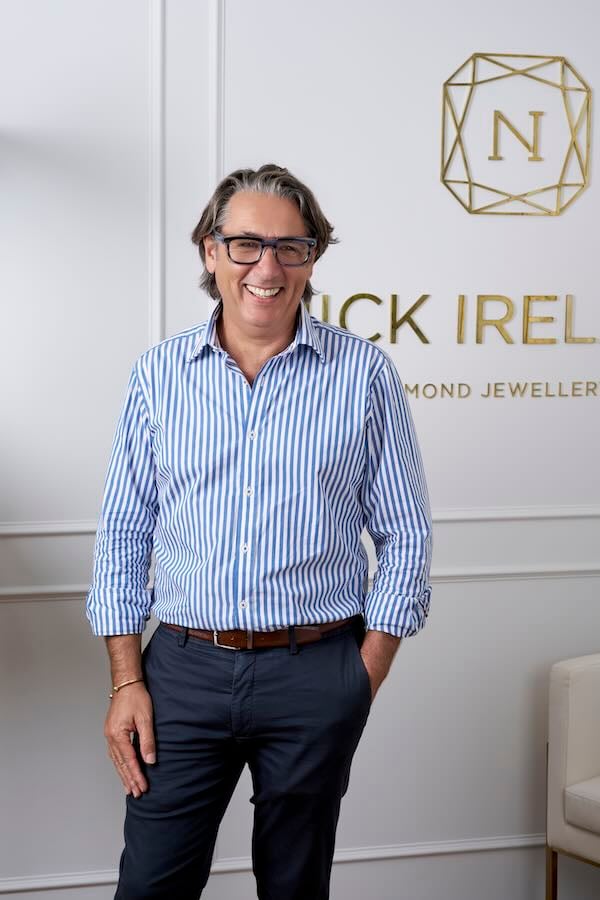
Argyle pink diamonds have long captivated collectors, but their true value is far more complex than colour alone. As demand accelerates in the wake of the Argyle Mine’s closure, investors are discovering that the world’s rarest pink diamonds are defined not just by how vividly they blush, but by the intricate interplay of intensity, rarity, provenance and cut. According to master jeweller Nick Ireland, two stones can look almost identical yet differ in value by hundreds of thousands — a reminder that in the realm of Argyle pinks, beauty is only the beginning.
Many Australians assume a darker pink diamond is automatically more valuable. From your experience, why is this belief both true and misleading.
People often think that the darker or more intense the pink, the more valuable the diamond. In principle that’s true, because stronger colour is generally rarer.
The Argyle colour scale runs from 1P, being the strongest pink, through to 9P, which is the lightest. If you put two otherwise identical diamonds side by side, the 1P will almost always be worth more.
Where people get caught out is assuming that colour is the only thing that matters.
I’ve seen beautifully coloured diamonds that have obvious inclusions, and I’ve seen slightly lighter pinks with exceptional clarity that are far more desirable. So, for example, a 3P with outstanding clarity can quite easily be worth more than a 1P with significant inclusions. You have to look at the whole stone, not just the colour grade.
Shape is another factor that’s often overlooked. A Round Brilliant is generally the most valuable shape because you lose so much of the original rough to produce a perfectly round diamond. A square or rectangular shape is much more economical to cut, so it’s entirely possible for a 2P Round Brilliant to be worth more than a similarly sized 1P Square Radiant.
That’s why I always say there is no single rule when it comes to valuing pink diamonds. Colour is incredibly important, but it doesn’t exist in isolation. Every stone has to be judged on its own merits, taking into account its colour, clarity, shape, size and, ultimately, how rare that particular combination is.

You’ve said two diamonds can look similar yet differ in value by hundreds of thousands. What are the most misunderstood factors that create these dramatic price gaps.
One of the biggest misconceptions is that people think two diamonds that look similar must be worth roughly the same amount. With Argyle pink diamonds, that’s often not the case.
Size and overall quality obviously play a major part, but provenance can make an enormous difference as well.
I’ve handled Tender stones over the years and this is where the real difference becomes apparent.
Less than 0.01% of the Argyle Mine’s annual production was selected for the invite-only Signature Tender. These were the rarest and finest diamonds the mine produced each year, chosen for their exceptional colour, clarity and, in later years, the quality of the cut.
To someone without experience, a Tender stone and an allocation stone can look remarkably similar. But they’re not the same. A Tender diamond represents the absolute pinnacle of that year’s production, and collectors all over the world recognise that.
What separates them isn’t always something you can appreciate at first glance. It’s the combination of extraordinary colour, clarity, craftsmanship and provenance. Once you’ve handled enough of these stones, you begin to recognise that difference almost instinctively.
Once a Tender stone is sold, that’s it. There will never be another one exactly like it. That’s why provenance is so important. You’re not simply buying a beautiful pink diamond, you’re buying one of the rarest diamonds ever produced by the Argyle Mine.
That’s why I always tell clients that you can’t value a pink diamond on appearance alone. The certificate is important, but experience matters just as much. Sometimes the most valuable qualities are the ones you only appreciate after you’ve handled these exceptional stones for many years.

With the Argyle Mine now closed, how has the concept of “finite supply” reshaped the global market for pink diamonds.
The closure of the Argyle Mine changed the pink diamond market almost overnight.
For the first time, everyone realised there would never be another Argyle pink diamond mined. It wasn’t a temporary shortage or a pause in production, it was the end of supply. That completely changed the way collectors, investors and jewellers viewed these diamonds.
From 1985 until its closure in 2020, the Argyle Mine produced more than 90% of the world’s pink diamonds. For decades, there was always another year’s production to look forward to. Once the mine closed, that pipeline disappeared forever.
I’ve watched the market evolve over many years, and I think the biggest shift was psychological. People stopped looking at Argyle pink diamonds as simply beautiful gemstones and started recognising them as a genuinely finite asset. Every stone in existence suddenly became more significant because the global supply could only ever decrease.
What also sets Argyle diamonds apart is that they’re unlike pink diamonds from anywhere else in the world. They have their own distinctive colour characteristics, their own proprietary grading system, and a provenance that simply can’t be replicated.
In my view, that’s what makes them so special. Every Argyle pink diamond you see today is part of a closed chapter in history. Once one finds its way into a private collection, it’s unlikely to return to the market anytime soon, making the remaining supply even scarcer.
How does the Argyle colour‑grading system differ from the simplified “pink diamond” terminology most consumers use.
Most people simply describe a diamond as a “pink diamond”, but that’s really only scratching the surface.
One of the things that made Argyle unique was that it developed its own proprietary colour grading system. After handling these diamonds for many years, I can tell you it’s a far more precise way of describing colour than most people realise.
The system grades colour intensity on a scale from 1 to 9, with 1 representing the strongest and rarest colour, through to 9, which is the lightest. It also identifies the diamond’s primary hue, whether it’s Purplish Pink (PP), Pink (P) or Pink Rosé (PR), along with separate classifications for reds, violets and pink champagne diamonds.
What surprises many people is that two diamonds can both be certified by the GIA as Fancy Intense Pink, yet have very different Argyle colour grades. For example, one might be graded 3P and another 6P. To most people they may appear quite similar, but within the Argyle system they’re recognised as very different diamonds and that difference can translate into a substantial difference in value.
I’ve found that once clients understand the Argyle grading system, they begin to appreciate why pink diamonds can’t be judged by colour alone. It’s one of the reasons Argyle stones have always stood apart. The grading captures subtle differences in colour that aren’t reflected in broader international terminology, and those subtleties are often what separate a very rare diamond from an exceptional one.

Which colour combinations or modifiers – purplish pink, pink rose, red, violet – tend to be the rarest and why do they command such strong premiums.
People often assume all pink diamonds are simply different shades of pink, but that’s not how the Argyle colour spectrum works.
In terms of rarity, nothing comes close to a genuine Argyle Red. Out of around 900 million carats of diamonds recovered from the Argyle Mine during its life, only around 20 to 30 carats have been certified as Red. When you put that into perspective, you begin to understand why they’re regarded as some of the rarest gemstones on earth.
After the Reds, the Blue and Violet diamonds are the next rarest, followed by the Purplish Pinks, Pinks and Pink Rosés.
I’ve been fortunate enough to handle many exceptional Argyle diamonds over the years, and what I’ve learned is that rarity always drives value. When only a handful of stones exist, collectors are competing for something that simply can’t be replaced.
People also ask whether modifiers make a difference. They certainly can. A beautiful Purplish Pink often has an extra depth and vibrancy that gives it an edge over a straight Pink. Those subtle differences might not mean much to the average person, but to experienced collectors they’re part of what makes each diamond unique.
That’s one of the fascinating things about Argyle diamonds. Sometimes the difference between two extraordinary stones is incredibly subtle, but those subtle differences are often what create the strongest premiums.
You often emphasise that size amplifies rarity exponentially. Can you explain how a one‑carat Argyle pink compares to a half‑carat stone in terms of scarcity and investment potential.
People often think a one-carat Argyle pink diamond is simply worth twice as much as a half-carat stone. It doesn’t work like that.
One of the unique characteristics of Argyle pink diamonds is that they’re naturally small. The same immense heat, pressure and crystal distortion that created their extraordinary pink colour also disrupted the growth of the diamond crystal itself. As a result, the vast majority of Argyle pink diamonds recovered were well under one carat.
What’s interesting is that this was recognised right from the beginning. The mine’s feasibility studies showed just how scarce larger diamonds were and that was factored into the economics of the mining operation. Because nature had already broken up so much of the diamond-bearing rock into smaller crystals, the processing plant was designed to handle enormous volumes of material using powerful 18-millimetre primary crushers.
I’ve always found that fact fascinating because it tells you just how uncommon large Argyle diamonds really were. Finding a one-carat pink wasn’t simply a matter of mining more ore, it was a matter of nature producing one in the first place.
That’s why a one-carat Argyle pink diamond is so much rarer than a half-carat stone. As the size increases, the number of available diamonds drops dramatically and that’s what collectors are really paying for. They’re not just buying a larger diamond; they’re buying something that nature produced only a handful of times.

In white diamonds, clarity is king. Why does clarity play a very different role in the valuation of Argyle pink diamonds.
One of the biggest differences between white diamonds and Argyle pink diamonds is the order of importance.
With a colourless diamond, clarity is one of the main drivers of value because the objective is absolute transparency. The fewer inclusions, the more valuable the stone.
With an Argyle pink diamond, it’s different. Colour is everything. The first thing I’m looking at is the quality of the colour, its hue, intensity and tone. After that comes the size of the stone. Clarity is still important, but it isn’t the deciding factor.
People are often surprised when I tell them I’d rather see an extraordinary pink diamond with a small inclusion than a flawless stone with average colour. The rarity lies in the colour, and that’s what collectors are searching for.
I’ve also found that this influences the way these diamonds are cut. The polisher’s job isn’t simply to produce the highest clarity or the most fashionable shape. Their priority is to preserve the strongest possible colour while retaining as much weight as they can from the original crystal.
That’s why Argyle pink diamonds often have shapes that are dictated by the rough rather than current trends. Every decision during the cutting process is a balance between colour, weight and beauty. In my experience, if preserving a little more colour means accepting a minor inclusion or a less conventional shape, that’s almost always the right decision because colour is what makes these diamonds so exceptionally rare.

How does cut quality influence the way colour presents in a pink diamond, and what should investors look for when assessing cut.
As I mentioned earlier, the cut of an Argyle pink diamond was never determined by fashion alone. The polisher’s first priority was always to preserve colour and retain as much weight as possible from the original rough crystal.
What many people don’t realise is that this philosophy evolved over the life of the mine.
In the earlier years, retaining weight was a major priority. In some cases, that came at the expense of the diamond’s overall brilliance and scintillation. I saw stones that were beautifully coloured but later received only average cut grades when they were submitted to the GIA for certification.
As Argyle pink diamonds became increasingly rare and valuable, that approach began to change. The polishers started placing much greater emphasis on the quality of the cut, while still protecting the colour that made the stone so valuable in the first place.
I’ve been fortunate enough to handle diamonds from throughout the mine’s history and you can see that progression. The later stones often display a much better balance between colour, brilliance and craftsmanship than some of the earlier production.
When I’m assessing a pink diamond, I’m looking for that balance. I want to see a stone that displays its colour evenly, has good life and brightness, and has been cut to bring out the very best in the material. A great cut should enhance the colour, not compete with it.
That’s what collectors should be looking for as well. The finest Argyle pink diamonds aren’t simply well cut, they’re cut in a way that allows their exceptional colour to speak for itself.
What are the biggest mistakes first‑time buyers make when entering the pink diamond market and how can they avoid emotional purchasing.
The biggest mistake I see isn’t that people buy with emotion, it’s that they buy without enough knowledge.
Most first-time buyers naturally gravitate towards size because it’s something they can easily compare. They assume that a larger diamond must be the better purchase. With Argyle pink diamonds, that’s often not the case.
Over the years, I’ve seen people buy larger Pink Rosé diamonds with average clarity, only to discover later that the market places a much stronger premium on smaller stones with more intense colour. When the time comes to sell or upgrade, they often wish they’d made a different decision.
I’ve also had clients come back wanting to trade into a stronger pink because, once they’ve learned more about Argyle diamonds, they’ve realised that colour was always the more important characteristic.
That’s why I’ve always believed the best buyers are informed buyers. Take your time, do your research, ask plenty of questions and deal with people who genuinely specialise in this field. Pink diamonds are far too rare and far too valuable to make a decision based on size alone.
There’s nothing wrong with falling in love with a diamond. In fact, I think that’s part of the experience. Just make sure your heart and your head are making the decision together.
Provenance is a major point of confusion for consumers. What distinguishes a certified Argyle pink diamond from other pink diamonds on the market.
Natural coloured diamonds are incredibly rare to begin with. It’s estimated that only around one in every 10,000 diamonds displays a noticeable natural body colour, and pink diamonds represent only a tiny fraction of those.
What made Argyle so extraordinary wasn’t just that it produced pink diamonds, it produced them in a concentration that has never been seen anywhere else in the world. That’s what makes Argyle diamonds geologically unique and now that the mine has closed, historically irreplaceable.
People often think an Argyle certificate is simply another grading report. I see it differently. I often describe it as the diamond’s birth certificate because it confirms the stone’s origin and connects it to the most significant source of pink diamonds ever discovered.
As we’ve discussed earlier, Argyle also developed its own proprietary colour grading system. In my experience, it’s a much more informative system than relying solely on a GIA colour description. Two diamonds may both receive the same GIA colour grade, yet the Argyle grading can reveal important differences in colour intensity and character that have a significant impact on rarity and value.
I’ve found that once buyers understand the importance of provenance, they begin to see an Argyle pink diamond very differently. They’re not simply buying a natural pink diamond, they’re buying a documented piece of the Argyle Mine’s history. In today’s market, that provenance is every bit as important as the diamond itself.

Pink diamonds are increasingly viewed as wealth‑preservation assets. What makes them attractive compared to traditional investments like shares or property.
I don’t think it’s a question of pink diamonds replacing shares or property. They’re completely different types of assets and they each have their place.
What I’ve found over many years is that people are attracted to Argyle pink diamonds because they’re genuinely finite. Shares can be issued, and new property developments can be built, but no more Argyle pink diamonds will ever be mined. Once the Argyle Mine closed, the world’s primary source of pink and red diamonds disappeared forever.
I’ve watched this market throughout the life of the mine and since its closure. During that time, exceptional Argyle pink diamonds have steadily become more sought after as collectors have recognised just how limited the supply really is.
For many of my clients, that’s the real attraction. They’re acquiring something tangible, portable and incredibly rare. They’re not just buying a beautiful diamond, they’re becoming the custodian of a piece of history that can never be reproduced.
History doesn’t guarantee future performance, but one thing will never change: the supply of certified Argyle pink diamonds is finite, while demand from collectors continues to be driven by their rarity, provenance and beauty.
Looking ahead, what do you believe will shape the future value trajectory of Argyle pink diamonds and what should long‑term investors focus on now.
I’ve been fortunate enough to watch the Argyle story unfold over many years, and if there’s one thing I’ve learned, it’s that markets change, fashions change, but true rarity never changes.
At this point, there are no new diamond mines anywhere in the world that have demonstrated significant deposits of pink diamonds comparable to Argyle. As long as that remains the case, certified Argyle pink diamonds will continue to stand in a category of their own.
I’ve watched the market throughout the life of the mine and since its closure. What I’ve seen is that as exceptional stones are absorbed into private collections, fewer of them return to the market. Over time, the available supply naturally becomes tighter.
I also think buyers are becoming much more discerning. They’re no longer simply looking for an Argyle pink diamond, they’re looking for the right Argyle pink diamond. Colour intensity, provenance, certification, size and overall quality have become increasingly important and I believe those qualities will continue to separate the truly exceptional stones from the rest.
For anyone taking a long-term view, my advice has never changed. Secure the best quality certified Argyle pink diamond you can afford. As I’ve mentioned in previous answers, exceptional colour, documented provenance and genuine rarity are the characteristics that have always defined the most desirable stones.
At the end of the day, you’re not simply buying a gemstone. You’re becoming the custodian of a small piece of Australian history that can never be repeated.
You can create more shares. You can build more property. But there will never be another Argyle Mine.