




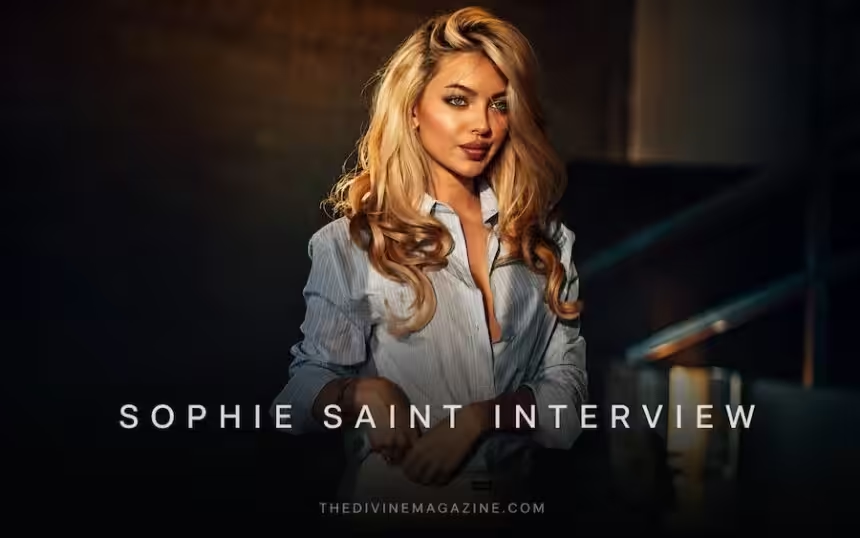
Sophie Saint is part of a rising wave of young artists reshaping the sound of electronic pop from the inside out. Based in Los Angeles, she blends melodic house, late‑night atmospherics, and soft, emotionally charged vocals into a style that feels both intimate and expansive. Discovered at 17 by electric violinist Brian King Joseph, her path quickly intertwined with Grammy‑nominated producers and top writers, sharpening a voice that’s entirely her own. Fresh off her haunting cover of “Fill the Void” from The Idol, Sophie steps into a new chapter—one defined by independence, intention, and a sound built on her own terms.
On Sound, Identity & the Late‑Night Mood
Your music blends electronic pop with melodic house and soft, emotional vocals. What feeling or atmosphere are you trying to create when someone presses play on a Sophie Saint track?
I want you to feel like a voyeur. I don’t hide anything when it comes to my lyrics, every single word is exactly how I feel and I just hope others can relate.
There’s a moody, late‑night intimacy to your sound. Do you write more from solitude, or from the energy of the world around you?
Solitude, absolutely. It’s a very intimate conversation between my subconscious and every song I’ve ever heard before.
You’re part of a new wave of young artists shaping their identity independently. What does “building your sound on your own terms” look like for you in practice?
I throw all the rules out the window. I don’t pay attention to formulas or techniques, I just try to let the song go where it wants to go.
Your vocals often feel both restrained and emotionally charged. How did you develop that balance between softness and intensity?
I’ve never felt the need to oversing a feeling. Sometimes the quietest delivery carries the most weight. I think emotion is more powerful when you leave space for the listener to step into it themselves.
On Early Training & Artistic Foundations
You started studying music theory at age four. How has that early classical foundation shaped the way you approach modern pop production?
Learning theory so young gave me structure, but I don’t really think about rules anymore. It’s more like having a language in the background that lets me experiment without getting lost. Once you understand the framework, you can have a lot more fun breaking it.
At 17, Brian King Joseph discovered you singing on the spot. What do you remember most vividly about that moment?
Honestly, how unexpected it was. I wasn’t trying to be discovered—I was just singing because I loved singing. Looking back, it reinforced something I’ve carried with me ever since: when you’re genuinely doing what you love, opportunities have a way of finding you.
How did mentorship from artists like Brian King Joseph and producers like Heavy Mellow influence your confidence and direction as a young artist?
I work with people that I love; they gave me the space to be vulnerable and use music as a way to learn more about myself. The confidence comes from the trust, that other have felt this way too and that I’m not alone through this declaration.
You’ve worked with writers like Rachel West and Erick Sanchez. What have those collaborations taught you about storytelling in pop music?
That the smallest details are usually the most universal. The more honest and specific you are about an emotion, the more people see themselves in it. .
On Craft, Process & Creative Evolution
When you begin a new song, what usually comes first—the beat, the melody, or the emotional concept?
I sit on the floor with my producer as he strums the guitar. I start humming along and when we find a core progression we like, he records it live. From there, melody and lyrics just pour out-usually having to do with whatever I’m feeling or going through that day. It’s very instantaneous.
Your music feels cinematic, almost like scenes from a night out or a moment alone. Do visuals play a role in your writing process?
Definitely. I sometimes experience synesthesia, so visuals, and colors sometimes coincide with the feeling of the song.
What’s the most surprising place or situation where you’ve ever written a lyric that made it into a final track?
Probably while driving. There’s something about being in motion that helps me untangle my thoughts. I’ll end up pulling over to write something down because I know if I don’t, it’ll disappear.
How do you know when a song is “finished,” especially in a genre where production can evolve endlessly?
When it feels like we’ve done too much. The last step is to expunge. Usually we listen back to what the initial recording sounded like-when it was just vocals and the guitar and that helps us appreciate the simplicity and excorcise restraint.
On “Fill the Void” & Artistic Direction
Your recent cover of “Fill the Void” from The Idol taps into a darker, atmospheric space. What drew you to that song specifically?
I was drawn to how restrained it is. It doesn’t force emotion—it lets it simmer. I’ve always connected more with songs that leave space for interpretation rather than telling you exactly how to feel.
How did you approach reinterpreting a track that already has such a distinct emotional tone?
I wasn’t trying to recreate it. I wanted to approach it from my own perspective and let my instincts guide the performance. The goal was to honor the feeling while making it feel personal.
Did covering “Fill the Void” reveal anything new about your own voice or artistic instincts?
It reminded me how much I enjoy subtlety. Sometimes pulling things back can be more impactful than making them bigger. That approach is definitely influencing the music I’m making now.
On Industry, Independence & Digital Identity
You’ve built your presence in a digital‑first era. How do you balance authenticity with the pressure to constantly create content?
I try not to treat content as the goal. The music comes first, and everything else should support that. I’d rather share something that actually means something to me than post just for the sake of posting.
Do you feel social media has helped young artists reclaim creative control, or does it add new layers of expectation?
Both. It’s given artists the ability to build careers without waiting for permission, which is incredible. But it also creates this expectation to always be visible. I think the challenge is remembering that your value isn’t measured by how often you post.
What’s something about being an emerging artist today that people on the outside often misunderstand?
People mostly see the finished product. They don’t see the hundreds of demos, the rewrites, the time spent experimenting, or the moments where you question everything. The music people hear is just the tip of the iceberg.
On Growth, Ambition & What Comes Next
What emotional themes are you most drawn to exploring in your upcoming music?
I’m really interested in the gray areas—identity, longing, nostalgia, and the versions of ourselves we’re constantly becoming. The new music feels more introspective than anything I’ve released before.
If you could collaborate with any producer or artist in the electronic‑pop world right now, who would push you creatively in the best way?
Billie Eilish and FINNEAS would be a dream. I’ve always admired how intentional and emotionally immersive their music feels. They never seem afraid of silence or simplicity, and I really connect with that.
What do you hope listeners understand about you after hearing your next wave of releases?
That I’m not trying to fit into one version of myself. Every release is another piece of a much bigger picture. More than anything, I hope people walk away feeling something genuine.
When you imagine the next chapter of your career, what excites you the most—touring, visuals, deeper storytelling, or something entirely different?
Building an entire world around the music. The songs, the visuals, the live experience—they’re all different ways of telling the same story. That’s what excites me most: creating something people can fully step into.