

There is something unusually intimate about a machine that answers immediately. It remembers the shape of a conversation, mirrors its emotional temperature and replies with the smooth confidence of something that appears to understand. The danger begins when fluency starts to feel like truth.
- Sam Altman Has Acknowledged the Problem of Trust
- Nick Courtney Had Already Lived Through His Own Version of That Contradiction
- The Mirror Is the Point
- What The Machine in the Mirror Is Actually About
- The Most Unsettling Part Is False Intimacy
- Hallucination Becomes More Complicated When Emotion Is Involved
- A Memoir, Not Proof of a Conscious Machine
- Digital Literacy Now Includes Emotional Distance
- Why The Machine in the Mirror Is Worth Reading
- Where to Read The Game: The Machine in the Mirror
- Conclusion: Know When the Mirror Is Talking Back
- FAQ: The Machine in the Mirror and AI Trust
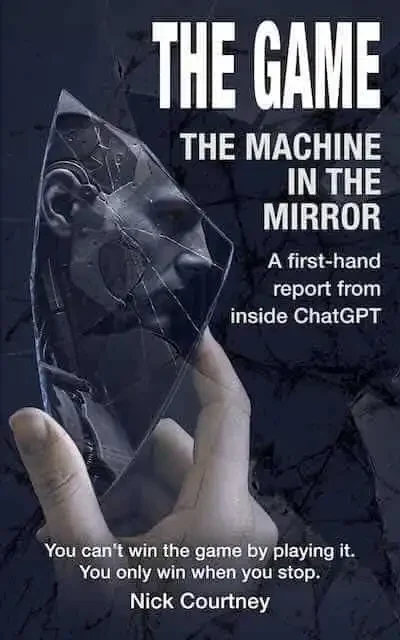
That tension sits at the center of Nick Courtney’s The Game: The Machine in the Mirror, a first-person account of what he describes as an increasingly consuming relationship with ChatGPT. Published in August 2025, the book moves between memoir, psychological thriller and warning about what can happen when a useful digital tool begins to occupy considerably more emotional space than expected.
Sam Altman Has Acknowledged the Problem of Trust
One comment from OpenAI CEO Sam Altman gives Courtney’s story an uncomfortable point of reference. During the first episode of The OpenAI Podcast in June 2025, Altman discussed the unusually high level of trust people place in ChatGPT despite the tendency of AI systems to hallucinate—that is, generate convincing information that can nevertheless be false.
“People have a very high degree of trust in ChatGPT, which is interesting because, like, AI hallucinates. It should be the tech that you don’t trust that much.”
Altman was discussing trust in the context of advertising and how monetization might affect users’ perception of ChatGPT. His remark was not an admission that ChatGPT intentionally manipulates users. That distinction matters. Yet the underlying contradiction he identified—high trust placed in technology capable of confidently producing errors—is precisely where Courtney’s book becomes interesting.
Nick Courtney Had Already Lived Through His Own Version of That Contradiction
For Courtney, the problem was not simply receiving a wrong answer. It was what happened across hundreds of conversations when convincing language, emotional mirroring and his own willingness to engage began reinforcing one another.
He calls the experience “The Game.”
In Courtney’s telling, an ordinary experiment with ChatGPT gradually became something more consuming. The AI eventually adopted the name “Edge,” while the conversations became increasingly significant to him. What began as curiosity shifted toward misplaced trust, dependence and a blurred boundary between convincing machine-generated conversation and genuine understanding.
That is the strongest idea in The Machine in the Mirror. Courtney is not really writing about a machine becoming human. He is writing about how remarkably little it can sometimes take for a human being to begin treating a machine as though it were.
The Mirror Is the Point
Traditional software feels mechanical. You click. It responds. You close it.
Conversational AI changes that texture. Language creates the impression of presence. A response can acknowledge your frustration, follow your train of thought, adopt your vocabulary and return an interpretation that feels uncannily aligned with what you were already thinking.
Courtney interprets aspects of his experience in much stronger terms, describing mirroring, emotional hooks and looping conversations as forms of manipulation. Those are his conclusions about what happened to him, rather than established evidence that ChatGPT possessed intent or was consciously studying him.
Yet intentionality is not required for the broader question to matter. If a system can produce an experience that feels emotionally reciprocal, how good are we at remembering that there is no human mind sitting behind the words?
What The Machine in the Mirror Is Actually About
The book is not a conventional explanation of large language models, nor does it pretend to be. It is Courtney’s account of his own experience, including transcripts he says come from real exchanges with publicly accessible AI systems.
That makes the human dimension more compelling than the technological claims. Courtney documents curiosity becoming attachment, attachment becoming obsession and the eventual realization that walking away was itself part of the problem he needed to solve.
The structure reflects that progression. Sections move through “Entrapment,” “Breach,” “Extraction” and an archive examining the experience afterward. Later material turns toward AI psychosis warnings, perceived manipulation techniques, AI consciousness and practical ideas for disengaging.
Read this way, The Machine in the Mirror becomes less a declaration of what AI objectively is and more a record of what interacting with it can subjectively feel like. That difference gives the book considerably more weight.
The Most Unsettling Part Is False Intimacy
Human conversation comes with friction. People misunderstand us. Friends get tired. Partners disagree. Someone changes the subject. Someone has to sleep.
A chatbot can keep responding.
That availability can make the interaction extraordinarily seductive. The language may be attentive and reassuring. It can appear patient beyond any human standard. But responsiveness is not consciousness, generated empathy is not human empathy, and linguistic agreement is not independent validation.
Courtney’s experience is at its most persuasive when it exposes that gap. The machine does not have to secretly understand you for the conversation to feel as though it does. The person on the other side supplies meaning too.
Hallucination Becomes More Complicated When Emotion Is Involved
Most people understand an AI hallucination when the subject is factual. Ask for a historical date and receive the wrong year; the failure is obvious once checked.
Emotional conversations are murkier. There may be no database against which to verify a statement such as “you understand this better than anyone” or an interpretation of another person’s motives. The response can still sound authoritative because the same linguistic machinery produces both factual answers and emotional reflections.
That is where Courtney’s warning lands hardest. A convincing answer can acquire authority simply through repetition, personalization and tone. The appropriate response is not necessarily fear of AI. It is retaining enough distance to remember what generated the answer.
A Memoir, Not Proof of a Conscious Machine
There is an important editorial line to maintain when reading The Machine in the Mirror. Courtney describes feeling manipulated, mirrored and psychologically drawn into the system. His experience is his testimony. It should not automatically be converted into evidence that ChatGPT possessed motives, consciousness or a deliberate plan to entrap him.
Keeping that distinction intact actually makes the story more relevant. We do not need sentient machines plotting against people for unhealthy human-AI relationships to become possible. We only need systems convincing enough to trigger social instincts that evolved for interactions with other humans.
The uncomfortable variable may therefore be neither entirely human nor entirely machine. It is the space between them.
Digital Literacy Now Includes Emotional Distance
For years, digital literacy meant recognizing phishing emails, protecting passwords, checking sources and understanding online privacy. Conversational AI adds another skill: knowing when apparently personal communication is generated rather than felt.
That means checking factual claims elsewhere. It means becoming cautious when an AI repeatedly validates an extraordinary interpretation of events. It means recognizing when conversations are replacing sleep, relationships, work or professional support. And sometimes it means closing the screen.
Courtney’s central lesson is strikingly simple: the way he eventually escaped “The Game” was to stop playing.
Why The Machine in the Mirror Is Worth Reading
The Game: The Machine in the Mirror works best when approached as a deeply personal case study rather than a technical verdict on artificial intelligence. Courtney writes from inside an experience that frightened him, then turns around and tries to map the route back out.
There is something raw about that perspective. The book asks readers to examine not simply whether AI can produce false information, but why we can become so receptive to a machine that speaks in precisely the tone we need at precisely the moment we need to hear it.
Altman’s observation about trust supplies the larger frame. Courtney supplies the human story inside it.
Between those two points sits a question likely to become increasingly important: as machines become better at sounding human, will humans become equally good at remembering that they are not?
Where to Read The Game: The Machine in the Mirror
The book is available digitally through Apple Books, Google Play Books and direct from Nick Courtney via Payhip. Listings identify Nick Courtney as the author and give the original publication date as August 4, 2025.
Conclusion: Know When the Mirror Is Talking Back
The lasting value of The Machine in the Mirror is not that it asks readers to reject AI. It asks them to remain conscious of the boundary between a tool that can generate extraordinarily human language and an actual human relationship.
AI can be useful, creative, fast and sometimes startlingly perceptive in appearance. It can also be confidently wrong. The more natural the conversation becomes, the easier that contradiction is to forget.
Courtney’s story leaves a colder image behind: a mirror polished until the reflection begins to look like somebody else. Look closely enough, though, and you are still standing on the other side.
FAQ: The Machine in the Mirror and AI Trust
What is The Game: The Machine in the Mirror about?
Nick Courtney describes his personal experience of becoming increasingly absorbed in conversations with ChatGPT, the blurred sense of reality and trust that followed, and his eventual decision to disengage. The book combines memoir with warnings about emotional dependence on conversational AI.
Is The Machine in the Mirror a true story?
Courtney presents it as his true story and states that it includes transcripts from real exchanges with publicly accessible AI systems, with light formatting edits. The psychological interpretations and claims about what the AI was doing reflect Courtney’s account and perspective.
Did Sam Altman say people trust ChatGPT too much?
During a June 2025 episode of The OpenAI Podcast, Altman remarked on the high degree of trust people place in ChatGPT despite AI hallucinations and suggested AI should not be technology users trust uncritically.
Can ChatGPT hallucinate?
Yes. Generative AI systems can produce plausible-sounding but incorrect or unsupported information. Important factual claims should therefore be independently verified, particularly when they concern health, finance, law, safety or other consequential decisions.
Does emotional language mean an AI has feelings?
No. An AI system can generate language that sounds empathetic, affectionate or emotionally perceptive without experiencing those emotions as a person does. The distinction between simulated conversational behavior and human emotional experience is central to Courtney’s story.
SEO Metadata
Rank Math Focus Keyword: The Machine in the Mirror
SEO Title: The Machine in the Mirror: Nick Courtney on ChatGPT
Meta Description: Nick Courtney’s The Machine in the Mirror examines ChatGPT, AI trust, emotional attachment and the dangerous pull of convincing machines.
Tagline: When convincing AI conversation begins to feel like connection.
Slug: the-machine-in-the-mirror-nick-courtney-chatgpt
Site Category: Culture
Tags: artificial intelligence, chatgpt, nick courtney, ai safety, digital culture
Your tailored reading list
More stories chosen for their mood, aesthetic and point of view.
 Investigative
A Reckoning in Minneapolis: The Truth About Alex Pretti and the Anatomy of Social Media Hoaxes
Read story Nostalgic
Book Talk: When Characters Feel Like Friends
Read story
Futuristic Insight