






Building bigger legs is less about chasing exhaustion and more about creating repeatable training stimulus. Squats, hinges, unilateral work, and targeted machine exercises each have a place. During a bulk, the extra energy available from food can support harder sessions and recovery, but calories alone do not build muscle. Progressive resistance training, adequate protein, sleep, and sensible programming still do the work.
- The Best Leg Exercises for Building Size
- Back Squats
- Front Squats
- Hack Squats
- Leg Press
- Stiff-Leg Deadlifts
- Good Mornings
- Hamstring Curls
- Leg Extensions
- Bulgarian Split Squats
- Walking Lunges
- Training Techniques That Make Leg Work More Effective
- How to Structure Leg Training During a Bulk
- Progressive Overload Matters More Than Novelty
- Nutrition and Recovery During a Bulk
- Conclusion: Bigger Legs Are Built Rep by Rep
- FAQ: Building Bigger Legs While Bulking
- How often should I train legs while bulking?
- What rep range is best for leg growth?
- Do I need squats to build big legs?
- Should I do cardio during a bulk?
- Should calves be trained separately?
- What supplements are useful when trying to gain muscle?
- How quickly will my legs grow?
- Can beginners use these exercises?
- How important is food during a bulk?
- What is a common mistake when training legs for size?
A strong leg program should train the quadriceps, hamstrings, glutes, and calves through complementary movement patterns. Compound exercises can carry much of the workload, while isolation movements add volume without requiring every set to become a full-body effort. The result is a more balanced approach to building muscle that can be sustained across weeks and months.
The exercises below offer practical options for building that structure. You do not need to perform all of them in one workout. Instead, choose movements that suit your mobility, experience, equipment, and recovery capacity, then improve your execution and performance gradually.
The Best Leg Exercises for Building Size
Back Squats
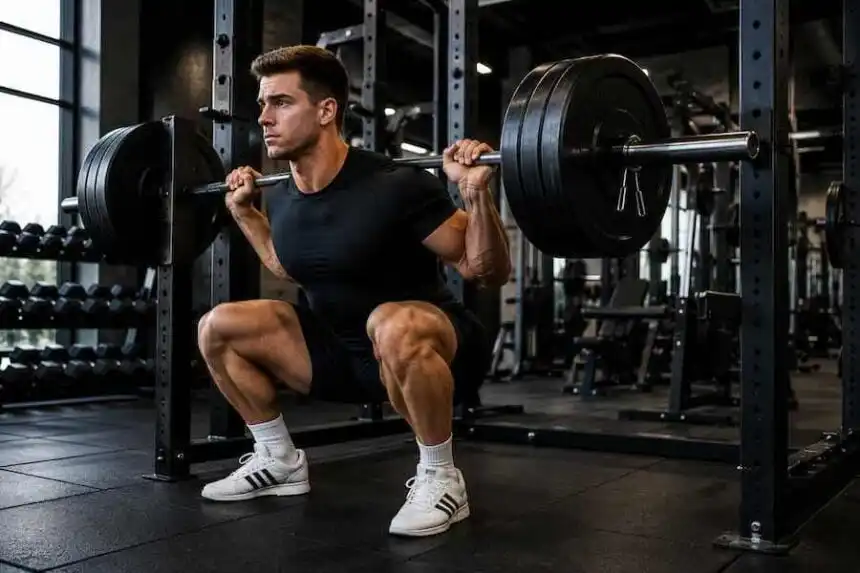
Back squats remain a useful compound exercise because they allow the hips and knees to work together under substantial resistance. A high-bar position can encourage a relatively upright torso and greater knee flexion for many lifters, making it a popular option when quadriceps development is a priority. The exact squat style matters less than finding a technically sound variation you can perform consistently and progressively.
Tempo work can also be useful when learning control, although deliberately slow repetitions are a programming tool rather than a requirement for muscle growth. For a deeper comparison of squat styles, see Stronger By Science.
Front Squats
Moving the bar to the front changes the mechanics noticeably. Front squats generally require a more upright position and can provide an effective quadriceps stimulus while using less absolute weight than many lifters handle in a back squat.
Wrist, shoulder, and upper-back mobility can affect how comfortable the movement feels. A clean grip, crossed-arm position, or suitable strap-assisted setup may be used depending on the lifter. This front squat guide provides additional technique guidance.
Hack Squats
A hack squat machine provides stability while allowing the legs to work through a controlled range of motion. That support can make it easier to focus on the quadriceps without balance becoming the limiting factor. Foot position, machine design, anatomy, and depth all influence how the exercise feels, so adjust the setup rather than forcing yourself into an uncomfortable position.
See BarBend’s hack squat guide for additional setup information.
Leg Press
The leg press is another stable way to accumulate lower-body training volume. Rather than loading as many plates as possible, use a resistance that lets you maintain control and an appropriate range of motion without your hips repeatedly lifting from the pad.
Because the machine reduces some of the stabilization demands associated with free-weight squatting, it can work particularly well after a primary compound exercise or as a main movement for lifters who prefer machine-based training.
Stiff-Leg Deadlifts
Stiff-leg deadlifts shift attention toward the posterior chain. The movement is built around hip flexion rather than simply lowering the bar toward the floor. Keep the load close, maintain control, and use a range that suits your hamstring flexibility and ability to maintain a stable trunk.
If the distinction between deadlift variations feels unclear, this stiff-leg deadlift guide offers further explanation.
Good Mornings
Good mornings train another hip-hinge pattern, loading the hamstrings, glutes, and spinal erectors. They reward patience. Start lighter than your ego might suggest, keep the bar controlled, and learn the hinge before increasing resistance.
Because fatigue can quickly affect technique, good mornings are usually better treated as deliberate strength and hypertrophy work rather than an exercise to grind through carelessly.
Hamstring Curls
Hamstring curls complement hip-hinge exercises by training knee flexion directly. Seated and lying machines provide slightly different setups, and either can be useful. Controlled repetitions make it easier to keep tension where it belongs instead of turning the movement into a swing.
Leg Extensions
Leg extensions isolate knee extension and make it easy to add quadriceps work without placing another barbell on your back. Adjust the machine carefully, use a manageable load, and keep the repetitions smooth. If the movement causes knee pain rather than normal muscular effort, stop and reassess the setup or exercise choice.
Bulgarian Split Squats
Few exercises make moderate weights feel quite as substantial as Bulgarian split squats. Training one leg at a time challenges the quadriceps and glutes while introducing a balance component. They can also expose noticeable side-to-side differences that bilateral movements sometimes disguise.
Rear-foot elevation should make the movement useful, not turn it into an acrobatic test. Choose a bench or support height that lets you move comfortably and concentrate on the working leg.
Walking Lunges
Walking lunges combine unilateral strength with coordination and can finish a leg session with surprisingly little equipment. Stride length and torso position influence how the exercise feels across the quadriceps and hips, but control remains more important than trying to cover the gym floor as quickly as possible.
They also fit naturally into a broader effort to develop a consistent fitness habit: simple movements performed well are easier to repeat and progress than unnecessarily complicated routines.
Training Techniques That Make Leg Work More Effective
Small technical adjustments can change how an exercise loads the body. They should solve a specific problem rather than become rules applied to every lifter.
- Use heel elevation when appropriate: A small heel lift can help some lifters achieve greater knee flexion during squat variations, particularly when ankle mobility affects their preferred technique.
- Train through a comfortable range of motion: Use as much controlled range as your technique and individual mobility permit rather than forcing depth for its own sake.
- Control the eccentric: Do not simply drop through the lowering phase. A controlled descent keeps the repetition deliberate and makes technique easier to reproduce.
- Use pauses strategically: Paused repetitions can improve positional control and make lighter loads challenging without requiring them in every workout.
- Keep momentum in check: If bouncing or swinging is doing most of the work, reduce the resistance and restore control.
How to Structure Leg Training During a Bulk
There is no universal leg workout that fits every lifter. Training history, available equipment, exercise tolerance, weekly schedule, and recovery all matter. A useful approach is to distribute the work across the week rather than trying to destroy every muscle in one enormous session.
For a quadriceps-biased session, begin with a squat or hack squat, follow with a leg press or unilateral movement, then use leg extensions for additional targeted work. Hamstrings and calves can still receive some volume so the session remains balanced.
For a posterior-chain-biased session, prioritize a hinge such as a stiff-leg deadlift, then add hamstring curls and another hip-dominant or unilateral exercise. Technique should remain crisp as fatigue accumulates.
For two balanced leg sessions each week, distribute quad- and hamstring-focused movements across both days. This gives each muscle another training exposure while avoiding the need to cram excessive volume into a single workout.
Progressive Overload Matters More Than Novelty
A constantly changing exercise list can make progress difficult to measure. Keep useful movements in your program long enough to become technically competent and track what happens. Depending on the exercise and training phase, progress might mean more repetitions with the same load, slightly more resistance, better range of motion, improved control, or additional productive sets.
You do not need to set a personal record every session. Muscle growth is a slow accumulation of productive training, food, and recovery. That quieter rhythm is usually more sustainable than turning every leg day into a test.
Nutrition and Recovery During a Bulk
A bulk creates an energy environment intended to support muscle gain, but a larger calorie surplus is not automatically a better one. Protein intake, sufficient total energy, carbohydrates to support demanding training, and a generally nutritious diet all matter. Supplements can be useful in specific circumstances, but they do not replace the fundamentals — an important distinction when considering whether supplements can drive fitness results.
Recovery is equally practical. Sleep, rest between demanding sessions, and sensible management of training volume give muscle tissue time to adapt. Persistent pain, declining performance, disrupted sleep, or fatigue that continues accumulating are reasons to reassess the workload rather than automatically adding another set.
Conclusion: Bigger Legs Are Built Rep by Rep
Building bigger legs during a bulk does not require an exotic exercise menu. Squat. Hinge. Train one leg at a time. Add targeted machine work where useful, then repeat the process with gradually improving performance.
The visual changes arrive slowly, but the process is measurable long before they become dramatic. Better control, another repetition, a little more load, and stronger movement across a familiar range are all signs that the program is moving forward. Support that work with an appropriate diet, adequate recovery, and enough patience to let adaptation happen.
FAQ: Building Bigger Legs While Bulking
How often should I train legs while bulking?
Many lifters can successfully train their legs more than once per week, but frequency should reflect total training volume and recovery. More sessions are only useful when you can recover sufficiently between them.
What rep range is best for leg growth?
Hypertrophy is not confined to a single repetition range. Moderate rep ranges are convenient for many compound movements, while higher repetitions can work particularly well for exercises such as curls, extensions, and calf raises. Effort, appropriate loading, technique, and progressive training all matter.
Do I need squats to build big legs?
No single exercise is mandatory. Squats are effective, but hack squats, leg presses, split squats, hinges, curls, and extensions can be combined into an effective program when conventional squatting is unsuitable.
Should I do cardio during a bulk?
Cardiovascular exercise can remain part of a bulking program. Manage its duration and intensity alongside resistance training so that it does not unnecessarily compromise recovery from demanding leg sessions.
Should calves be trained separately?
Direct calf work can be useful because squats and hinges are not designed primarily to train the calves through their full functions. Standing and seated calf-raise variations can be incorporated according to your goals and available equipment.
What supplements are useful when trying to gain muscle?
Protein supplements can be convenient when food intake does not provide enough protein, while creatine monohydrate is among the most extensively researched sports supplements. Individual needs vary, and anyone with a medical condition, medication use, or uncertainty about supplementation should seek qualified healthcare advice.
How quickly will my legs grow?
There is no reliable universal timeline. Training experience, genetics, nutrition, sleep, program quality, and starting muscle mass all influence the rate of change. Track strength, measurements, training performance, and photographs over longer periods rather than expecting dramatic week-to-week differences.
Can beginners use these exercises?
Many can be adapted for beginners, but exercise selection and loading should match current skill. Learning stable movement patterns with manageable resistance should come before aggressively adding weight.
How important is food during a bulk?
Nutrition is central to the process. Resistance training provides the stimulus, while sufficient energy and protein help support recovery and tissue growth. A bulk should still be structured around nutritional quality rather than simply eating as much as possible.
What is a common mistake when training legs for size?
Adding volume without considering recovery is a common problem. More exercises and sets are not automatically more productive. Build enough training to stimulate progress, monitor performance, and adjust when recovery begins to deteriorate.