






A sofa can be beautiful and still look strangely lost against a wall. A coffee table can cost thousands and somehow feel like it belongs to a dollhouse. An expensive rug can make the entire living room look smaller simply because its proportions are wrong.
- What is the 2/3 rule in interior design?
- Start with the sofa and coffee table
- But coffee-table length is only half the equation
- The 2/3 rule can help you choose a sofa too
- The sofa-to-rug relationship is slightly different
- The 2/3 rule is brilliant for artwork
- Treat a gallery wall as one object
- Why furniture often looks smaller after you bring it home
- The Divine tape test: do this before buying furniture
- Our version: calculate the visual anchor, not just the furniture
- The shape correction matters too
- Sectional sofas need a different measurement
- Small rooms are where you should break the rule first
- The doorway test catches what measurements miss
- Do not confuse the 2/3 rule with the 60-30-10 rule
- A cheat sheet worth saving
- When should you ignore the 2/3 rule?
- The practical takeaway
- Conclusion
- Frequently Asked Questions
This is why designers spend so much time thinking about scale.
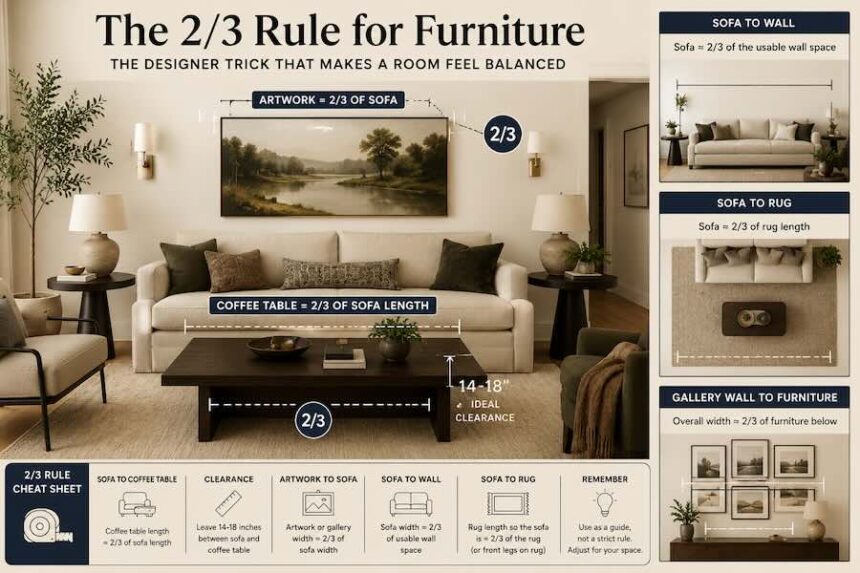
One of the easiest shortcuts is the 2/3 rule for furniture: when two elements need to relate visually, the smaller one will often feel balanced at roughly two-thirds the size of the larger one.
It appears most clearly between sofas and coffee tables, furniture and artwork, sofas and rugs, and sometimes furniture and the wall behind it. Designers interviewed by Apartment Therapy describe the two-thirds principle as a way of creating proportion and visual balance throughout a room.
But there is an important detail: two-thirds is a starting proportion, not an instruction to make everything in your home exactly 66.6 percent of something else.
What is the 2/3 rule in interior design?
The basic principle is simple.
Take the width or length of your larger anchor element and multiply it by approximately 0.66.
If your sofa is 90 inches long, for example:
90 × 0.66 = 59.4 inches
A coffee table around 60 inches long therefore gives you a useful starting point.
The reason the relationship tends to look comfortable is visual rather than mystical. The smaller object has enough scale to feel connected to the larger one, while leaving enough difference between them to create hierarchy and breathing room.
Too small and the secondary object can look stranded. Too large and the two begin competing.
Start with the sofa and coffee table
This is probably the most useful application of the rule.
A coffee table should generally be around two-thirds the length of the sofa it serves. Current 2026 furniture-sizing guidance continues to use this proportion as a reliable starting point.
Here is what that looks like:
| Sofa length | Approx. 2/3 | Coffee table target |
|---|---|---|
| 60 in / 152 cm | 40 in / 101 cm | 36–42 in |
| 72 in / 183 cm | 48 in / 122 cm | 44–50 in |
| 84 in / 213 cm | 56 in / 142 cm | 52–60 in |
| 90 in / 229 cm | 60 in / 152 cm | 56–64 in |
| 96 in / 244 cm | 64 in / 163 cm | 60–68 in |
Do not become obsessed with finding the exact number. A 57-inch table can work beautifully in front of an 84-inch sofa even though the calculator says 55.4 inches.
The calculation gets you into the right neighborhood. The room makes the final decision.
But coffee-table length is only half the equation
A perfectly proportioned table can still be uncomfortable if it is sitting in the wrong place.
Current furniture guidance commonly recommends leaving roughly 14 to 18 inches between the sofa and coffee table. That gives enough room for legs and movement while keeping the surface within comfortable reach.
Height matters too. The table generally works best around the height of the sofa seat or slightly lower.
This gives us a more useful formula than two-thirds alone:
Scale decides whether the table looks right. Clearance decides whether living with it feels right.
A beautiful proportion that bruises your shins every morning is not good design.
The 2/3 rule can help you choose a sofa too
Now reverse the relationship and look at the wall.
A common interpretation of the rule is that a sofa can occupy roughly two-thirds of the wall behind it. A 12-foot wall, for example, gives an initial sofa target around eight feet.
That leaves negative space at either end instead of turning the sofa into wall-to-wall upholstery.
This application needs considerably more flexibility, however. An open-plan room may have an enormous wall that should not dictate an enormous sofa. Windows, doorways, radiators, side tables and circulation routes also change the usable wall considerably.
Measure the visual furniture zone, not blindly the entire architectural wall.
The sofa-to-rug relationship is slightly different
This is where online explanations of the two-thirds rule can become confusing.
You may see advice saying the sofa should be approximately two-thirds the length of the rug. That means the rug is larger than the sofa, not the other way around.
For example, an 80-inch sofa might sit comfortably with a rug around 120 inches long, depending on the room and furniture arrangement.
Designers also use another interpretation: roughly two-thirds of the seating arrangement should visually connect with or sit on the rug. Livingetc describes the rule as a proportional cue rather than a commandment and notes both approaches.
The important idea is simpler than either calculation: the rug should anchor the furniture rather than float underneath the coffee table like an island.
The 2/3 rule is brilliant for artwork
This may be the fastest way to fix a wall that feels wrong.
Artwork hanging above a sofa, headboard or console often looks strongest when the complete artwork arrangement is around two-thirds the width of the furniture underneath it.
So above an 84-inch sofa:
84 × 0.66 = approximately 55 inches.
That could mean one 55-inch-wide painting. It could also mean a pair of prints or an entire gallery arrangement spanning roughly the same width.
The common mistake is going much smaller.
A tiny frame centered above a large sofa technically occupies the correct wall, yet the two objects do not visually belong together. The artwork appears to float while the sofa carries all the weight below.
Treat a gallery wall as one object
This makes the artwork rule much easier.
Do not calculate two-thirds for every individual frame. Measure the complete outer boundary of the gallery wall as though it were one enormous artwork.
If your sofa is 90 inches wide, aim for a grouping somewhere around 60 inches across as an initial reference.
The empty spaces between frames belong to the composition too.
Why furniture often looks smaller after you bring it home
Furniture showrooms are dangerous places to judge scale.
High ceilings, enormous floor plates and generous spaces between displays can make a substantial coffee table appear modest. Product photography creates a similar problem because wide-angle lenses and carefully selected surrounding furniture can distort our sense of proportion.
Then the delivery arrives.
The table that looked restrained online suddenly occupies half the living room.
This is where the two-thirds calculation becomes genuinely practical. You are comparing a product measurement with something already inside your home rather than judging scale from an image.
The Divine tape test: do this before buying furniture
We would add one step before purchasing any major table, rug or storage piece.
Put the dimensions on the floor.
Use painter’s tape to mark the complete footprint of the furniture. If you are testing a coffee table, sit on the sofa afterward. Put your feet down. Walk around it. Reach toward where a glass would sit.
Leave the tape there for an evening.
This reveals something a floor plan cannot: whether the furniture interferes with the way you actually move.
For tall pieces, take the experiment further. Use removable tape on the wall to mark the height and width of a cabinet, artwork or headboard.
Ten minutes of blue tape can prevent six months of quietly resenting an oversized table.
Our version: calculate the visual anchor, not just the furniture
Here is where we would push the standard two-thirds advice further.
A sofa does not always look as wide as its specification says it is.
Imagine two sofas measuring exactly 90 inches. One has enormous rolled arms, dark velvet and a high back. The other has slim arms, pale linen and exposed legs.
Their dimensions match. Their visual weight does not.
That means the mathematically correct 60-inch coffee table may feel different in front of each sofa.
For Divine, we would treat the calculation as two-thirds plus visual correction.
- Dark, heavy sofa: test slightly more substantial tables.
- Pale, visually light sofa: test the calculated size or slightly smaller.
- Chunky table: its visual mass may allow a shorter length.
- Glass table: its transparency can tolerate greater physical size without feeling as dominant.
- Strongly patterned rug: remember that pattern adds visual weight even when dimensions stay unchanged.
This is not a formal industry formula. It is a more useful way to apply proportion in an actual room.
The shape correction matters too
Two-thirds works most cleanly when comparing similar horizontal shapes: rectangular sofa, rectangular coffee table.
Change the geometry and the eye reads the relationship differently.
A round coffee table does not need to visually stretch across two-thirds of the sofa in exactly the same way. Neither does a pair of nesting tables or two smaller tables placed together.
Instead, imagine the combined footprint. Does the table arrangement occupy enough of the seating zone to feel connected to everyone using it?
That question is more useful than forcing a circular object into a rectangular equation.
Sectional sofas need a different measurement
Do not measure the entire perimeter of an L-shaped sectional and multiply it by 0.66. You could end up shopping for a conference table.
Instead, identify the part of the sectional that directly faces the coffee table. Treat that span as the primary anchor, then check how the table relates to the chaise or return.
Round and square tables can work particularly well inside L-shaped arrangements because they respond to the central negative space rather than mirroring one long sofa edge.
Small rooms are where you should break the rule first
A 2/3 calculation should never defeat circulation.
If the ideal coffee-table length leaves insufficient walking space, choose something smaller, narrower or visually lighter. Nesting tables may solve the problem better. So might a compact round table.
The same applies to sofas. A two-thirds-of-the-wall sofa is irrelevant if it blocks a doorway or makes a narrow living room difficult to navigate.
Function outranks proportion.
The doorway test catches what measurements miss
After arranging the room, leave it.
Then return and stop in the doorway.
Do not inspect the lamp or cushion you have been moving for twenty minutes. Look at the entire composition.
Ask which object dominates first. Then look at the furniture surrounding it.
If the coffee table disappears, it may be too small or visually light. If it feels like a platform occupying the centre of the room, it may be too large. If the artwork seems disconnected from the sofa, compare their widths.
Two-thirds gives you the calculation. Distance gives you perspective.
Do not confuse the 2/3 rule with the 60-30-10 rule
They solve different problems.
The 2/3 rule is primarily about proportion and scale between objects: sofa to coffee table, furniture to artwork, sofa to rug or furniture to wall.
The 60-30-10 decorating rule deals primarily with color hierarchy: roughly 60 percent dominant color, 30 percent secondary color and 10 percent accent.
You can use both simultaneously. In fact, a room with strong color balance can still feel strangely wrong when its furniture is badly scaled.
Color catches the eye. Proportion tells it where everything belongs.
A cheat sheet worth saving
| Relationship | Useful starting point |
|---|---|
| Coffee table → sofa | About 2/3 of sofa length |
| Artwork → sofa | About 2/3 of sofa width |
| Gallery wall → furniture below | Treat the complete grouping as one object; start around 2/3 |
| Sofa → wall | About 2/3 of the usable visual wall can be a starting point |
| Sofa → rug | Sofa can read around 2/3 of rug length, depending on layout |
| Coffee table clearance | Approximately 14–18 inches from sofa |
When should you ignore the 2/3 rule?
Ignore it when following it makes the room less comfortable.
Architecture comes first. Circulation comes next. Then proportion.
A narrow apartment may need a smaller coffee table. An unusually long wall may need furniture grouped into zones rather than one gigantic sofa. A dramatic oversized painting may intentionally exceed the expected proportion. A tiny antique table might work precisely because it looks delicate beside a substantial sofa.
Once you understand the expected relationship, breaking it becomes a choice rather than an accident.
The practical takeaway
Before buying furniture, identify the object it needs to relate to.
Measure that anchor. Multiply by roughly 0.66. Use the result to establish a sensible shopping range rather than an exact requirement.
Then correct for shape, visual weight, architecture and movement. Tape the footprint onto the floor. Walk around it. Sit beside it. Look at it from the doorway.
The calculation takes seconds. The correction is where the room becomes yours.
Conclusion
Good rooms contain invisible relationships.
The coffee table does not match the sofa, but it understands its scale. The artwork has enough wall around it to breathe. The rug reaches beyond the furniture just far enough to hold everything together.
You rarely notice the mathematics.
You notice that nothing feels lost.
Frequently Asked Questions
What is the 2/3 rule for furniture?
The 2/3 rule is a proportional decorating guideline suggesting that a secondary element can often be around two-thirds the width or length of the larger element it relates to. A common example is choosing a coffee table approximately two-thirds the length of a sofa.
How big should a coffee table be compared with a sofa?
A useful starting point is approximately two-thirds of the sofa’s length. An 84-inch sofa, for example, suggests a coffee table around 56 inches long, although shape and available clearance may justify going smaller or larger.
How far should a coffee table be from a sofa?
Approximately 14 to 18 inches is a commonly recommended starting range. It generally keeps the table reachable while leaving enough space for legs and movement.
How big should artwork be above a sofa?
Artwork or a complete gallery-wall grouping can often look balanced at roughly two-thirds the width of the sofa beneath it. Treat multiple frames as one overall composition when measuring.
Should a sofa be two-thirds the length of a wall?
It can be a useful starting point, but it should not override the architecture. Measure the usable visual area and account for doors, windows, side tables, walkways and open-plan zones before choosing the sofa.
Does the 2/3 furniture rule need to be exact?
No. The rule is a proportion guide rather than an exact formula. Shape, color, material, visual weight and available space can all change which dimensions look and function best.