







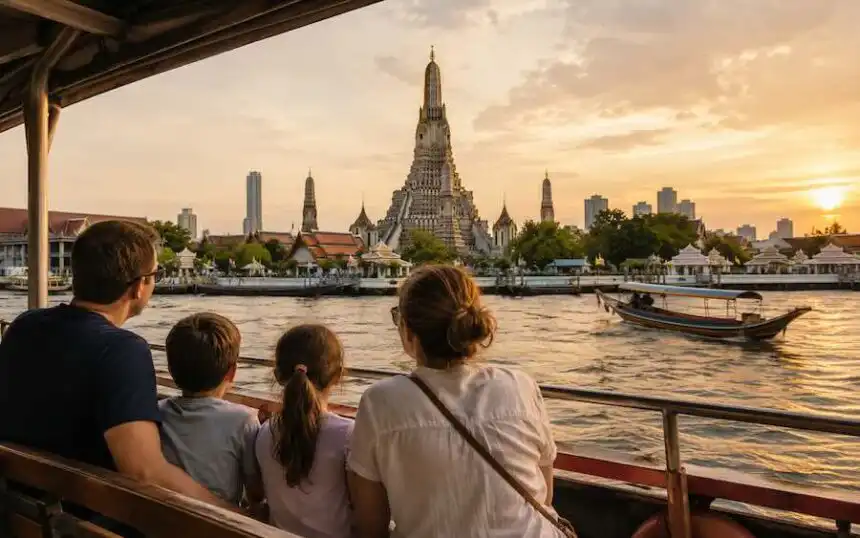
Bangkok rarely moves at one speed. Long-tail boats cut across brown-green water, trains slide above traffic, incense hangs in the air around temple courtyards, and glass towers catch the afternoon sun. For families visiting in 2026, that constant motion is part of the appeal — provided the days leave enough room to slow down.
- Why Bangkok Works Surprisingly Well for Families
- 1. Explore Bangkok from the Chao Phraya River
- 2. See Wat Arun in the Morning
- 3. Spend a Few Hours at SEA LIFE Bangkok Ocean World
- 4. Make Bangkok Planetarium a Science Stop
- 5. Take a Slow Morning in Lumphini Park
- 6. Turn Bangkok’s Transport Into an Activity
- 7. Let Children Discover Thai Food Gradually
- 8. Save One Evening for the Riverside
- How to Plan Bangkok Days With Children
- When to Visit Bangkok With Kids in 2026
- Conclusion: Give Bangkok Room to Breathe
- FAQ: Bangkok Family Activities in 2026
The best Bangkok family activities are not necessarily the ones that fill every hour. A stronger trip mixes temples and river journeys with green space, interactive museums, air-conditioned attractions, and unstructured time for mango, noodles, swimming, or simply watching the city pass from a BTS platform.
Why Bangkok Works Surprisingly Well for Families
Bangkok can look intimidating on a map, particularly for parents planning a first trip with children. In practice, many major attractions sit close to the BTS Skytrain, MRT, or Chao Phraya River transport routes. That makes it possible to build compact days instead of spending hours crossing the city in road traffic.
The other advantage is variety. One morning can begin beside a gilded temple and end beneath an aquarium tunnel. The following day might involve monitor lizards in a park, a planetarium show, and dinner beside the river.
1. Explore Bangkok from the Chao Phraya River
For children, Bangkok often makes more sense from the water. Ferries and boats turn transportation into an activity while giving everyone a break from pavements and traffic.
A river journey also connects naturally with several major sights. Families can combine a boat ride with Wat Arun, the Grand Palace area, or a slower lunch near the waterfront rather than treating the river as a separate excursion.
Keep the itinerary loose. Heat, queues, and tired legs can quickly change the pace with younger children, and the river is at its best when there is time to watch wooden houses, hotel terraces, temple roofs, tugboats, and modern towers drift through the frame.
2. See Wat Arun in the Morning
Wat Arun is one of the easier major temples to turn into a focused family experience. Its central prang rises above the Chao Phraya in layers of pale ceramic detail, creating a setting that feels tactile rather than purely ceremonial.
Go early when possible. Cooler temperatures make exploring more comfortable, while softer morning light brings out the porcelain patterns without the hard glare of midday.
Temple visits also offer an opportunity to introduce children to Thai customs. Shoulders and knees should be covered where required, voices kept low, and religious spaces approached respectfully.
3. Spend a Few Hours at SEA LIFE Bangkok Ocean World
Some Bangkok days need air conditioning. SEA LIFE Bangkok Ocean World, inside Siam Paragon, is particularly useful during the hottest part of the afternoon or when rain interrupts outdoor plans.
The aquarium includes an ocean tunnel, coral environments, rainforest exhibits, seahorses, penguins and shark-focused displays. Families can comfortably spend around two hours inside, although there is no need to rush through the exhibits. SEA LIFE’s published 2026 schedule lists daily opening from 10:00 a.m. to 8:00 p.m., with last entry at 7:00 p.m.
For trips taking place through September 20, 2026, the aquarium is also running its Glowing Ocean experience, using light and projection across several zones.
Its Siam location makes this one of the easiest attractions to pair with lunch, shopping, or a relaxed return to the hotel.
4. Make Bangkok Planetarium a Science Stop
Families with children interested in planets, dinosaurs and hands-on science can move away from the standard sightseeing circuit at Bangkok Planetarium and the surrounding Science Centre for Education.
Thailand’s tourism authorities highlight the planetarium’s 4K digital full-dome system alongside interactive science areas covering subjects including the universe, electricity, minerals, insects and the environment.
It is the kind of stop that can reset the rhythm of a trip. After several days of temples, markets and city streets, darkened exhibition spaces and hands-on displays give children something different to engage with.
5. Take a Slow Morning in Lumphini Park
Not every family activity needs a ticket. Lumphini Park gives children space to move without the visual density of central Bangkok.
Early morning is particularly atmospheric. Runners move beneath broad tropical trees, birds cut across the lake, and the skyline appears between branches. Families may also spot the park’s famously conspicuous monitor lizards near the water.
Use the park as breathing space rather than another attraction to complete. An hour with drinks, snacks and no schedule can be more valuable than squeezing another landmark into the day.
6. Turn Bangkok’s Transport Into an Activity
Children do not always separate sightseeing from transportation. That works in Bangkok’s favor.
The elevated BTS offers broad glimpses of the city between stations. MRT journeys provide a fast retreat from heat. River boats introduce an entirely different perspective, while a tuk-tuk can be memorable as a short ride when the route and fare are agreed in advance.
Rather than relying on taxis for every journey, choose transport that becomes part of the day’s story. It reduces time trapped in traffic and gives children frequent changes of scenery.
7. Let Children Discover Thai Food Gradually
Bangkok is a remarkable food city, but family eating does not need to become a nightly test of adventurousness. Start with approachable textures and flavors: grilled chicken, rice, omelets, noodles, fresh fruit, mango sticky rice, or mild versions of familiar Thai dishes.
Food courts can work especially well because everyone can choose independently while parents still get access to regional Thai dishes. Markets add more atmosphere, but the combination of heat, crowds and unfamiliar food can be tiring for younger children after a long sightseeing day.
Keep bottled water close and build snack stops into the schedule. Bangkok’s heat changes appetites as much as it changes energy levels.
8. Save One Evening for the Riverside
Bangkok changes after sunset. Temperatures soften, boats leave broken lines of light across the Chao Phraya, and illuminated towers begin reflecting in the water.
A riverside dinner can therefore work better for families than trying to add another formal attraction at night. It gives adults a sense of occasion without asking children to negotiate another long queue or museum.
How to Plan Bangkok Days With Children
The most useful rule is simple: plan less than you think you can fit in.
- Schedule major outdoor sights in the morning.
- Use midday for lunch, swimming, museums, aquariums or hotel downtime.
- Group attractions geographically instead of crossing Bangkok repeatedly.
- Carry water, sunscreen, hats and a light layer for aggressively air-conditioned interiors.
- Allow extra travel time during rush hour.
- Keep at least one part of every day unscheduled.
- Check official attraction hours and ticket conditions shortly before visiting.
Bangkok rewards flexibility. A tropical downpour can turn a park afternoon into an aquarium visit. A child fascinated by riverboats may care less about the landmark waiting at the next pier. Leave room for those shifts.
When to Visit Bangkok With Kids in 2026
Weather should shape the itinerary more than the calendar on a phone. Bangkok remains warm throughout the year, while seasonal humidity and rainfall can significantly affect how comfortable long outdoor days feel.
Families traveling during hotter periods should treat early mornings as prime sightseeing time and protect the middle of the day. During wetter months, short heavy showers are a reason to build flexibility into the schedule rather than abandon outdoor plans completely.
Conclusion: Give Bangkok Room to Breathe
A successful Bangkok family trip is less about collecting attractions than finding a rhythm the whole family can sustain.
Ride the river. Walk through a temple courtyard before the heat builds. Watch sharks move silently overhead at Siam. Give children an afternoon in a park or science museum, then sit beside the Chao Phraya as the daylight fades from gold to blue.
Bangkok supplies the spectacle without much effort. The trick in 2026 is leaving enough space to notice it.
FAQ: Bangkok Family Activities in 2026
Is Bangkok suitable for a family vacation?
Yes. Bangkok combines cultural attractions, parks, shopping centers, interactive indoor attractions and extensive public transportation. Families should account for heat, traffic and travel time when planning each day.
How many days should a family spend in Bangkok?
Three to five days gives most families enough time to combine major landmarks with slower activities without turning every day into a full sightseeing schedule.
What are good indoor family activities in Bangkok?
SEA LIFE Bangkok Ocean World and Bangkok’s science and museum attractions are useful choices during hot or rainy periods. Large shopping complexes around Siam also make it easy to combine meals, entertainment and air-conditioned downtime.
Is Bangkok easy to navigate with children?
It becomes considerably easier when itineraries are organized around BTS, MRT and river connections. Avoid scheduling attractions on opposite sides of the city on the same day unless there is a clear transport route between them.
What should parents pack for Bangkok?
Light breathable clothing, comfortable shoes, hats, sunscreen, refillable or bottled water, rain protection and modest clothing suitable for temple visits cover most daily needs. A lightweight layer can also be useful inside strongly air-conditioned buildings.