







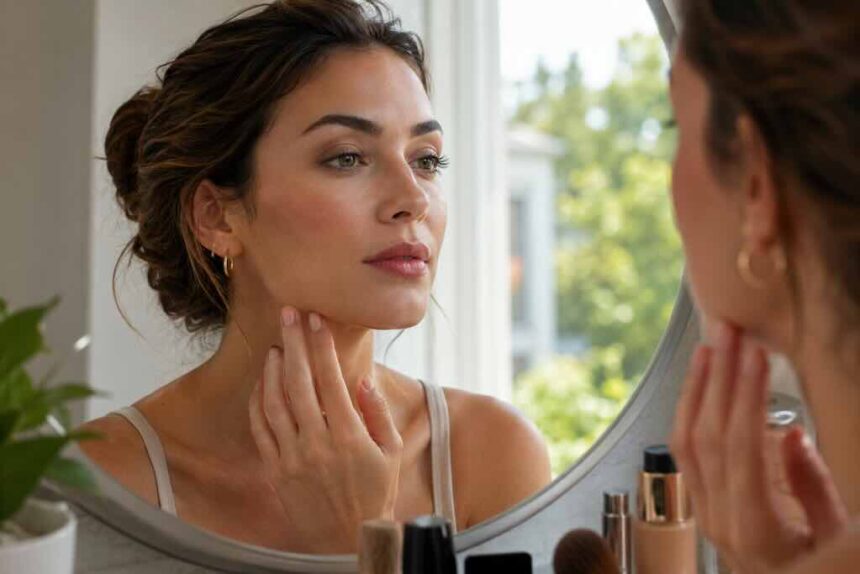
Bathroom light can be wonderfully forgiving. Foundation looks smooth, concealer disappears, blush seems softly diffused. Then you catch your reflection beside a window and see something else entirely: a yellow cast along the jaw, powder sitting around the nose, bronzer that suddenly looks orange.
- Your makeup doesn’t have one fixed appearance
- Daylight is revealing, but it isn’t neutral all day
- Foundation exposes the problem first
- Sometimes it’s the blush, not the foundation
- Why your skin suddenly looks more textured by a window
- Build a better makeup-lighting routine
- Makeup doesn’t need to look identical everywhere
- FAQ
Nothing dramatic happened on the walk from the bathroom to the window. You simply changed the light.
Makeup is color laid over a surface that already contains considerable variation. Skin has undertones, redness, pigmentation, shadows and texture; foundation and color cosmetics add another layer. What your eye sees depends partly on the light illuminating all of it. Some indoor lighting softens those differences or shifts them warmer or cooler. Daylight can reveal them with uncomfortable efficiency.
Your makeup doesn’t have one fixed appearance
Color depends on light. We see a foundation as beige, golden, pink or neutral because light strikes the skin and product, then reflected light reaches our eyes. Change the characteristics of the light source and our perception can change with it.
The International Commission on Illumination describes color rendering in terms of the effect an illuminant has on the perceived color of objects compared with a reference illuminant. It’s a technical idea with a very ordinary consequence: the foundation that blends beautifully under one lamp may look slightly wrong under another.
Think about the light around a typical mirror. A warm bulb can bathe skin in amber. Some cool LEDs push the scene in another direction. Shadows may fall from above, from both sides or barely appear at all. A window introduces a completely different environment.
There is measurable evidence for these changes in facial appearance. Research examining faces and cosmetics under different illuminants found that lighting could alter facial color contrasts, including the relationship between lipstick and surrounding skin.
Daylight is revealing, but it isn’t neutral all day
“Check it in natural light” is useful beauty advice, but it can sound as though daylight were a single perfect setting.
It isn’t.
A grey morning produces a different visual atmosphere from direct late-afternoon sun. Open shade can feel cool and blue; low sunlight can turn a room honey-colored. Weather, time of day, window direction and surrounding surfaces all influence the light reaching your face.
For makeup, soft indirect daylight is usually the useful version. Stand near a bright window without direct sun hitting your face. You can see the relationship between foundation and skin, the edges of bronzer and blush, and areas where concealer or powder has accumulated without the hard shadows of full sunlight.
Artificial lighting varies considerably in its ability to render color, too. The National Institute of Standards and Technology has explained how the spectral qualities of white light affect perceived colors. Brightness alone doesn’t tell you whether a lamp will show makeup colors faithfully.
Foundation exposes the problem first
A tiny color difference in eyeliner is easy to overlook. Foundation covers much of the face, so a small mismatch becomes a large field of slightly wrong color.
Under warm indoor lighting, a foundation with too much yellow may settle comfortably into the scene. Beside a window, the face can suddenly look warmer than the neck. A shade with too much pink may create the opposite problem.
Skin isn’t a paint swatch, either. A clinical review of skin color measurement describes the contribution of factors including melanin, hemoglobin and carotene to visible skin color. The face can also carry natural redness, pigmentation and tonal variation that isn’t present in exactly the same way on the neck or hand.
So the familiar habit of swiping foundation across the back of your hand has limits. Your hand may simply be a different color.
For a more useful test, place two or three close shades along the lower cheek and jaw. Blend the edges lightly and walk over to a window. Don’t search for the prettiest swatch. Look for the shade that stops demanding your attention.
If you’re buying foundation in a shop, checking the swatch near a window or outdoors in open shade before committing can reveal a mismatch that bright retail lighting disguised. Research into skin-tone estimation under different illumination supports the broader point that lighting conditions affect perceived skin tone.
Sometimes it’s the blush, not the foundation
You can have an excellent foundation match and still feel that your makeup looks strangely different outside.
Look at the color products.
A restrained peach blush under warm lighting can reveal much more orange pigment in daylight. Bronzer may become redder. A pale concealer can create bright shapes beneath the eyes that weren’t obvious at the dressing table. Highlighter is particularly dependent on angle: a quiet sheen when you’re facing the mirror can turn into a sharp reflective patch as you move your head.
Colors on the face also influence one another. Research on facial color perception has shown that lip color can affect the perceived lightness of surrounding facial skin. Makeup isn’t read as a collection of isolated shades. The eye takes in their relationships.
After applying blush, bronzer and lipstick, move away from the mirror for a moment. Look at the whole face. A product that seemed perfectly subtle while you were concentrating on one cheek may feel much stronger once you see the complete composition.
Why your skin suddenly looks more textured by a window
This can be the unnerving part.
Soft frontal lighting fills small shadows and makes surfaces appear smoother. Directional window light can skim across the face instead, catching the edge of a dry patch, individual hairs, powder around a pore or a crease where concealer has settled.
It’s easy to respond by adding more product. Often that makes the daylight view heavier.
Try pressing a slightly damp makeup sponge over the area or sweeping away excess powder with a clean, soft brush. If the foundation itself is already even, more coverage may only add another visible layer.
And remember what you’re looking at: skin at close range under revealing directional light. Pores and fine texture aren’t evidence that a base has gone wrong.
Build a better makeup-lighting routine
You don’t need a dressing room filled with professional lighting. A window and a couple of minutes are enough to catch most problems.
Apply makeup where you’re comfortable, then make one final check in indirect daylight. Face the window first. Turn your head slowly to each side and look at the jaw, around the nose, beneath the eyes and along the outer edges of blush and bronzer. Those areas tend to reveal abrupt changes in color or texture quickly.
At night, avoid judging complexion color under one strongly warm or cool lamp if you can. A well-rendering white light around the face gives you a more useful view than a dim overhead bulb casting shadows beneath the eyes and chin.
Be cautious with the phone camera as a final judge. Cameras make their own decisions about exposure, white balance and image processing, and the screen adds another layer between the real face and the image you see. A photograph can expose an obvious blending line, but it isn’t an infallible color reference.
Makeup doesn’t need to look identical everywhere
A restaurant at night, an office beneath cool ceiling lights and a pavement on a bright September morning are three different visual environments. No foundation can control the light falling on it.
A more realistic goal is makeup that remains convincing as those environments change. Match complexion products in dependable light. Keep an eye on undertones rather than shade depth alone. Check the edges, not just the center of the face. If something looks heavy by the window, remove or soften before adding.
Once you start looking at the light itself, the surprise of that first daylight reflection becomes less mysterious. Sometimes your makeup needs adjusting. Sometimes you simply walked into a much more revealing room.
FAQ
What natural light is best for checking makeup?
Bright, indirect daylight is the most practical. Face a window without standing in direct sunlight, which can create glare and hard shadows that make makeup difficult to judge.
Why does my foundation look orange or yellow outside?
The foundation may contain a warmer undertone than your skin, while your indoor lighting was making the difference harder to see. Compare the lower cheek and jaw with the neck in indirect daylight. If the warm cast appears consistently, try a more neutral or differently balanced undertone.
Why does foundation look cakey in natural light?
Directional daylight makes small changes in surface texture more visible, so excess powder, dry areas and layers of complexion products can stand out. Before applying more foundation, try removing excess product or pressing the existing base gently into the skin.
Should I match foundation to my face or neck?
Faces and necks aren’t always exactly the same color. Test foundation along the lower cheek and jaw and look for a shade that creates a natural transition across the visible skin rather than matching one small area in isolation.