







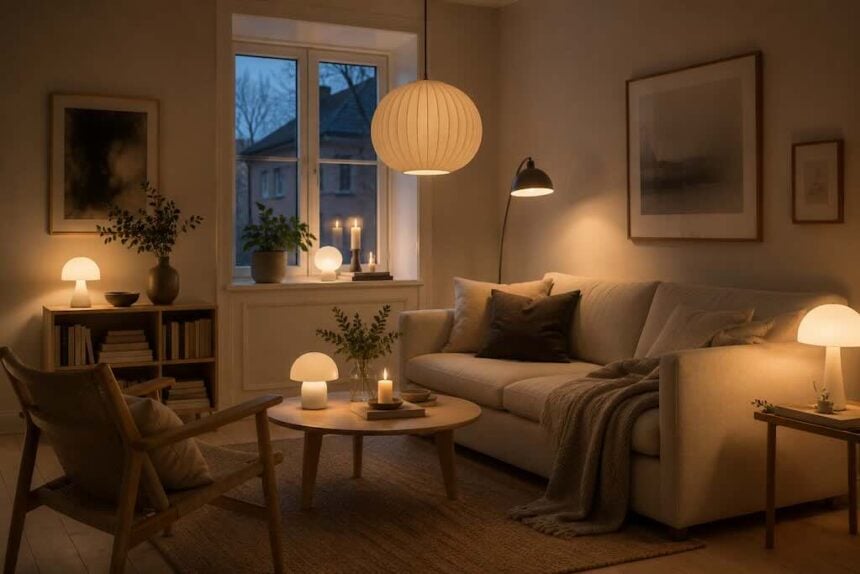
Walk into a Scandinavian living room after sunset and the first thing you may notice is not the furniture.
- Why Scandinavian interiors use so many lamps
- The ceiling light is not supposed to do everything
- Lamps create islands inside a room
- This is also where hygge enters the conversation
- Why warm low light changes how furniture looks
- The Divine three-height lighting rule
- Start with five light sources, not five lamps
- One room should have several lighting moods
- Why dim evening light can feel calmer
- Do not make every bulb the same brightness
- Where should you put lamps in a living room?
- Try the no-ceiling-light test
- The practical takeaway
- Conclusion
- Frequently Asked Questions
It is the light.
A pendant over the dining table. A small lamp on a sideboard. Another beside the sofa. Perhaps a wall light near a bookshelf, a low glow in the window and a candle somewhere in between.
None of them are trying to illuminate the entire room.
That is precisely the point.
Scandinavian homes often rely on multiple smaller light sources instead of one dominant ceiling light. The result is a room that feels softer, deeper and more intimate because light is distributed in layers rather than poured evenly from above.
It is one of the easiest Scandinavian design ideas to copy, and you do not need Scandinavian furniture to make it work.
Why Scandinavian interiors use so many lamps
The practical reason begins with geography.
Across much of Scandinavia, winter brings long periods of darkness and very short days. Homes therefore spend a significant portion of the year functioning under artificial light.
That makes lighting less of a finishing detail and more of an architectural material.
Rather than relying entirely on one overhead fixture, Scandinavian interiors commonly combine general lighting, task lighting and softer mood lighting. IKEA Sweden’s own lighting guidance recommends several different categories of light in a room and even suggests roughly five to seven light sources as a useful rule of thumb.
That does not mean every Scandinavian living room literally contains seven visible lamps.
It means one room can have several independent pools of light, each performing a different job.
The ceiling light is not supposed to do everything
This is the biggest difference between a layered room and a brightly lit room.
Turn on one strong ceiling fixture and the entire space receives roughly the same visual treatment. Walls flatten. Corners disappear. Furniture loses some of its dimensional contrast.
It is practical.
It is rarely atmospheric.
Now switch that light off and turn on four smaller lamps positioned at different heights.
A floor lamp illuminates an armchair. A table lamp washes a wall with warm light. A pendant pulls the dining table forward visually. A small lamp creates a quiet glow in the far corner.
The room suddenly has foreground, middle ground and background.
This layered approach closely matches IKEA’s guidance on combining task, general and mood lighting rather than expecting one fixture to handle every activity.
Lamps create islands inside a room
Think about a dark Scandinavian living room in January.
Outside the window, everything is blue-black. Inside, a lamp glows beside the sofa.
The sofa does not simply become brighter.
It becomes a destination.
That is what small light sources do particularly well. They create what we might call visual islands: distinct zones of warmth that quietly tell you where to sit, read, eat or gather.
A dining pendant says: stay here.
A reading lamp says: this chair has a purpose.
A tiny lamp on a bookshelf says: this corner matters too.
The architecture has not changed.
Your perception of it has.
This is also where hygge enters the conversation
The Danish idea of hygge is frequently reduced to candles and blankets, but the underlying concept is broader: warmth, intimacy and a sense of ease.
VisitDenmark describes hygge as creating a warm atmosphere and enjoying quieter pleasures, and specifically identifies candlelight as one of its most recognizable expressions.
Lighting fits naturally into that idea because intimacy depends partly on scale.
A room illuminated uniformly from the ceiling feels public.
A table illuminated by one pendant while the rest of the room falls gently darker feels private.
Same room.
Different emotional scale.
Why warm low light changes how furniture looks
Lighting also changes material.
A pale oak table beneath flat white ceiling light looks clean and graphic.
Put a warm-shaded lamp beside it and the grain becomes richer. Linen develops shadow. Wool looks softer. Ceramics acquire depth. Plaster walls reveal texture that disappeared under uniform illumination.
This is particularly effective in Scandinavian interiors because the material palette is often restrained.
Wood. Wool. linen. paper. glass. stone.
When the color palette is quiet, changes in shadow and reflected light become more noticeable.
The lamp is not simply lighting the decor.
It is helping create it.
The Divine three-height lighting rule
If you want to reproduce the effect without buying six random lamps, begin with height.
Use light at three levels:
- High: a pendant, ceiling fixture or wall light.
- Middle: a floor lamp beside seating or a lamp on a console.
- Low: a small table lamp, shelf lamp or other low source.
This is a Divine editorial framework rather than a formal Scandinavian design standard, but it solves a common problem: several lamps positioned at exactly the same height can still make a room feel visually flat.
Different heights create different shadows.
Different shadows create depth.
Start with five light sources, not five lamps
Here is another useful distinction.
You are not counting objects.
You are counting functions.
A living room might include:
- one ceiling or pendant light for general illumination,
- one floor lamp for reading,
- one table lamp for atmosphere,
- one small accent light near artwork or shelving,
- one additional low-glow source near the opposite side of the room.
That closely follows the principle behind IKEA’s current layered-lighting guidance, which encourages mixing ceiling, wall, floor and table lighting according to activity rather than relying on a single source.
The important word is independent.
You should be able to turn different combinations on depending on the moment.
One room should have several lighting moods
A well-lit room is not one fixed scene.
It should change.
Morning might use daylight and one practical lamp.
Late afternoon adds a floor lamp.
Dinner brings the pendant lower into focus.
At ten at night, perhaps only two small warm lamps remain.
This is why dimmers are so useful. They do not simply make a light brighter or darker. They allow one fixture to play a different role as the day changes.
Why dim evening light can feel calmer
There is also a biological reason not to flood a home with bright light late at night.
Research into residential evening lighting has found that ordinary home light exposure can meaningfully affect the circadian system. In one study published in Scientific Reports and available through the National Institutes of Health, many participants’ evening home lighting was bright enough to suppress melatonin substantially, although sensitivity varied considerably between individuals.
That does not mean every warm table lamp is automatically “better for sleep.” Brightness, duration, timing, spectrum and individual sensitivity all matter.
But it does reinforce something Scandinavian lighting culture gets intuitively right:
night does not need to look like noon.
Do not make every bulb the same brightness
This is where people often ruin a layered lighting plan.
They buy several lamps, then install very bright bulbs in all of them.
The room becomes brighter, but not more interesting.
Instead, allow hierarchy.
Your reading light can be functional. The lamp across the room can be much dimmer. A pendant can illuminate the dining surface while leaving surrounding walls softer.
The goal is not equal light everywhere.
The goal is controlled contrast.
Where should you put lamps in a living room?
Start with behavior rather than symmetry.
Where do you actually read?
Where do people sit with a drink?
Which corner disappears after sunset?
Which wall has texture or artwork worth seeing?
Place light where the room needs activity or depth.
A floor lamp beside a sofa is useful. A tiny lamp in the opposite corner may be just as important because it prevents that side of the room from collapsing into darkness.
That second lamp may illuminate almost nothing practical.
Visually, it can transform the room.
Try the no-ceiling-light test
Tonight, wait until the room is dark.
Turn on every lamp except the main ceiling fixture.
Then look for three things:
- Is there enough light where people actually sit?
- Does one corner of the room disappear completely?
- Do you have at least two different heights of light?
If the room feels too dark, resist immediately switching the ceiling light back on.
Add one smaller source where the darkness feels visually heavy.
This is often more effective than increasing the brightness everywhere.
The practical takeaway
You do not need to recreate a Copenhagen apartment.
You need layers.
Keep the ceiling fixture for cleaning, finding things and moments when strong general light is useful. Then build smaller pools around the activities and surfaces that matter.
Use at least three heights. Let one or two sources stay deliberately dim. Choose warm evening light where appropriate. Put a lamp in a corner that currently disappears after sunset.
Then turn off the overhead light.
You may discover that the room did not need more furniture.
It needed shadows.
Conclusion
Scandinavian interiors are often praised for pale wood, restrained color and clean lines.
But after dark, another design system takes over.
Light pools around a chair. A pendant defines the table. One small lamp warms a wall that would otherwise disappear.
The effect is quiet, but structural.
Several lamps do not simply make the room brighter.
They make it feel inhabited.
Frequently Asked Questions
Why do Scandinavian homes use so many lamps?
Multiple lamps allow a room to be lit in layers instead of relying entirely on one ceiling fixture. This creates separate areas for reading, dining and relaxing while adding visual depth and a warmer evening atmosphere.
How many lamps should a living room have?
There is no fixed number, but several lighting guides recommend combining multiple sources and functions. IKEA Sweden suggests roughly five to seven light sources per room as a useful rule of thumb, including general, task, accent and mood lighting.
Should you use a ceiling light in Scandinavian interiors?
Yes. Ceiling lights remain useful for general illumination. The difference is that they are usually not expected to create every lighting condition on their own. Floor, table, wall and pendant lights can provide additional layers.
What color temperature works for a cozy living room?
Warm-white lighting is commonly used for relaxed evening spaces, while brighter or cooler task lighting can be useful where concentration and visibility matter. Mixing functions is generally more useful than forcing every light in the room to use exactly the same intensity.
How can I make my living room feel cozy with lighting?
Use several smaller light sources at different heights, keep some areas intentionally darker, position lamps near seating and reflective or textured surfaces, and avoid making every fixture equally bright.
Is dim light at night better for sleep?
Evening light can influence the circadian system, but the effect depends on brightness, timing, spectrum and individual sensitivity. Reducing unnecessary bright light late at night is generally more consistent with the natural day-night cycle than keeping a home intensely illuminated until bedtime.