







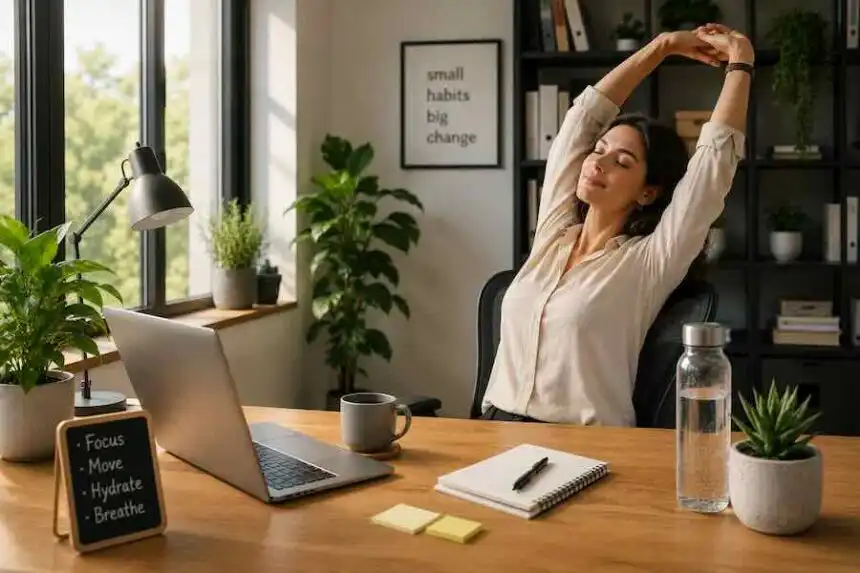
A better workday does not always require a dramatic reset. Often, it begins with smaller shifts: standing between meetings, looking away from the screen, drinking water before fatigue arrives, or protecting the hour when your mind naturally feels clearest. In 2026, workplace wellness is becoming less about adding another demanding routine and more about designing the day around how your body and attention actually behave.
- Start by Understanding Your Energy, Not Fighting It
- Build a Softer Start to the Workday
- Give Your Eyes Regular Distance From the Screen
- Break Up Long Periods of Sitting
- Make Hydration Easier to Remember
- Use a Workday Energy Audit
- Match the Task to the Energy You Have
- Find the Habits That Quietly Drain You
- Create a Micro-Habit Prescription You Can Actually Keep
- Practical Takeaway: Pick Two Habits This Week
- Conclusion: Small Habits Make the Workday More Sustainable
- FAQ: Micro-Habits for a Better Workday
These micro-habits can fit between emails, calls, deadlines, and deep-focus sessions without dismantling your schedule. The goal is simple: reduce unnecessary friction, interrupt long periods of sitting and screen exposure, and create small moments of recovery before exhaustion starts dictating the rest of the day.
Start by Understanding Your Energy, Not Fighting It
One useful shift is to stop assuming every working hour should feel equally productive. Concentration naturally rises and falls. Instead of treating an afternoon dip as a personal failure, pay attention to when demanding work feels relatively fluid and when even a straightforward email begins to feel strangely heavy.
This approach connects with the broader conversation around work-life balance: sustainable productivity depends partly on knowing when to push and when to recover. For several days, note your energy, focus, and mood at regular intervals. Patterns often become visible surprisingly quickly.
Build a Softer Start to the Workday
The first minutes of work can set the emotional temperature for everything that follows. Opening email, messages, and notifications simultaneously creates instant noise. A quieter beginning gives you a little space before other people’s priorities enter the room.
Try a repeatable five-to-ten-minute sequence instead. Drink some water. Take a few slow breaths. Check your calendar and identify the one or two tasks that deserve your clearest attention. These are intentionally small actions, similar to the micro-habits that can reshape a day in under five minutes.
Give Your Eyes Regular Distance From the Screen
Hours of close-up screen work can leave the eyes feeling dry, tired, and strained. The American Academy of Ophthalmology recommends the familiar 20-20-20 approach for digital eye strain: periodically look away from the screen toward something approximately 20 feet away for around 20 seconds.
In practice, the habit can feel pleasantly physical. Let your gaze leave the bright rectangle in front of you and settle on a window, a corridor, a tree, or the far wall. Blink. Relax your shoulders. Twenty seconds is barely noticeable in a working day, yet it creates a clean interruption in continuous near-focus.
Break Up Long Periods of Sitting
A workout before or after work does not make eight uninterrupted hours in a chair disappear. The World Health Organization recommends limiting sedentary time alongside regular physical activity, which makes movement during the working day worth considering in its own right.
Keep it uncomplicated. Stand while taking a phone call. Walk to refill your water. Try two minutes of gentle desk yoga between meetings. Take a short walk after lunch when your schedule allows. None of these replaces structured exercise; their value lies in preventing sitting from becoming the default state for hours at a time.
Make Hydration Easier to Remember
Hydration is another habit that becomes difficult mainly when it depends on memory. A bottle sitting within sight creates a physical cue. Linking drinking water to something you already do—finishing a meeting, returning from lunch, or starting a new task—can make the behavior more automatic.
There is no need to turn hydration into another performance metric. Individual fluid requirements vary with factors including activity, climate, diet, and health. The practical aim is simply to make regular access to water easier throughout the day.
Use a Workday Energy Audit
If your schedule constantly feels misaligned with your concentration, run a simple three-day experiment. Record your energy, focus, mood, and what you were doing or eating at several points during the day. This is not a medical assessment. It is a personal observation tool designed to reveal recurring patterns.
| Time | Energy (1–10) | Focus (1–10) | Mood (1–10) | Activity / Food | |
|---|---|---|---|---|---|
| 8:00 AM | |||||
| 10:00 AM | |||||
| 12:00 PM | |||||
| 2:00 PM | |||||
| 4:00 PM | |||||
| 6:00 PM |
After three days, look for your strongest focus window, your most consistent dip, and any late-day rebound. Then compare those periods with your calendar. You may discover that your sharpest hour is being consumed by routine administration while difficult creative work has been pushed into your lowest-energy period.
Match the Task to the Energy You Have
Once a pattern emerges, experiment with moving tasks rather than demanding the same intensity from yourself all day. Protect stronger periods for work requiring sustained concentration. Save simpler administrative tasks for lower-energy stretches. Meetings and collaborative work can occupy the middle ground when possible.
| Task Type | Energy Demand | When to Try It | Examples |
|---|---|---|---|
| Deep work | High | Your strongest focus window | Writing, strategy, analysis, coding |
| Administrative work | Lower | Your recurring dip | Email, filing, scheduling, expenses |
| Collaborative work | Moderate | A stable or rebound period | Meetings, brainstorming, one-to-ones |
Find the Habits That Quietly Drain You
The same audit can expose less obvious patterns. Does concentration disappear after checking social media? Do certain meetings consistently leave you depleted? Are your worst afternoons also the days when you barely leave your desk?
- Digital distraction: Note whether brief scrolling sessions repeatedly become longer interruptions.
- Movement: Compare periods of prolonged sitting with periods when you stood or walked.
- Hydration: Notice whether water disappears from your routine during your busiest hours.
- Environment: Track recurring noise, meetings, interruptions, or workspace conditions associated with lower focus.
Do not attempt to fix everything simultaneously. Choose one pattern with a clear trigger and test one small response for a week.
Create a Micro-Habit Prescription You Can Actually Keep
The most useful micro-habit is rarely the most ambitious one. It is the action small enough to survive a difficult Tuesday. You might protect the first 60 minutes of your strongest focus window from nonessential notifications, schedule a ten-minute walk during your afternoon dip, or leave your phone outside reach while completing a demanding task.
An end-of-day ritual can be equally useful. Close unnecessary tabs, note tomorrow’s first priority, clear the immediate workspace, and physically step away. That small sequence creates a boundary between professional attention and personal time—something increasingly valuable when home and work occupy the same physical space.
Practical Takeaway: Pick Two Habits This Week
Choose one habit that supports your body and one that protects your attention. Perhaps that means standing after every meeting and keeping your phone away during your best concentration window. Or it could mean a short lunchtime walk paired with a consistent shutdown routine.
The point is not to construct a flawless wellness system. It is to make the workday slightly easier on your eyes, muscles, attention, and energy—then repeat what genuinely helps.
Conclusion: Small Habits Make the Workday More Sustainable
Workplace wellness can become strangely exhausting when every recommendation turns into another item on the to-do list. Micro-habits offer a quieter alternative. A distant gaze through a window. Two minutes standing beside the desk. Water within reach. A protected hour without notifications.
Individually, these actions are modest. Together, they can create useful breathing room inside a demanding schedule. That’s why designing a wellness-minded workplace begins as much with daily behavior as with the physical office itself. Start with what feels realistic, observe what changes, and keep the habits that leave you with a clearer mind when the working day ends.
FAQ: Micro-Habits for a Better Workday
What is a micro-habit?
A micro-habit is a deliberately small behavior designed to be easy to repeat. At work, that might mean standing after a meeting, taking several relaxed breaths before opening email, or looking away from your monitor periodically.
Can short movement breaks replace exercise?
No. Brief movement breaks can interrupt prolonged sitting, but they do not provide all the benefits of a complete physical activity routine that includes aerobic activity and muscle strengthening.
How can I remember to take breaks while working?
Attach the habit to something that already happens. Stand after a video call, refill your water before lunch, stretch when a long task ends, or use a timer if you regularly lose track of time during focused work.
Should I schedule difficult work for the morning?
Not automatically. Track your concentration for several days and identify when you personally tend to work most effectively. Your strongest focus period may occur earlier or later than someone else’s.
How many micro-habits should I start at once?
Start with one or two. Keeping the experiment small makes it easier to determine whether a particular change actually improves your workday.