







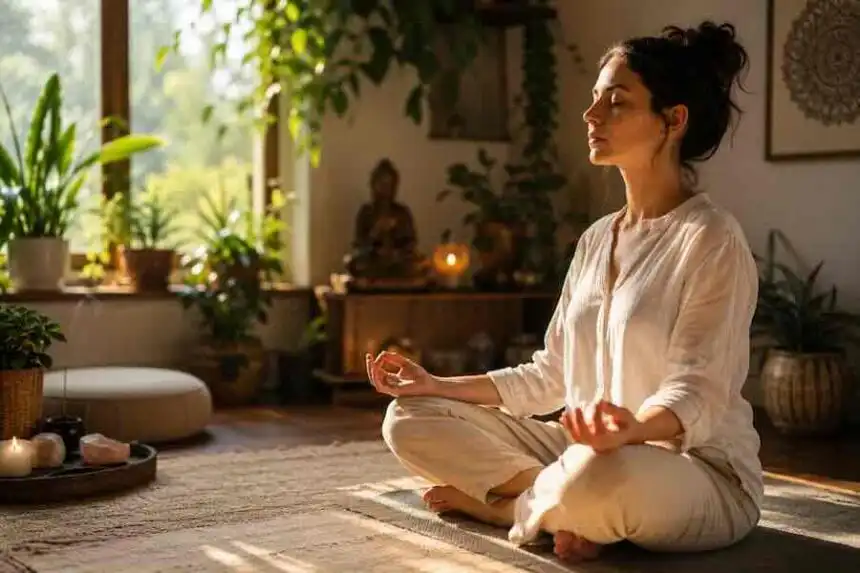

Healing meditation is often described in language that makes it sound almost medicinal: calm the mind, lower stress, help the body heal. The reality is more precise. Meditation cannot cure chronic illness or replace medical treatment, but mindfulness and meditation practices may help some people sleep problems, and certain forms of pain. That makes healing meditation most useful as a complementary practice rather than a promise of recovery.
- What Is Healing Meditation?
- How to Practice Healing Meditation
- What Healing Meditation May Help With
- Managing Stress
- Changing Your Relationship With Pain
- Creating Mental Space
- Supporting Attention and Mental Clarity
- A Gentle Guided Imagery Exercise for Pain and Tension
- 1. Settle Into the Body
- 2. Scan Without Trying to Fix Anything
- 3. Imagine Cooling Light
- 4. Bring the Image Toward Discomfort
- 5. Widen Your Attention
- 6. Return Slowly
- Where Meditation Fits Into Healthcare
- Conclusion: Think Support, Not Cure
- FAQ: Healing Meditation
The distinction matters. The mind and body constantly influence one another, but claims that meditation can directly repair damaged tissue, rewrite disease-causing biology, or function as the body’s own pharmacy go beyond what current evidence can reliably support. A calmer nervous system can still be valuable, especially when pain, stress, or poor sleep is making an already difficult health situation harder.
What Is Healing Meditation?
Healing meditation is not one standardized medical technique. The term is commonly used for meditation practices focused on relaxation, bodily awareness, visualization, breathing, compassion, or coping with physical and emotional discomfort.
Some approaches draw from long-established contemplative traditions, while modern programs may incorporate mindfulness, guided imagery, or structured breathing. The National Center for Complementary and Integrative Health notes that meditation and mindfulness have been studied for conditions including anxiety, depression, insomnia, and pain, although research quality and results vary.
That is a more useful way to understand the word “healing.” Meditation may change how you experience stress, discomfort, or difficult thoughts. It should not be interpreted as evidence that meditation itself is curing an underlying disease.
How to Practice Healing Meditation
You do not need special equipment, biometric data, a perfectly silent room, or an elaborate ritual. A simple practice that you can repeat consistently is usually more practical.
- Choose a comfortable place: Find somewhere relatively quiet where you are unlikely to be interrupted.
- Support your body: Sit in a chair, sit on the floor, or lie down if that is more comfortable. People dealing with chronic fatigue or pain should prioritize comfort rather than forcing a particular posture.
- Choose an anchor: Your breathing, bodily sensations, a repeated word, or a neutral visual point can give your attention somewhere to return.
- Start small: Five or ten minutes may be easier to sustain than immediately attempting a long meditation session.
- Notice rather than fight thoughts: Your mind will wander. Notice it, then gently return your attention to your chosen anchor.
- Pay attention to your response: Meditation should not become another source of pressure. Shorten or stop a session if it consistently makes you feel distressed or physically uncomfortable.
What Healing Meditation May Help With
The strongest reason to approach meditation as part of a wellness routine is not the promise of extraordinary biological transformation. It is its potential usefulness in areas where mental and physical experiences overlap.
Managing Stress
Stress can be felt physically: a tight jaw, shallow breathing, tense shoulders, racing thoughts, or difficulty sleeping. Meditation creates a deliberate period in which you can notice those reactions without immediately responding to every one of them.
For some people, that pause makes it easier to relax and regulate their response to everyday pressure. It can complement other habits that support quality of life, including movement, sleep, social connection, and appropriate medical care.
Changing Your Relationship With Pain
Pain is particularly complex because physical signals, attention, emotion, memory, and expectation can interact. Meditation cannot simply switch those signals off, but mindfulness practices may help some people relate differently to discomfort and pain relief.
That distinction is important for anyone living with persistent pain. Feeling calmer does not mean that an injury or medical condition has disappeared. New, severe, unexplained, or worsening pain still deserves appropriate medical assessment.
Creating Mental Space
Phones buzz. Messages arrive. Work follows us home. Meditation offers something increasingly scarce: several minutes without having to react.
Rather than thinking of this as an emotional “detox,” it may be more useful to see meditation as practice in observing thoughts and feelings without automatically following them. Anger can be noticed. Anxiety can be noticed. Neither needs to dictate the next few minutes.
Supporting Attention and Mental Clarity
Regular mindfulness practice involves repeatedly noticing when attention has wandered and directing it back. That deceptively simple exercise may support aspects of attention and emotional regulation, although dementia or other neurological diseases.
For evidence-based information about cognitive health and dementia risk, the Alzheimer’s Association provides guidance on brain health, risk factors, and current research.
A Gentle Guided Imagery Exercise for Pain and Tension
Guided imagery can provide a focal point when simply watching the breath feels difficult. The following exercise is designed for relaxation and coping with discomfort. It is not intended to numb warning signs, treat an injury, or replace pain management recommended by a healthcare professional.
1. Settle Into the Body
Find a position that supports you comfortably. Allow your breathing to settle into its natural rhythm. Notice the points where your body meets the chair, bed, cushion, or floor.
2. Scan Without Trying to Fix Anything
Move your attention slowly from your feet upward. Notice warmth, coolness, pressure, tingling, tension, or areas where you feel very little. There is no need to change the sensations. For now, simply notice them.
3. Imagine Cooling Light
Picture a soft blue light or mist around your feet. Imagine it moving gradually upward through your legs. You are not asking the image to physically heal anything. Let it represent calm, space, and a temporary release from having to fight every sensation.
4. Bring the Image Toward Discomfort
If there is an area of discomfort, allow the imagined light to surround it. Instead of demanding that the pain disappear, notice whether you can soften any tension around it. Perhaps the sensation changes. Perhaps it does not. Either response is fine.
5. Widen Your Attention
Gradually expand your awareness beyond the uncomfortable area. Feel your hands, feet, breathing, and the surface beneath you. Pain may be part of your present experience, but it does not have to occupy every part of your attention.
6. Return Slowly
Notice the sounds around you. Move your fingers and toes. Open your eyes when you are ready and give yourself a moment before standing or returning to another activity.
Where Meditation Fits Into Healthcare
Meditation works best when expectations remain realistic. It may sit alongside medication, psychotherapy, physical rehabilitation, sleep interventions, or other treatments recommended by qualified healthcare professionals. It should not be used to delay diagnosis or replace treatment for a medical or mental health condition.
There is also no requirement to force yourself through meditation because it is supposed to be healthy. Some people find inward-focused practices uncomfortable or distressing. Alternatives such as mindful walking, gentle movement, listening to music, or another grounding activity may feel more appropriate. Mindful movement can be particularly useful for people who dislike sitting still.
Conclusion: Think Support, Not Cure
The quiet appeal of healing meditation is not that the mind possesses a secret ability to cure every illness. It is that a few intentional minutes can change the atmosphere in which you experience stress, uncertainty, tension, and sometimes pain.
Keep the practice simple. Sit somewhere comfortable. Notice your breathing. Allow thoughts to arrive and leave. If visualization helps, use it. Then let meditation occupy its proper place: one supportive tool within a much larger picture of physical and mental healthcare.
FAQ: Healing Meditation
Can healing meditation cure an illness?
No. Meditation should not be presented as a cure for cancer, autoimmune disease, chronic pain conditions, or other illnesses. Research suggests meditation may help with certain symptoms and aspects of well-being, making it potentially useful as complementary care.
Can meditation replace prescribed medication?
No. Do not stop or alter prescribed medication because of meditation without discussing the change with the healthcare professional managing your treatment.
What if I cannot stop thinking while meditating?
You do not need to stop thinking. Noticing that your attention has wandered and gently returning it to your breath, body, or another anchor is part of the practice itself.
How long should I meditate?
There is no universally ideal duration. Beginners may find five to ten minutes manageable. A shorter practice you repeat consistently can be more useful than setting an ambitious target that makes meditation feel like another obligation.
What is the best time of day to meditate?
The most practical time is one you can maintain. Some people enjoy quiet morning meditation, while others use a short session after work or before bed. Consistency matters more than following a supposedly perfect hour.