







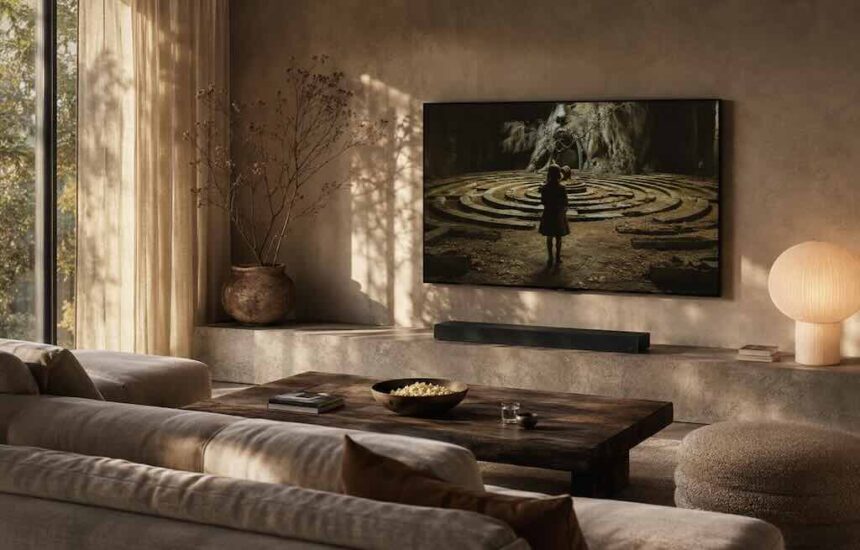
A hallway in Hong Kong glows red after midnight. Rain turns the streets of Tokyo silver. A family in Seoul climbs toward a house that seems to belong to another world. In Mexico, a child walks from political violence into a labyrinth where the monsters may be easier to understand than the adults.
- 1. In the Mood for Love — Hong Kong
- 2. City of God — Brazil
- 3. A Separation — Iran
- 4. Pan’s Labyrinth — Spain and Mexico
- 5. Parasite — South Korea
- 6. Pather Panchali — India
- 7. Amélie — France
- Why these seven films still matter in 2026
- The Divine seven-night world cinema experiment
- One rule: watch with subtitles, not dubbing
- Before you press play: check which version you found
- Three more if seven is not enough
- The practical takeaway
- Conclusion
- Frequently Asked Questions
Some films do more than survive their release year. They become doors.
For anyone building a serious watchlist before 2026 ends, international independent and auteur cinema offers an enormous landscape beyond the familiar Hollywood canon. The seven films below are not simply “foreign movies worth watching.” They are films whose visual language, storytelling or cultural impact changed what audiences expected cinema to do.
There is another reason to revisit them now. International cinema has become dramatically easier for American audiences to discover through streaming, restorations and boutique physical releases. A film that once required an art-house theater or imported DVD can now be sitting beside a studio blockbuster on the same television screen.
So consider this less a ranking than a seven-stop passport.
1. In the Mood for Love — Hong Kong
Director: Wong Kar-wai
Year: 2000
Start here if you like: romantic tension, immaculate cinematography, quiet heartbreak
Few films understand the erotic charge of almost touching quite like In the Mood for Love.
Set largely in 1960s Hong Kong, Wong Kar-wai’s film follows neighbors Chow Mo-wan and Su Li-zhen after they begin to suspect their spouses are having an affair. What develops between them is less a conventional romance than an exquisitely controlled study of longing.
The visual language is extraordinary. Narrow corridors. Patterned wallpaper. Mirrors. Cigarette smoke. Maggie Cheung moving through saturated reds and greens while Shigeru Umebayashi’s recurring music seems to slow the air around her.
The camera frequently watches through doorways and around corners, making the viewer feel simultaneously intimate with the characters and excluded from them.
Its reputation has only hardened with time. BFI’s Sight and Sound polling has repeatedly placed the film deep inside the modern cinematic canon, while filmmakers and critics continue to single out its use of color, composition, movement and restraint.
The detail to watch: pay attention to repetition. The same corridors, music and gestures return, but their emotional meaning keeps changing. Wong does not simply show time passing. He makes you feel what cannot be recovered from it.
Divine verdict: Watch it at night, with the lights low and your phone somewhere you cannot reach it.
2. City of God — Brazil
Directors: Fernando Meirelles and Kátia Lund
Year: 2002
Start here if you like: crime films, kinetic editing, sprawling ensemble stories
City of God does not gently introduce its world.
It drops you into it.
Set around Rio de Janeiro’s Cidade de Deus, the film traces overlapping lives across years of poverty, violence, ambition and organized crime. At its center is Rocket, a young man whose camera offers one possible route through a world where other boys are picking up guns.
The filmmaking moves with startling velocity. Freeze frames collide with handheld movement. Stories branch into other stories. Characters who initially appear incidental suddenly become essential.
Yet underneath that technical energy is something much colder: the way violence reproduces itself when children inherit the conditions created by adults.
The film became an international breakthrough and received four Academy Award nominations, including directing and cinematography.
The detail to watch: notice how photography changes meaning throughout the film. A camera begins as escape, becomes evidence and eventually turns the person holding it into someone capable of deciding what the outside world sees.
Divine verdict: Ferocious, uncomfortable and visually alive. More than two decades later, its editing still feels startlingly modern.
3. A Separation — Iran
Director: Asghar Farhadi
Year: 2011
Start here if you like: moral dilemmas, intimate drama, films that refuse easy answers
There are no dragons here. No serial killers. No elaborate cinematic universe.
Just people making decisions.
That becomes more stressful than almost any thriller.
Asghar Farhadi’s A Separation begins with a marriage coming apart. Simin wants to leave Iran with her daughter. Nader wants to remain and care for his father, who has Alzheimer’s disease.
From that apparently domestic conflict comes an increasingly intricate chain of choices involving another family, money, religion, class, responsibility and the unreliable ways people remember their own behavior.
The remarkable thing is how often your sympathies move.
Someone appears unquestionably right. Ten minutes later, another piece of information arrives. Then another.
The film won the Academy Award for Best Foreign Language Film and became a defining international success for contemporary Iranian cinema. Filmmaker Ritesh Batra later selected it for his Sight and Sound ballot, describing a film without simple heroes or villains.
The detail to watch: doors, windows and glass repeatedly divide people inside the frame. Characters can see one another while remaining separated by architecture, class, belief or incomplete information.
Divine verdict: The quietest film on this list may leave you arguing with yourself longest.
4. Pan’s Labyrinth — Spain and Mexico
Director: Guillermo del Toro
Year: 2006
Start here if you like: dark fantasy, gothic imagery, historical drama
The Pale Man remains terrifying.
But he may not be the film’s worst monster.
Guillermo del Toro’s Pan’s Labyrinth moves between fairy tale and the brutality of Francoist Spain, following young Ofelia as she arrives at a military outpost commanded by her mother’s new husband, Captain Vidal.
Below the human world waits another: stone passages, ancient creatures, insects becoming fairies and a faun offering Ofelia a series of tasks.
The film never uses fantasy simply as decoration. The imaginary and political worlds reflect each other. One contains monsters that look monstrous. The other contains people who do not.
Pan’s Labyrinth won three Academy Awards, including cinematography, art direction and makeup, and remains one of del Toro’s defining works. It also continues to appear on critics’ selections of essential modern cinema.
The detail to watch: compare the shapes of the two worlds. Del Toro uses curves and organic forms around Ofelia’s fantasy spaces while Vidal’s world repeatedly favors hard geometry, uniforms, machinery and control.
Divine verdict: Do not mistake it for children’s fantasy. This is a film about disobedience, imagination and what happens when authority becomes monstrous.
5. Parasite — South Korea
Director: Bong Joon Ho
Year: 2019
Start here if you like: thrillers, black comedy, social satire
If someone says they “don’t really watch subtitled movies,” this is the film to hand them.
Do not explain much else.
Parasite begins with the struggling Kim family living in a semi-basement apartment. Through a mixture of opportunity, improvisation and deception, family members gradually find employment inside the immaculate home of the wealthy Park family.
Then Bong changes the temperature.
Comedy tightens into suspense. Suspense turns darker. Architecture that initially looked beautiful begins revealing what it conceals.
The film made history at the 2020 Academy Awards by becoming the first non-English-language film to win Best Picture. It also won Best Director, Original Screenplay and International Feature Film.
Its reputation has not faded into Oscar trivia. Parasite continues appearing in critics’ and filmmakers’ selections of defining twenty-first-century cinema, praised for combining social critique with unusually precise genre filmmaking.
The detail to watch: stairs.
Characters are constantly moving upward or downward. The Parks occupy elevated space behind walls and gates. The Kims descend toward home. Another descent waits beneath even that.
Class is not simply discussed in Parasite.
It is built into the floor plan.
Divine verdict: Go in as cold as possible. If you somehow still do not know what happens, protect that ignorance.
6. Pather Panchali — India
Director: Satyajit Ray
Year: 1955
Start here if you like: humanist cinema, family stories, lyrical photography
A train appears in the distance.
For two children standing among tall grasses, it might as well be another planet.
Satyajit Ray’s debut feature Pather Panchali follows Apu, his older sister Durga and their impoverished family in rural Bengal. Its scale is intimate: food, rain, family tension, an elderly relative, childhood curiosity, small pleasures and losses that gradually become enormous.
The film helped introduce Ray to international audiences and became the first chapter of his celebrated Apu Trilogy. It remains a foundational work of Indian and world cinema and continues to appear prominently in international assessments of cinema history.
What makes it essential in 2026 is precisely what makes it resistant to aging. Ray is not rushing to manufacture plot every few minutes. He watches.
Wind moves through plants. Children run. Rain arrives. Faces change when somebody enters a room.
The extraordinary emerges from attention.
The detail to watch: the famous train sequence is often discussed as an iconic piece of cinema, but notice the children’s faces more than the train itself. Technology is impressive because we see it through people encountering a larger world.
Divine verdict: The oldest film here, and possibly the one that feels least interested in proving anything to you.
7. Amélie — France
Director: Jean-Pierre Jeunet
Year: 2001
Start here if you like: romance, Paris, visual whimsy, warm eccentricity
After six films involving betrayal, poverty, fascism, moral crisis and class warfare, we are allowed a crème brûlée.
Jean-Pierre Jeunet’s Amélie follows an intensely imaginative young waitress in Montmartre who quietly begins interfering in other people’s lives, engineering small moments of happiness while remaining far less capable of pursuing her own.
The film’s Paris is not documentary reality. Greens and reds glow. Streets feel polished by memory. Tiny pleasures — cracking the surface of crème brûlée, dipping a hand into grain, skipping stones — become cinematic events.
Audrey Tautou’s performance holds the entire construction together. Amélie can be mischievous, lonely, generous and emotionally evasive within the same sequence.
The film became an enormous international success, earned five Academy Award nominations and remains one of the most accessible entry points into modern French-language cinema.
The detail to watch: Jeunet frequently isolates tiny sensory experiences that conventional films would treat as background. That is the real philosophy of Amélie: a life can become larger when attention becomes smaller.
Divine verdict: Yes, it is whimsical. Watch closely and you will find loneliness underneath nearly every bright color.
Why these seven films still matter in 2026
Look across the list and something interesting happens.
None of these filmmakers needed the same visual language.
Wong Kar-wai compresses desire into narrow rooms. Fernando Meirelles and Kátia Lund accelerate through streets. Farhadi traps morality inside apartments and courtrooms. Del Toro builds fantasy beside fascism. Bong Joon Ho turns architecture into class politics. Ray waits for ordinary life to reveal itself. Jeunet transforms private eccentricities into color.
That is why “international cinema” is ultimately a slightly awkward category. These films have less in common with one another than the label suggests.
The common denominator is simply that Hollywood is not the center of their imagination.
The Divine seven-night world cinema experiment
If a list like this normally disappears into your bookmarks, try something more deliberate: seven nights, seven countries, no algorithm choosing what comes next.
Monday: Amélie. Start warm.
Tuesday: A Separation. Strip away the visual fantasy and watch people negotiate truth.
Wednesday: City of God. Increase the pulse.
Thursday: Pather Panchali. Slow everything down.
Friday: Parasite. Turn off notifications.
Saturday: Pan’s Labyrinth. Wait until dark.
Sunday: In the Mood for Love. End quietly.
By the end, the interesting question is not which film you liked most.
It is which country’s cinema you want to explore next.
One rule: watch with subtitles, not dubbing
When possible, choose the original-language soundtrack with subtitles.
An actor’s voice is part of the performance: breath, rhythm, hesitation, volume, regional accent. Dubbing can be useful for accessibility and certain viewing situations, but if you are approaching one of these films specifically for its performances, the original audio preserves more of what the director recorded.
After ten or fifteen minutes, something curious often happens.
You stop thinking about reading.
Before you press play: check which version you found
Classic international films increasingly exist in restored editions, and that can materially change the experience. Color grading, aspect ratio, subtitles and audio presentation can vary between releases.
This is particularly relevant with visually exacting films such as In the Mood for Love. When several editions are available, look for an established restoration or reputable distributor rather than automatically choosing the first upload or cheapest digital copy.
And because streaming catalogs change constantly by country, search the title immediately before watching rather than relying on an old “where to stream” article.
Three more if seven is not enough
Once these are crossed off, the next three on our list would be Seven Samurai from Japan, Persona from Sweden and Oldboy from South Korea.
They take you somewhere different again: Kurosawa toward the architecture of modern action cinema, Bergman toward psychological abstraction and Park Chan-wook toward operatic revenge.
Seven films will not make anyone an expert in world cinema.
They can make the next seven easier to find.
The practical takeaway
Do not try to “get into foreign films.” That category is too large to mean much.
Find the film here that resembles something you already love. If you like thrillers, begin with Parasite. Romance: In the Mood for Love. Fantasy: Pan’s Labyrinth. Crime: City of God. Intimate drama: A Separation. Quiet human stories: Pather Panchali. Something lighter: Amélie.
Then follow the director rather than the recommendation algorithm.
That is usually where the interesting journey begins.
Conclusion
A great film makes its place specific and its emotions borderless.
A basement window in Seoul. Tall grass in Bengal. A cramped apartment in Tehran. Red walls in Hong Kong.
You enter somewhere unfamiliar.
Two hours later, something in it feels strangely close to home.
Frequently Asked Questions
What are the best international films to watch in 2026?
A strong starting list includes In the Mood for Love, City of God, A Separation, Pan’s Labyrinth, Parasite, Pather Panchali and Amélie. Together they cover romance, crime, drama, fantasy, satire and humanist cinema across several filmmaking traditions.
What international movie should a beginner watch first?
Parasite is one of the easiest starting points for viewers accustomed to contemporary Hollywood thrillers because its pacing and genre shifts are immediately accessible. Amélie is another approachable option for viewers who prefer romance and comedy.
What is the best Korean film for beginners?
Parasite is an excellent entry point. Afterward, viewers interested in darker Korean cinema could move toward films such as Oldboy, Memories of Murder, Burning and The Handmaiden.
Should you watch international movies dubbed or subtitled?
For viewers able to use subtitles comfortably, the original-language soundtrack preserves the actors’ voices and vocal performances. Dubbing remains useful for accessibility and personal preference, but it changes one component of the original performance.
Is Parasite an independent film?
Parasite is better described as a South Korean auteur production and international film than as a tiny independent production in the American sense. “Indie” becomes imprecise when applied across different national film industries, which is why this list uses the term broadly while focusing on international and auteur cinema outside the traditional Hollywood studio canon.
Where can I stream these films?
Availability varies by country and changes frequently as licensing agreements expire. Search current listings in your region immediately before watching rather than relying on older streaming guides.