





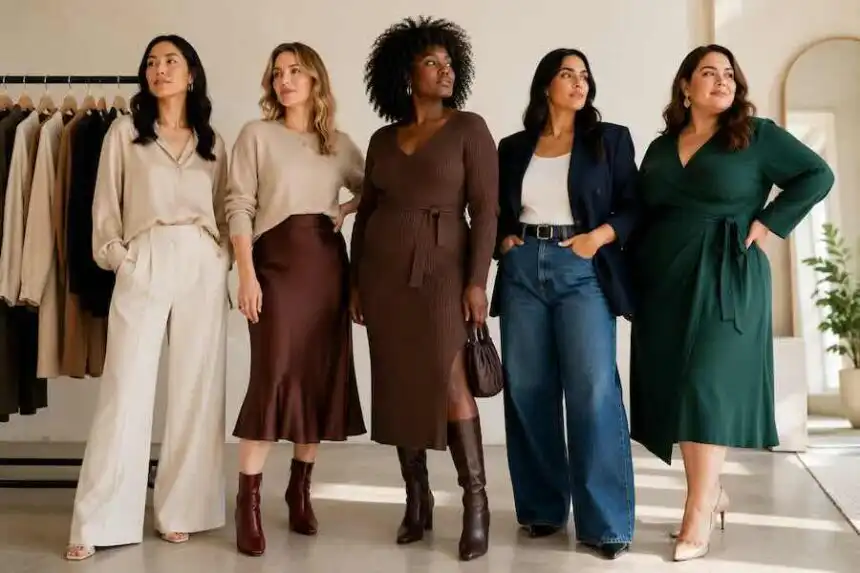
Great personal style does not begin with forcing your body into a prescribed silhouette. It begins with noticing proportion, texture, movement, and—most importantly—what makes you feel comfortable when you walk out the door.
- Why Body-Inclusive Styling Matters
- 1. Understand Your Body Shape Without Letting It Define You
- 2. Decide What You Want to Highlight
- 3. Use Proportion as a Creative Tool
- 4. Pay More Attention to Fit Than the Size Label
- 5. Let Fabric Do Some of the Styling
- 6. Use Layering to Change the Silhouette
- 7. Build Around Comfort You Can Actually Live In
- 8. Shop More Slowly and Learn Your Personal Fit
- Practical Takeaway: Create Your Own Styling Formula
- Conclusion: Style Is for Every Body
- FAQ: Styling for Different Body Types
Styling for different body types can be useful when it gives you a vocabulary for understanding clothes. It becomes much less useful when hourglass, pear, apple, rectangle, and inverted-triangle labels start behaving like rules. In 2026, the more interesting approach is personal: understand your proportions, then decide what you actually want to emphasize rather than what fashion convention says you should hide. :contentReference[oaicite:0]{index=0}
That might mean defining your waist one morning and deliberately ignoring it the next. It could mean a sharply tailored jacket, a loose column dress, or trousers wide enough to move beautifully as you walk. The point is choice. These practical styling ideas can help you dress comfortably while still looking stylish without treating your body as something that needs correcting.
Why Body-Inclusive Styling Matters
For decades, mainstream fashion presented an unusually narrow picture of who clothes were supposedly designed for. The problem was never that different silhouettes require different fits; bodies obviously have different proportions. The problem was turning those differences into a hierarchy.
Body-inclusive styling offers a more useful perspective. Instead of asking how to make yourself appear smaller, taller, thinner, or more conventionally proportioned, ask what you want the clothes to do.
Do you want structure? Movement? A defined waist? More volume? A clean vertical line? Something wonderfully oversized?
Once the question changes, getting dressed becomes considerably more creative.
1. Understand Your Body Shape Without Letting It Define You
Traditional body-shape categories can provide a quick reference point for understanding proportion. Think of them as descriptions rather than diagnoses.
- Hourglass: Bust and hips have relatively similar proportions with a more defined waist.
- Pear or triangle: Hips are proportionally wider than the upper body.
- Apple or round: More volume is carried through the torso or midsection.
- Rectangle: Shoulders, waist, and hips create a relatively straight silhouette.
- Inverted triangle: Shoulders or bust are proportionally broader than the hips.
Real bodies rarely fit perfectly inside geometric categories. Height, torso length, shoulder width, bust, hips, leg length, mobility, and personal preference all influence how a garment sits.
Use the category if it helps you understand why one jacket hangs differently from another. Forget it the moment it starts telling you what you are allowed to wear.
2. Decide What You Want to Highlight
Older styling advice frequently begins with camouflage. A more enjoyable wardrobe begins with emphasis.
If you love your waist, a wrap dress, cropped jacket, high-rise trouser, or belt can bring attention there. If you like your shoulders, try a clean boat neckline, sleeveless tailoring, or an off-the-shoulder silhouette. A V-neck can create an open line through the upper body, while cropped trousers and skirts can make footwear and ankles part of the composition.
You can also highlight something simply because the garment itself is beautiful. An oversized cobalt sleeve does not need to make anyone look thinner. Sometimes it can just be an oversized cobalt sleeve.
3. Use Proportion as a Creative Tool
Proportion changes how an outfit reads before color or accessories even enter the picture.
A fitted top with wide-leg trousers creates one relationship. An oversized shirt over a narrow skirt creates another. A long coat worn open establishes strong vertical lines, while a cropped jacket visually shifts the waistline upward.
If you want to visually balance wider hips, adding structure or volume around the shoulders is one option. If your shoulders are broader and you want greater volume below, wide-leg trousers and A-line skirts can create it. Rectangle silhouettes can introduce definition through belts, tailoring, gathering, or peplum shapes.
None of these techniques are obligations. You do not have to “balance” anything. They are simply ways of manipulating silhouette when that is the effect you want.
4. Pay More Attention to Fit Than the Size Label
The number sewn into a garment is considerably less important than what happens when the fabric meets your body.
Check the shoulders first on structured jackets and coats. Look at whether trousers pull across the hips or collapse around the waist. Sit down in dresses before deciding whether they fit. Raise your arms. Walk. Bend. Clothes exist in motion.
A tailor can also transform an almost-right garment. Adjusting a hem, waist, sleeve, or trouser length may produce a better result than repeatedly searching for a theoretically perfect ready-to-wear size.
5. Let Fabric Do Some of the Styling
Fabric changes silhouette as much as cut does.
Denim, twill, structured cotton, and heavier wool tend to hold their architecture. Silk, modal, lightweight knits, and lyocell-based fabrics move closer to the body’s natural lines. Stretch can provide additional ease, particularly in garments intended for long days or frequent movement.
Texture matters too. Crisp poplin catches light differently from brushed wool. Satin reflects it. Ribbed knit creates narrow shadows. Linen softens as it is worn.
Instead of choosing fabric solely because it is supposedly “flattering,” consider how you want the garment to behave. Should it stand away from your body or move with it?
6. Use Layering to Change the Silhouette
Layering is one of the simplest ways to experiment without rebuilding your wardrobe.
An open jacket or cardigan creates vertical lines through the torso. A cropped knit changes the perceived waist. A longer shirt beneath a shorter jacket introduces another horizontal break. Scarves, jewelry, bags, and belts can move the visual focal point without changing the foundation of the outfit.
This is where experimentation becomes particularly useful. Photograph a few combinations rather than judging them only in the mirror. Small changes in jacket length, trouser rise, shoe shape, or necklace scale can alter the entire composition.
7. Build Around Comfort You Can Actually Live In
An outfit that looks immaculate while standing perfectly still but becomes irritating after 20 minutes is not especially successful.
Comfort includes more than softness. Waistbands should stay where you want them. Straps should remain secure. Shoes should support the amount of walking your day requires. Jackets should allow your arms to move. Fabrics should make sense for the temperature.
This practical layer of styling is easy to overlook because photographs freeze clothes in ideal positions. Daily life does not.
8. Shop More Slowly and Learn Your Personal Fit
One advantage of understanding your proportions is that shopping can become more selective.
Measure garments you already love and compare those measurements when shopping online. Note your preferred trouser rise, jacket length, shoulder width, and skirt length. Read size charts instead of automatically ordering the same numerical size across different labels.
Then consider repetition. A beautifully cut jacket that works with ten outfits may deserve more wardrobe space than five trend pieces that never feel quite right.
This approach can support more intentional consumption too. Buying fewer pieces that fit, function, and genuinely suit your taste is often more useful than constantly replacing clothes purchased to satisfy temporary styling rules.
Practical Takeaway: Create Your Own Styling Formula
Instead of memorizing dozens of rules for your body type, identify three or four outfit formulas that consistently make you feel good.
Perhaps yours is wide-leg trousers, a tucked knit, and a structured coat. Maybe it is a fluid midi dress with flat boots and an oversized jacket. Or straight denim, a crisp shirt, and sculptural jewelry.
Once you know those foundations, experimentation becomes easier. Change the fabric. Push the color. Alter the proportions. Add something unexpected.
Conclusion: Style Is for Every Body
Body-inclusive style works best when it gives you more choices, not another collection of restrictions.
Understanding proportion can help. Knowing how fabric behaves can help even more. A good tailor, accurate measurements, comfortable shoes, and a clear sense of what you actually enjoy wearing can quietly change an entire wardrobe.
Your body does not need to earn access to fashion by resembling an ideal silhouette. Clothes are the variable. Let them do the adapting.
FAQ: Styling for Different Body Types
Do I need to know my body shape to dress well?
No. Body-shape categories can help explain proportion, but they are optional tools rather than styling requirements. Fit, comfort, personal taste, and the silhouette you want to create are more important.
What clothes are flattering for every body type?
There is no universal garment that produces the same effect on every body. Look instead for clothes that fit correctly, allow comfortable movement, and create proportions you enjoy. Tailoring can make a significant difference.
Can I wear oversized clothing if I have a curvy body?
Absolutely. Oversized clothing can look intentional on any body. Pay attention to proportion, garment length, fabric weight, and where you want volume. You can combine an oversized piece with something more fitted, or embrace volume throughout the outfit.
How can I make online clothes shopping easier?
Keep your current measurements and compare them with each brand’s size chart. Measuring a few garments that already fit you well can be even more useful because you can compare garment-to-garment dimensions rather than relying only on body measurements.
How can I feel more confident experimenting with fashion?
Start from an outfit formula you already enjoy and change one element at a time: color, proportion, texture, accessories, or footwear. Confidence often comes from familiarity and experimentation rather than following a prescribed set of fashion rules.