






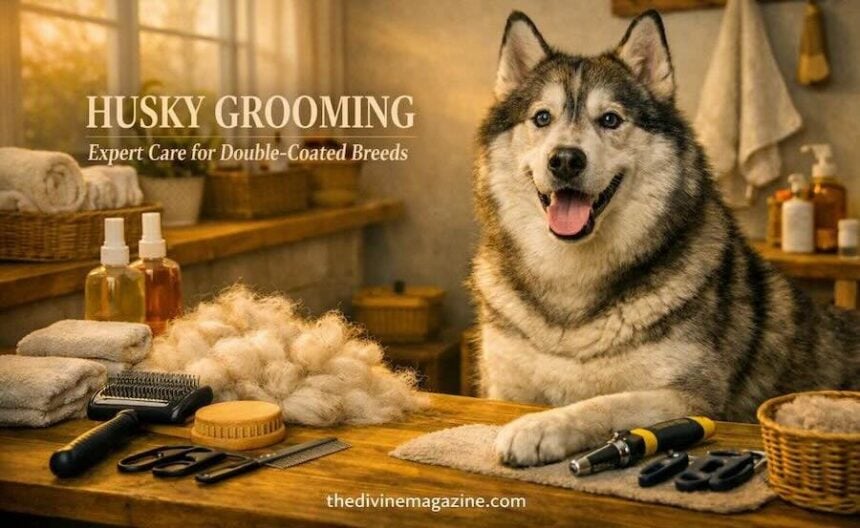
Living with a Siberian Husky means accepting a certain amount of beautiful chaos. There is the endless energy, the expressive personality, the dramatic conversations—and, of course, the fur.
- The Double Coat Is a Feature, Not a Problem
- Why Seasonal Shedding Feels So Intense
- What a Complete Husky Grooming Session Should Include
- Not Every Husky Responds to Grooming the Same Way
- What “Husky Groomers Near Me” Should Really Mean
- A More Thoughtful Experience at Rebel Tails
- Home Care Still Matters
- A Healthy Coat, Without the Shortcut
During seasonal shedding, that fur seems to appear everywhere at once. It gathers beneath furniture, floats across freshly cleaned floors, and somehow finds its way onto clothes stored in closed closets. Searching for “husky grooming near me” may begin as an attempt to reclaim the living room, but professional grooming offers benefits that go far beyond a cleaner home.
A Husky’s coat is not simply decorative. It is a sophisticated natural system that requires knowledgeable, breed-appropriate care.
The Double Coat Is a Feature, Not a Problem
A Husky has two distinct layers of fur. The dense undercoat provides insulation, while the straighter outer coat helps protect the skin from moisture, dirt, and environmental exposure.
Together, these layers help the dog adjust to changing temperatures. This is why responsible grooming is focused on removing loose undercoat—not removing the coat itself.
Shaving may seem like a logical solution during warm weather or an intense shedding season, but it can interfere with the natural structure of the coat. Unless shaving is medically necessary or required because of severe matting, a Husky generally benefits more from thorough brushing, bathing, controlled drying, and professional deshedding.
The goal is not to redesign the dog. It is to help the existing coat function as it should.
Why Seasonal Shedding Feels So Intense
Most Husky owners eventually become familiar with the phrase “blowing coat.” This is the period when the dog releases a large amount of undercoat to prepare for a seasonal change.
At first, small tufts may appear around the hindquarters, shoulders, and sides. Soon, loose fur can be lifted out in handfuls. Ordinary surface brushing may remove some of it, but much of the dead undercoat remains trapped beneath the outer layer.
That buildup can make the coat feel heavy and uneven. It may also limit airflow near the skin and create areas where moisture or debris can linger.
Professional husky grooming addresses the coat layer by layer. A complete session can loosen compacted undercoat, remove dead hair, clean the skin, and restore the coat’s lighter, more balanced texture.
What a Complete Husky Grooming Session Should Include
A proper appointment is more involved than a quick shampoo and towel dry. The products, tools, water pressure, drying technique, and handling style all matter.
Depending on the dog’s coat condition, a grooming session may include:
- A detailed coat and skin assessment
- Deep brushing and undercoat removal
- Bathing with coat-appropriate shampoo and conditioner
- High-velocity drying without excessive heat
- Removal of loose fur released during the bath
- Nail trimming and filing
- Ear cleaning
- Paw pad and sanitary-area detailing
- Light trimming of untidy areas when appropriate
High-velocity drying is especially valuable for dense-coated breeds. It helps separate the coat, release undercoat loosened during bathing, and dry the fur thoroughly without relying on extreme heat.
The finished coat should look clean, full, and natural—not sculpted into a different breed.
Not Every Husky Responds to Grooming the Same Way
Huskies are intelligent, independent, and famously expressive. Some enjoy brushing and attention. Others object loudly to water, dryers, nail care, or simply being asked to remain in one place.
This does not automatically make a dog “difficult.” It often means the grooming process needs to be predictable, patient, and adapted to that individual animal.
Experienced husky groomers pay attention to body tension, breathing, movement, and changes in behavior. They know when to continue, when to provide a break, and when a session should be adjusted.
For puppies and first-time clients, a calm introduction can be more valuable than trying to complete every possible service in one visit. Positive, consistent experiences help grooming become familiar rather than frightening.
What “Husky Groomers Near Me” Should Really Mean
Convenience matters, but the nearest salon is not always the right salon for a double-coated dog.
When comparing professionals after searching husky groomers near me look beyond distance and availability. Ask whether the team works regularly with northern breeds and heavy shedders. Find out how they remove undercoat, whether they use excessive heat, and how they respond when a dog becomes anxious.
A knowledgeable groomer should be comfortable explaining why shaving is generally avoided and what can realistically be achieved during one appointment.
Transparency is equally important. Owners should understand which services are included, how long the process may take, and whether additional work could be required because of coat density, matting, or peak shedding.
A More Thoughtful Experience at Rebel Tails
Rebel Tails provides specialized Husky grooming in Morrisville, North Carolina, with an approach designed around coat health and canine comfort.
The salon works with Huskies and other double-coated breeds, offering deep brushing, undercoat removal, coat-safe bathing, high-velocity blow-drying, nail care, ear cleaning, and practical hygiene detailing. The objective is a clean, healthy coat rather than a shaved shortcut.
The environment is cage-free, and appointments are organized to reduce long periods of waiting. Rebel Tails uses a team-based approach in which the groomer can focus on technical coat care while an assistant helps with calm, controlled handling. The team also monitors each dog’s physical and emotional responses and may slow down or modify the procedure when necessary.
This individualized care can be especially important during a heavy coat blow, when a long-haired Husky may require significantly more time than an average grooming appointment. Coat condition, seasonal shedding, and the dog’s behavior all affect the length and complexity of the service.
Home Care Still Matters
Professional appointments are most effective when supported by a consistent home routine.
Brush the coat regularly, paying particular attention to the hind legs, tail, neck, and areas behind the ears. Work gently in sections instead of dragging a tool through the entire coat at once.
Avoid bathing too frequently without a reason, and always make sure the dense undercoat dries completely. Moisture trapped near the skin can contribute to irritation and unpleasant odors.
Your groomer can recommend suitable tools and a realistic appointment schedule based on your dog’s coat. During peak shedding, more frequent maintenance may make each session easier for both the Husky and the owner.
A Healthy Coat, Without the Shortcut
Husky grooming is not about making a naturally fluffy dog shed-free. That promise would be unrealistic. It is about controlling loose undercoat, supporting skin and coat health, improving comfort, and making seasonal shedding more manageable.
Rebel Tails combines double-coat knowledge with patient handling and a transparent, comfort-focused environment. For local Husky owners looking for more than a basic bath, a professional coat assessment is the ideal first step toward a cleaner home, a healthier coat, and a calmer grooming routine.