







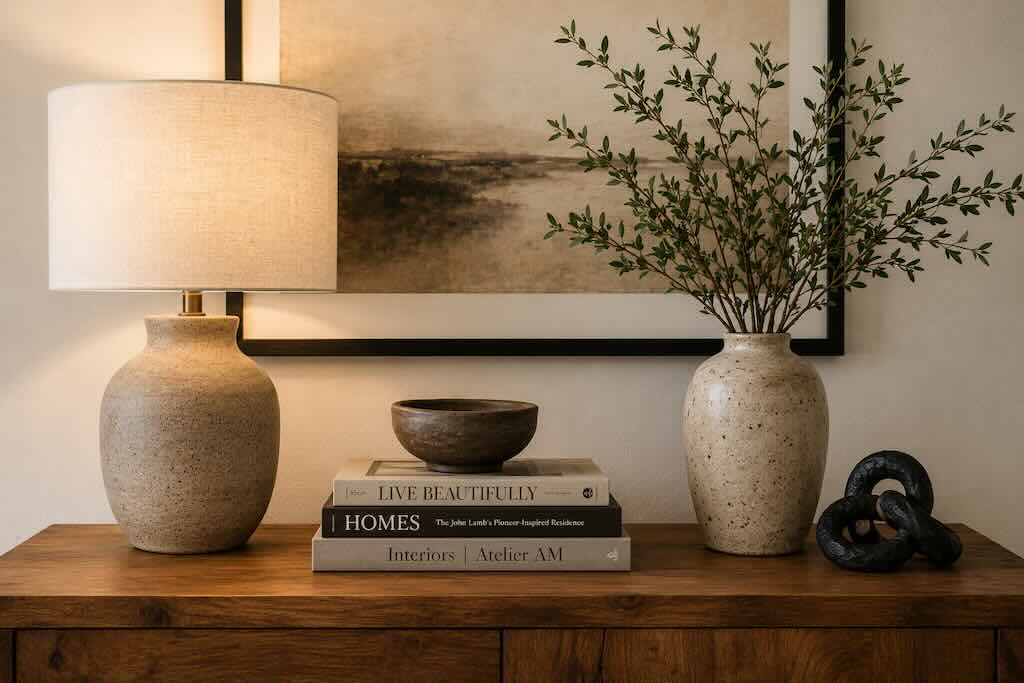
Put two candlesticks on a console and the arrangement can feel formal. Add a third object — perhaps a low ceramic bowl — and something shifts. The surface feels less staged. Your eye begins moving between the objects instead of reading them as a pair.
- Why three objects look different from two
- Three identical objects aren’t necessarily enough
- Try it on the surface that’s bothering you
- Books can count as one object
- Shelves need rhythm, not rows of trios
- The rule works beyond small accessories
- Color can hold mismatched objects together
- Five can work when three feels too small
- Sometimes two is better
- The best version doesn’t look like a rule
- FAQ
Interior designers use this idea constantly. Three vases on a shelf. Three cushions across a sofa. A lamp, a stack of books and a small sculpture on a side table.
It’s usually called the rule of three: the practice of arranging decorative elements in groups of three, or more broadly in odd numbers, to create compositions that feel balanced without becoming rigidly symmetrical.
The useful part isn’t the number itself. It’s what three allows you to do with height, shape, texture and empty space.
Why three objects look different from two
Pairs naturally create symmetry. Two matching lamps on either side of a console can look beautiful precisely because they’re orderly and predictable.
Three introduces another relationship.
A tall vase beside a medium candle and a low bowl creates several heights for the eye to follow. Instead of moving directly from left to right, your gaze travels around the arrangement.
This is why designers often arrange trios loosely as a triangle rather than placing three identical objects in a straight line. Interior designers speaking to Homes & Gardens about the rule of three describe using triangular compositions, different silhouettes and contrasting scales to turn separate objects into a coherent display.
The arrangement has structure, but it doesn’t immediately announce the structure.
Three identical objects aren’t necessarily enough
Take three matching white vases of exactly the same height and line them up on a shelf. Technically, you’ve followed the rule. Visually, you may have created little more than repetition.
Now keep one tall vase, replace another with a rounded vessel and make the third object a small stoneware bowl. Stay within a similar palette.
The display becomes more interesting because the objects share something while differing elsewhere.
Height is particularly useful. Designers interviewed by Architectural Digest recommend varying scale, height and thickness when styling surfaces, while also using odd-numbered groupings to create visual interest.
You don’t need three statement pieces competing for attention. Often one object provides height, another supplies visual weight and the smallest gives the eye somewhere to finish.
Try it on the surface that’s bothering you
The easiest place to understand the rule is a console, sideboard or coffee table.
Clear the surface first. Then choose three things with noticeably different profiles.
On an entryway console, that could be a lamp, a shallow bowl and a vase with a branch. On a coffee table, try a stack of books, a small sculptural object and a vessel. On a bedside table, the lamp may already count as the tallest element; a book and one smaller object can complete the composition.
Move them closer together than instinct initially suggests. Objects scattered evenly across an entire surface often read as separate pieces of clutter. A tighter cluster reads as a deliberate group and leaves some of the tabletop exposed.
That empty area matters. Negative space gives the arrangement a boundary without requiring a tray, box or other container to define it.
Books can count as one object
The arithmetic doesn’t need to become absurd.
Three books stacked together can function visually as a single element. So can a vase filled with several branches, a bowl of fruit or a collection of small objects placed on one tray.
Think in terms of visual masses rather than counting every individual item.
A stack of books creates a low horizontal shape. Put a small ceramic piece on top and it can still read as one layered element within a larger arrangement. Add a tall vase beside it and a medium-sized candle nearby, and you have three distinct forms without making the surface feel sparse.
Shelves need rhythm, not rows of trios
Bookshelves are where the rule of three can become too obvious.
Three objects on every shelf quickly produce their own kind of monotony. Instead, vary the density. One shelf might hold a substantial ceramic vessel beside several books. Another can carry three smaller objects. Leave part of the next shelf almost empty.
Architectural Digest’s advice on bookshelf styling includes using trios in varying sizes and materials, while other designers emphasize changing the position and scale of similar objects from shelf to shelf.
Stand several steps away while you’re arranging things. Up close, you see individual objects. From across the room, you see their collective weight.
If one side looks dense and dark while the other is mostly pale and empty, moving a single vase may improve the shelf more than adding anything new.
The rule works beyond small accessories
Three doesn’t have to mean three ornaments.
Three pendant lights can define a kitchen island. Three framed works can occupy a long stretch of wall. Three cushions of different proportions can soften one end of a sofa. A large plant, floor lamp and chair can form a quiet reading corner.
The scale changes, but the principle remains recognizable: several elements relate closely enough to be read as a composition.
Artwork is particularly forgiving. Three matching frames create clear repetition, while three pieces with different dimensions can produce a looser arrangement. The surrounding furniture should influence which version feels appropriate.
Color can hold mismatched objects together
Objects don’t need to belong to the same collection.
A smoked-glass vase, an old wooden box and a small bronze object can sit comfortably together if their tones share warmth. A glossy white vessel, pale stone bowl and clear glass candle holder may connect through a cooler, quieter palette.
This is useful when styling things you already own. Rather than buying three coordinated accessories, look for an existing connection: material, color, shape or mood.
Then introduce contrast elsewhere.
If all three pieces are ceramic, vary their height and silhouette. If the shapes are similar, mix the materials. If everything is neutral, a branch or plant can introduce an irregular organic form.
Five can work when three feels too small
The rule of three belongs to a broader decorating habit of using odd-numbered groupings. On a long mantel, substantial dining table or large shelving unit, three small objects may simply lack enough presence.
Five can give you more range without losing the asymmetry that makes these arrangements interesting. Designers also use seven when working with larger collections, although the more objects you introduce, the more important spacing and visual hierarchy become.
Don’t turn five into five equally spaced objects marching across a shelf. Cluster some closely. Let one stand slightly apart. Vary the heights.
The number gives you a starting framework, not a diagram.
Sometimes two is better
A pair of lamps flanking a bed has a clarity that a trio wouldn’t improve. Two armchairs facing a fireplace can reinforce the architecture of a room. A pair of large artworks may be exactly what a wall needs.
Symmetry can feel calm, architectural and intentional. There is no reason to disrupt it merely to satisfy a decorating rule.
The rule of three becomes most useful when a surface feels stiff, scattered or unfinished. It gives you a quick way to test another composition without buying anything.
Remove the fourth candle. Bring the three remaining objects closer together. Put the tallest one slightly behind the others. Step away.
You may prefer the original arrangement. If so, put it back.
The best version doesn’t look like a rule
A beautifully styled room rarely looks as though someone has been counting.
There may be three objects on the console and five on a shelf, but what you actually notice is the space between them. A tall stem against a plain wall. Rough ceramic beside smooth glass. A dark object giving weight to a pale tabletop.
Three simply makes those relationships easier to arrange.
So when a shelf or table feels slightly wrong, don’t immediately shop for another accessory. Take everything off. Choose three pieces you already like. Change their heights, pull them together and leave a little space around them.
The room may not need more.
It may just need a better arrangement.
FAQ
What is the rule of three in interior design?
The rule of three is a styling principle that groups decorative elements in threes. Designers often vary the objects’ height, shape, scale or texture so the arrangement feels connected without becoming completely symmetrical.
Why do designers decorate in odd numbers?
Odd-numbered arrangements make asymmetry easy to introduce while still allowing a display to feel balanced. Three is particularly practical because it creates enough variation for a composition without requiring many objects.
Do three decorative objects need to match?
No. They often look more interesting when they differ in height, shape or material. Giving the pieces one shared quality, such as a similar color palette or material, can help connect them.
Can you use five objects instead of three?
Yes. Larger surfaces and collections may suit groups of five or seven. The same basic approach applies: vary scale and height, create a clear relationship between the objects and leave enough empty space for the arrangement to breathe.