






Back in 2018, streaming still felt like the challenger. Cable television dominated the living room, smartphones were becoming secondary screens, and “cord-cutting” sounded like a rebellious alternative rather than the direction of travel. Nine years later, the hierarchy has flipped.
- Streaming Is Now the Main Screen, Not the Alternative
- The Smart TV Replaced the Old Entertainment Hub
- YouTube Became Television
- Free Television Is Returning Through FAST Channels
- Cable Is Smaller, but It Is Not Dead
- Live Sports Are Holding the Ecosystem Together
- Mobile Is Still Important, but the Living-Room Screen Won
- Advertising Has Followed the Audience
- Piracy Is No Longer the Defining Streaming Story
- Social TV Moved Beyond Live-Tweeting
- What Changed Since 2018?
- The Practical Takeaway
- Conclusion: Television Did Not Die — It Changed Its Delivery System
- Frequently Asked Questions
In 2026, streaming is the largest single category of television viewing in the United States. Smart TVs have become the default gateway to entertainment, free ad-supported channels are growing quickly, live sports now move between traditional networks and streaming platforms, and YouTube competes directly with the biggest media companies for television watch-time.
Streaming Is Now the Main Screen, Not the Alternative
The biggest change since 2018 is measurable. According to Nielsen’s May 2026 Gauge report, streaming represented 48.6 percent of total U.S. television watch-time. Broadcast accounted for 19.2 percent and cable 20.4 percent.
That would have sounded extraordinary when this article was first published. At the time, digital viewing was still described largely through services such as Netflix, Hulu and YouTube competing with traditional television. Today, those platforms are television for a substantial part of the audience.
The screen itself has not disappeared. What changed is what arrives through it.
The Smart TV Replaced the Old Entertainment Hub
In 2018, using a PC or games console as an entertainment hub still felt like a distinctly tech-minded setup. Modern television has absorbed much of that function directly into the display.
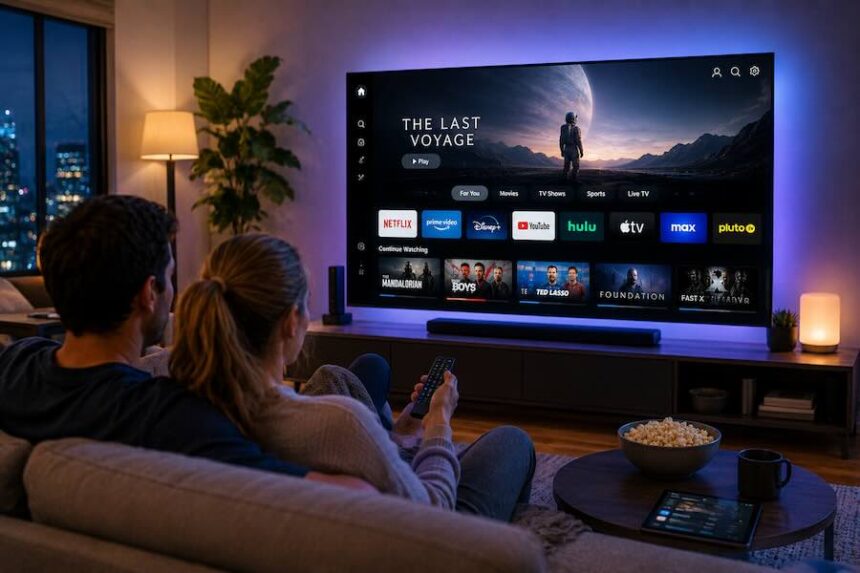
Smart TVs now place streaming apps, live channels, rentals, games and music behind one interface. Separate boxes and consoles remain useful, but they are no longer required simply to turn a television into a connected device.
The practical result is that the modern television behaves more like a media operating system than a passive screen. Viewers increasingly begin with a home screen and choose a service, rather than beginning with a channel number.
YouTube Became Television
Perhaps the clearest sign of how much viewing habits have changed is YouTube. Once associated primarily with laptops and mobile phones, it now commands enormous television viewing time.
In May 2026, Nielsen reported that YouTube represented 13.8 percent of total U.S. TV watch-time, putting it ahead of every other individual media distributor measured that month.
That changes the meaning of television content itself. A favorite show might still be a scripted network drama, but it could just as easily be a long-form video essay, creator-led series, podcast recording or live stream watched on a 65-inch screen from the sofa.
Free Television Is Returning Through FAST Channels
Streaming initially sold itself through a simple proposition: pay a monthly fee and avoid traditional television advertising. That model has changed dramatically.
Free ad-supported streaming television, commonly known as FAST, now offers scheduled channels without a conventional cable subscription. Services such as Pluto TV and The Roku Channel combine familiar linear-style browsing with internet delivery.
The Roku Channel alone reached 3.1 percent of total U.S. television viewing in May 2026, according to Nielsen. Meanwhile, ad-supported viewing remains significant across the wider market. Nielsen’s Q1 2026 Ad Supported Gauge found that nearly 73 percent of total television viewing was ad-supported.
In other words, television did not eliminate commercials. It redistributed them.
Cable Is Smaller, but It Is Not Dead
The old cord-cutting conversation often imagined cable disappearing almost entirely. The reality is more complicated.
Cable’s share has fallen considerably, but news and live sports continue to give it moments of concentrated strength. In January 2026, for example, cable still represented 21.2 percent of U.S. TV usage, helped by college football, news and other major live programming.
The more accurate story is fragmentation. Viewers now move between broadcast, cable, subscription streaming, free streaming and online video depending on what they want to watch.
Live Sports Are Holding the Ecosystem Together
If one form of programming still makes viewers care about a precise start time, it is live sport.
Yet even sports no longer belong neatly to traditional television. Prime Video, Peacock, Netflix and other streaming platforms increasingly carry major live events alongside established broadcasters and sports networks.
Prime Video reached a platform-best 4.5 percent of U.S. television usage in May 2026, with Nielsen attributing a substantial part of that performance to NBA playoff games, WNBA coverage and NASCAR events. Streaming and linear television are no longer separate sports worlds.
The 2026 FIFA World Cup reinforced the enduring pull of scheduled television too. Nielsen reported that World Cup matches generated more than 84 billion viewing minutes across FOX, FS1 and Telemundo properties during June.
Mobile Is Still Important, but the Living-Room Screen Won
One of the original 2018 assumptions was that smartphones and tablets might become the primary force changing television. Mobile viewing certainly became normal, but it did not make the television itself obsolete.
Instead, streaming migrated back onto the largest screen in the home. Apps that began on phones, tablets and computers now sit directly beside broadcast inputs on connected televisions.
Mobile remains valuable for viewing while commuting, travelling or moving around the house, but premium series, movies and sports still benefit from the scale, sound and comfort of a dedicated television setup.
Advertising Has Followed the Audience
The subscription-only streaming model has become harder to maintain as platforms search for growth. Netflix, Disney+, Peacock, Paramount+, Prime Video and other services have increasingly embraced advertising in one form or another.
Among U.S. adults aged 18 to 49, Nielsen reported in March 2026 that streaming accounted for 66.7 percent of their time spent with ad-supported television. Within streaming itself, 81.1 percent of viewing among that demographic occurred on ad-supported tiers or platforms included in Nielsen’s analysis.
The result feels strangely familiar. Viewers escaped traditional commercial television, only to encounter a more personalised version of advertising inside streaming.
Piracy Is No Longer the Defining Streaming Story
The 2018 version of this article gave significant attention to illegal downloads and unauthorised streaming, particularly around high-demand shows such as Game of Thrones. Piracy still exists, but it is no longer the most useful lens through which to understand mainstream television technology.
The bigger consumer problem in 2026 is fragmentation. A household may need several subscriptions to follow different series, films and sports competitions, while rights frequently move between platforms. Finding where something is available can sometimes feel as complicated as finding something to watch.
Social TV Moved Beyond Live-Tweeting
In 2018, “social television” often meant watching a programme while discussing it on Twitter. That behaviour helped turn premieres and finales into communal events.
In 2026, the conversation is distributed across short-form video, reaction clips, creator commentary, memes, podcasts and fan communities. A series can continue occupying the culture long after an episode ends because discussion becomes content of its own.
Ironically, streaming’s on-demand convenience has also made genuine simultaneous viewing feel more valuable. Sports, finales, reality competitions and major cultural broadcasts still create moments where millions of people want to watch at approximately the same time.
What Changed Since 2018?
- Streaming moved from challenger to leader: it now represents close to half of U.S. television watch-time.
- Smart TVs became standard: the television itself now acts as the entertainment hub.
- YouTube moved onto the big screen: creator-led video now competes directly with traditional media companies for television attention.
- Free streaming expanded: FAST services recreated the channel-surfing experience without conventional cable.
- Advertising returned: ad-supported streaming tiers are now central to the market.
- Sports became multi-platform: major events increasingly move between streaming, broadcast and cable.
The Practical Takeaway
The modern American television setup does not require every available subscription. Start with what your household genuinely watches. A smart TV and one or two paid services may cover most needs, while FAST platforms and free online video can fill the gaps.
Sports fans need to pay closer attention to rights because individual leagues and competitions may sit across several services. Everyone else can benefit from rotating subscriptions rather than maintaining a permanent stack of monthly fees.
Conclusion: Television Did Not Die — It Changed Its Delivery System
The television set survived every prediction of its disappearance. What faded was the assumption that one cable connection would determine almost everything appearing on it.
In 2026, the American living room contains broadcast television, cable, streaming subscriptions, free channels, YouTube, live sports and creator media inside the same interface. The box is still there. It simply became a doorway to almost everything.
Frequently Asked Questions
Is streaming more popular than cable in the United States?
Yes. Nielsen reported streaming at 48.6 percent of U.S. television watch-time in May 2026, compared with 20.4 percent for cable.
Are people still watching traditional broadcast television?
Yes. Broadcast television remains significant, particularly for news, sports and major live events. Its share is smaller than streaming, but high-profile programming can still draw very large audiences.
What are FAST channels?
FAST stands for free ad-supported streaming television. These services provide internet-delivered channels supported by advertising rather than a traditional cable subscription.
Do you still need a streaming device with a smart TV?
Not necessarily. Most modern smart TVs include major streaming apps directly. Separate streaming devices can still be useful if you prefer their interface, need additional apps or want to replace an older television’s software experience.
Why are streaming services adding advertisements?
Advertising gives platforms another source of revenue while allowing them to offer lower-priced or free viewing options. Ad-supported streaming has become a substantial part of the U.S. television market.