
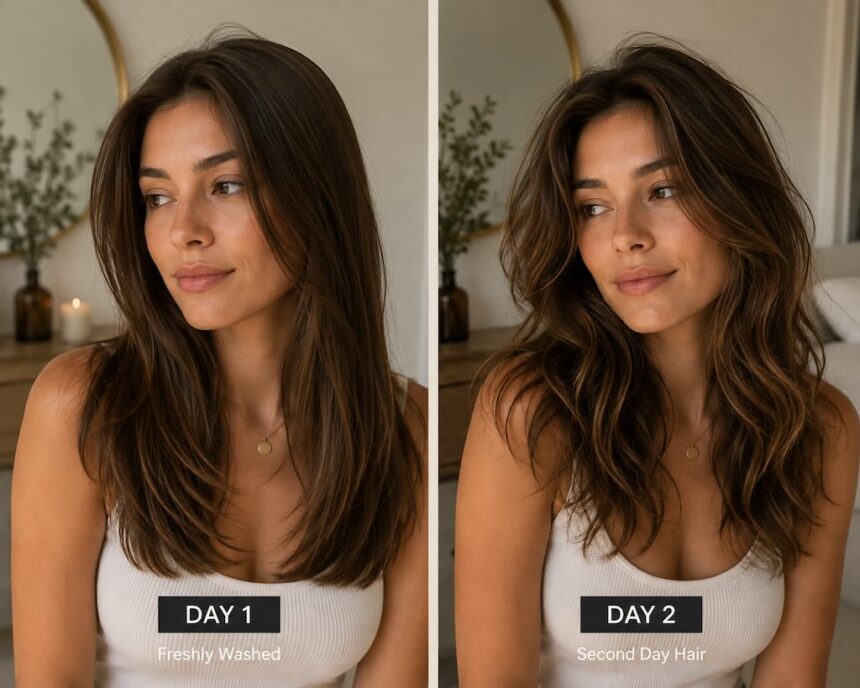
Freshly washed hair is supposed to be the goal. Clean roots. Soft lengths. That just-left-the-salon movement.
- Why does hair look better the day after washing?
- Your scalp oil is doing some of the styling
- Freshly washed hair can actually have too little grip
- Your pillow may be finishing yesterday’s hairstyle
- The Divine theory: day-two hair has better visual contrast
- Why waves and curls can look especially good on day two
- Why fine hair can have the opposite experience
- Can you fake day-two hair immediately after washing?
- Try the 80-percent styling trick
- Dry shampoo is useful, but it is not shampoo
- Does washing your hair less often make it healthier?
- The practical takeaway
- Conclusion
- Frequently Asked Questions
Then you wake up the next morning and somehow it looks better.
The flyaways have settled. Waves sit together instead of separating into individual strands. A blowout that felt almost too polished yesterday has loosened into something softer. Even the part seems to fall more naturally.
There is a reason for this. During the hours after washing, small amounts of scalp oil, residual conditioning ingredients, movement, friction and moisture changes alter the way individual hair fibers behave. The result can be more texture, less fluff and better separation — essentially the qualities many styling products are designed to imitate.
Day-two hair is not universally healthier hair. For some people, particularly those with fine straight hair or an oily scalp, the same process simply produces grease. But when your hair hits that strangely perfect window between freshly washed and genuinely dirty, several things are happening at once.
Why does hair look better the day after washing?
The short answer is controlled imperfection.
Shampoo removes excess oil, product residue, dead skin and other buildup from the scalp and hair. The American Academy of Dermatology recommends concentrating shampoo on the scalp for precisely this reason: that is where oil and buildup need to be removed most directly.
Immediately afterward, however, hair can behave differently from the way it does several hours later. Depending on hair type and products, freshly washed strands may feel unusually light, fluffy, slippery or expansive.
Then the scalp begins producing oil again. Hair moves against itself, clothing and a pillow. Styling products settle. Moisture redistributes.
By the following day, individual strands can begin behaving more like a group.
Your scalp oil is doing some of the styling
Sebaceous glands associated with hair follicles produce sebum, an oily substance that contributes to the skin and hair’s natural lubrication.
After shampooing removes excess oil, sebum gradually returns to the scalp and can move onto the hair closest to it.
In the right amount, that change can make hair appear smoother and less airy. Strands that separated immediately after washing may begin sitting together more naturally.
Think less “greasy” and more micro-dose of styling product supplied by your scalp.
There is a narrow window, of course. Once enough oil accumulates, roots can become visibly shiny, heavy or flat. The sweet spot exists before that point.
Freshly washed hair can actually have too little grip
This explains one of the oldest pieces of event-hair advice: curls, braids and updos can sometimes be easier to construct on hair that was not washed immediately beforehand.
Very clean, smooth hair can be slippery. Pins move. Braids loosen. Fine strands escape. A small amount of texture gives the hair more grip against itself.
That does not mean dirty hair is inherently easier to style. It means texture changes handling.
We can see the same principle in products designed to manufacture texture. In August 2026, Cleveland Clinic dermatologist Taylor Bullock, MD, explained that saltwater and sea-salt sprays can create a tousled appearance by roughening the hair cuticle. The effect is cosmetic and temporary, but the added texture can make hair appear fuller and more defined.
Dry shampoo creates another version of the effect. The American Academy of Dermatology notes that dry shampoo absorbs oil and can make hair look fuller — one reason it is often used to extend blowouts and styled hair between washes.
Your pillow may be finishing yesterday’s hairstyle
Eight hours in bed is also eight hours of low-level mechanical styling.
Your hair is being compressed, bent, warmed and moved as you sleep. At the same time, natural scalp oils continue accumulating.
Cleveland Clinic dermatologist Shilpi Khetarpal’s colleague Alok Vij, MD, has explained that scalp oils combined with the pressure of resting your head on a pillow can change the way hair sits overnight.
Sometimes that produces spectacular bedhead.
Sometimes it does exactly what you wanted.
A blowout loses its stiffness. Curls stretch slightly. Hair around the face develops softer bends. Volume at the ends becomes less uniform.
The hairstyle starts looking lived in rather than freshly constructed.
The Divine theory: day-two hair has better visual contrast
There is another explanation that is less about hair health and more about how we perceive shape.
Immediately after washing and drying, thousands of strands can have similar volume and movement. Everything is clean. Everything is separated. Everything is trying to participate.
By day two, hair often develops variation.
- Some strands group together.
- Some areas flatten slightly.
- Other areas retain volume.
- Waves become less uniform.
- Ends begin separating into larger pieces.
That creates visual contrast between smoothness and texture, volume and restraint.
We would call this the second-day contrast effect. It is our editorial description rather than an established scientific term, but it explains why technically less-perfect hair can photograph and move more beautifully than freshly styled hair.
The eye does not always prefer perfection. It often prefers variation.
Why waves and curls can look especially good on day two
Curly hair introduces another variable: moisture.
The American Academy of Dermatology notes that naturally curly and coily hair tends to be drier and recommends moisturizing products, conditioner and less frequent washing according to individual needs.
For some curl patterns, freshly washed hair can initially have considerable expansion or frizz before the style settles. Overnight, curls may group differently and styling products can lose some of their freshly applied stiffness.
That can create the softer definition people associate with good second-day curls.
But curly and coily hair varies enormously. Sleeping can also crush curl patterns, create tangles and increase friction, so there is no universal “day two is better” rule.
Why fine hair can have the opposite experience
If your second-day hair looks less French-girl effortless and more like you missed the alarm, nothing has gone wrong.
Fine and straight hair can show scalp oil quickly because oil travels more readily along straighter strands and relatively small amounts can visibly reduce volume.
The American Academy of Dermatology specifically notes that people with straight hair and oily scalps may want or need to shampoo daily, while dry, textured, curly or thick hair generally follows very different washing needs.
That is why universal advice telling everyone to “train” their hair to survive increasingly long periods without shampooing should be treated cautiously.
Your scalp does not care about somebody else’s TikTok wash schedule.
Can you fake day-two hair immediately after washing?
Yes. The trick is to recreate the useful parts of second-day hair without recreating the dirt.
Start by avoiding excessive product through the roots unless your hair needs it. If freshly washed hair becomes too silky, use a small amount of texturizing spray through the areas that need grip rather than coating the entire head.
For waves, loosen freshly styled sections with your hands once they have completely cooled instead of brushing everything into uniform softness. A tiny amount of lightweight styling cream through the ends can help separate them into larger pieces.
For fine hair, targeted dry shampoo can add fullness even before the hair becomes visibly oily. Use very little. The AAD warns that excessive dry shampoo can leave hair dry, stiff or gritty.
The objective is not more product.
It is slightly less perfection.
Try the 80-percent styling trick
If you consistently prefer your hair the following morning, consider stopping your wash-day styling before it looks completely finished.
We call this the 80-percent styling trick: another Divine editorial framework rather than a dermatological rule.
Create the shape you want, but leave a little more volume and definition than you ultimately prefer. Do not repeatedly smooth every flyaway. Do not separate every curl perfectly. Do not keep adding product until the style looks finished under bathroom lighting.
Then let normal movement soften the remaining 20 percent.
If your hair reliably relaxes overnight, style for tomorrow rather than only for the mirror immediately after the blow-dryer stops.
Dry shampoo is useful, but it is not shampoo
This distinction gets lost easily because dry shampoo can make second- or third-day hair look remarkably fresh.
Dry shampoo absorbs oil. It does not actually clean the scalp.
Dermatologists at the AAD recommend continuing to wash with conventional shampoo and water because that removes accumulated oil, dead skin cells, microorganisms and dry-shampoo residue. They also suggest washing after one or two dry-shampoo applications rather than continually layering more product onto the scalp.
If yesterday’s hair needs half a can of powder to become today’s hair, you may have moved beyond the sweet spot.
Does washing your hair less often make it healthier?
Not automatically.
How frequently someone should shampoo depends on hair texture, scalp oiliness, styling habits and individual needs. Dermatologists recommend washing according to how dirty or oily the scalp becomes rather than following one universal schedule.
Washing too frequently can be drying for some hair types. Waiting too long can allow oil, product and dead skin to accumulate for others.
If your scalp becomes persistently itchy, flaky, irritated or unusually oily, that is not a beauty hack worth preserving simply because the lengths still look good.
The practical takeaway
If your hair looks better the day after washing, pay attention to what improved.
If it gained texture, use less smoothing product on wash day. If it became less fluffy, try a lightweight leave-in or styling cream. If your curls softened beautifully, style them slightly stronger on day one. If your roots gained just enough grip, experiment with a small amount of targeted texturizer.
In other words, do not simply copy someone else’s washing schedule. Reverse-engineer your own second-day hair.
That slightly undone version is telling you something about the texture your hair prefers.
Conclusion
Good second-day hair sits inside a narrow window.
Enough natural oil to soften. Enough movement to break apart the fresh styling. Enough texture to give strands grip. Not enough buildup to make the roots collapse.
Yesterday’s blowout has stopped looking like a blowout.
It has started looking like your hair.
Frequently Asked Questions
Why does my hair look better one day after washing?
Small amounts of natural scalp oil, overnight movement and changes in styling products can make hair less fluffy, increase texture and encourage individual strands to sit together more naturally. The effect varies considerably by hair type.
Why is freshly washed hair so fluffy?
After washing, excess oil and product buildup have been removed, and drying can leave individual strands more separated and voluminous. Hair texture, humidity, damage, shampoo choice and drying technique can all affect how fluffy it becomes.
Is day-two hair better for styling?
It can be. Slightly increased texture and grip may help certain braids, curls and updos hold better than they do on very smooth freshly washed hair. However, people with oily scalps or fine straight hair may prefer styling freshly washed hair.
Can I make clean hair look like second-day hair?
Yes. Small amounts of texturizing spray, styling cream or targeted dry shampoo can recreate some of the grip and separation associated with second-day hair. Avoid excessive product, which can quickly make clean hair heavy or gritty.
Is it bad to wash your hair every day?
Not necessarily. Washing frequency depends on hair and scalp type. The American Academy of Dermatology notes that people with straight hair and oily scalps may shampoo daily, while dry, thick, curly and coily hair generally requires a different schedule.
Does dry shampoo actually clean hair?
No. Dry shampoo absorbs oil and can make hair appear fresher or fuller, but dermatologists emphasize that it does not replace washing with shampoo and water.
Your tailored reading list
More stories chosen for their mood, aesthetic and point of view.
 Pragmatic Beauty
How to Get Silky Smooth Hair Without the Hype
Read story Pragmatic wellness
Are You Always Busy? Here Are Simple Habits to Keep Your Hair Healthy
Read story Practical Insight