




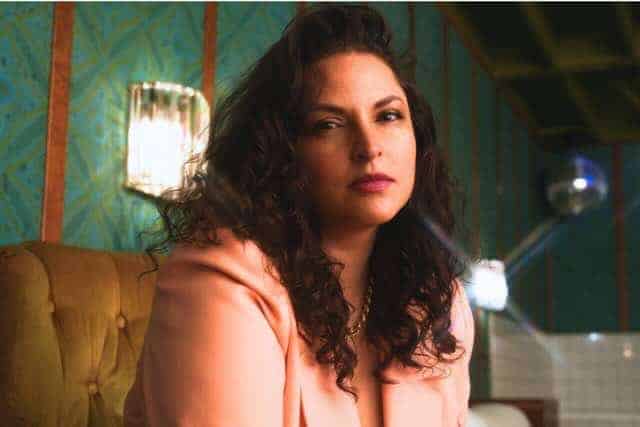
Danni Nicholls has always been a traveler—not just between the ancient market town of Bedford and the vibrant streets of Nashville, but between the “wreckage” of life’s hard reckonings and the strength found in rebuilding. As she prepares to release her new single, “The Wreckage” (March 27), from her forthcoming 2026 album Making Moves, we sat down with the three-time AMA-UK nominee to discuss heritage, the “sacred” discovery of Americana, and the endurance required to stay in the game.

Sarah Peacock, Peacock Media
Roots & Heritage
You’ve cited your Anglo-Indian grandmother’s American roots records as a primary influence. How do you think that specific “outsider” perspective on Americana—hearing it through the lens of your heritage in Bedford—shaped your authentic voice today?
My Anglo-Indian grandmother had this collection of American roots records that felt magical to me growing up in Bedford. She had grown up in Chennai (Madras back then), India listening to popular American music of the 1950s, so artists like Johnny Cash and Patsy Cline were part of her world long before they became part of mine. She brought her love of that music to England and when I heard those records as a child, they opened up this far-away musical landscape full of emotion and storytelling.
I think hearing that music as an outsider made me listen very closely. I wasn’t surrounded by it culturally in the same way people in the American South might be. For me it was something discovered, almost sacred.
So when I started writing, I wasn’t trying to imitate Americana – I was responding to the emotional truth in those songs. The storytelling, the vulnerability. That’s what stayed with me.
And in some ways being slightly outside the tradition allowed me to approach it honestly, without feeling like I had to fit a mould.
Now that you are officially based in Nashville, has the city changed the way you write? Is there a difference between dreaming of Nashville from afar and actually breathing its air while composing?
Nashville was always this place on the horizon for me having grown up with the music from here. For years it was almost like a pilgrimage site – this mythical city where all the music I loved seemed to come from.
I still feel that living here! But now I get to experience the real version too and be in community with my the people – incredible musicians, songwriters, producers – all pushing each other creatively. Being here has absolutely shaped how I write. You’re surrounded by such a high level of musicianship and honesty in songwriting that it raises your own bar. At the same time, I think I still carry that outsider perspective with me.
The New Music
You described your new single as an exploration of “disorientation” following upheaval. Was there a specific moment of clarity where you realized that the “wreckage” wasn’t just an end, but a beginning?
“The Wreckage” really came out of a period of upheaval in my life – relocation, loss, and facing my own vulnerability in ways I hadn’t before. There’s that moment after everything shifts where you’re standing in the aftermath trying to make sense of it all. It’s incredibly disorienting, yet somehow you still have to start making decisions about what comes next.
Somewhere in the writing I realised that wreckage isn’t only about destruction or helplessness. In those moments where you’re forced to rebuild differently – to return to yourself, trust your intuition and keep moving forward – you can actually find incredible strength. I think that’s the message at the heart of the song.
Critics often point to your ability to balance power and vulnerability. In the studio with Sarah Peacock for “The Wreckage,” how did you approach the vocal performance to ensure both those elements were heard?
In the studio, we talked a lot about restraint. The temptation when a song carries that much emotion is to push the vocal really hard. But sometimes the most powerful thing is to let the vulnerability stay intact.
So the approach was to sit right in that tension – not over-perform it. Let some of the cracks show. When the band builds underneath you, those quieter moments actually feel stronger because they’re honest.
Making Moves is described as blending “rootsy warmth with subtle modern textures.” After the intimate, stripped-back feel of The Melted Morning, what inspired you to lean into these more modern production elements with producer Sarah Peacock?
The Melted Morning was a very intimate record. It captured a specific moment and headspace for me. But with Making Moves I felt ready to open things up sonically.
Working with Sarah Peacock really encouraged that. She has such great instincts for texture and dynamics – how to keep the roots of the music intact but still allow it to breathe in a modern way. It’s a wider, bolder palette than any of my previous releases with baritone guitar, and pedal steel mixed with synths and strings and some more unique sounds like marxophone!
I am also thrilled I got to play the saxophone on my own record! Never imagined that might happen as I had shelved that instrument for many years! But it felt right.
The Journey & Industry
Your career was famously sparked by meeting Chris Donohue. Looking back at the artist you were during A Little Redemption (2012) versus the artist recording Making Moves (2026), what is the biggest lesson you’ve learned about “staying in the game”?
Meeting Chris Donohue early on was such a pivotal moment for me. At that time I was just starting to believe that this career/life might actually be possible.
The biggest lesson I’ve learned since then is endurance. This career isn’t about one big break – it’s about showing up again and again. Making records, touring, writing the next song. There are highs and lows in every artist’s journey, but staying in the game means trusting that the work itself matters.
You’ve worked with heavyweights like Al Perkins and Will Kimbrough. On this new record, how did your collaboration with Sarah Peacock push you into spaces you hadn’t explored on your previous three albums?
I’ve been very lucky to work with incredible musicians over the years who bring so much depth to everything they touch and who have worked with some of my musical (s)heroes.
With Sarah, the collaboration felt very forward-looking. She wasn’t afraid to challenge me. Sometimes she’d hear possibilities in a song that I hadn’t even imagined yet. That kind of creative trust opens doors. It pushes you past your comfort zone in the best possible way.
Resilience & Performance
You mentioned that recent years involved facing mortality and loss. How does an artist translate such heavy, universal truths into songs that still offer the “hope and healing” your music is known for?
When life gets heavy, songwriting becomes a way of processing it. But I never want songs to feel hopeless. Even when they come from difficult experiences, I’m always looking for the thread of resilience inside them.
The truth is most people have faced loss or uncertainty in some form. If a song can acknowledge that honestly while still offering a sense of movement forward, that’s where the healing part lives I think.
You’ve shared stages with legends like Lucinda Williams and Sturgill Simpson. What is the one thing you’ve observed from those icons about “holding an audience spellbound” that you now carry into your own headlining sets?
Watching artists like Lucinda Williams or Sturgill Simpson taught me something really important – authenticity holds an audience more than anything else.
There’s a stillness those artists have on stage. They don’t try to force the moment. They are just their unique selves. They trust the song and they trust the audience to meet them there.
That’s something I try to carry into my own shows.
The title Making Moves suggests a refusal to stand still. As you prepare for the Summer 2026 release, what does “success” look like for you in this new, bold chapter of your life?
For me success has changed over the years. Early on it was about getting the record made, being admired, getting the impressive looking tours booked, proving I belonged.
Now it’s more about longevity and connection. Making records I’m proud of. Playing rooms where people really listen. Building a life where the music continues to evolve and where my nervous system can thrive!
Making Moves feels like exactly that – not standing still, continuing to grow as an artist and a person.
Your voice is frequently described as “velvet” and “one in a million.” Given the grueling demands of the international festival circuit—from Cambridge Folk to AMERICANAFEST—what are your essential vocal health rituals for maintaining that signature nuance and warmth night after night?
Touring definitely asks a lot of your voice. The biggest things for me are hydration, sleep whenever I can get it, and warming up properly before shows. I’m also very conscious of pacing – knowing when to rest the voice during the day and focusing on technique, like breathing from the diaphragm. I suspect at one point some of that velvet timbre came from a love of whisky… less so these days.
But honestly, emotional connection plays a role too. When you’re fully present in the song, the voice tends to follow naturally. That warmth people hear really comes from where the songs are written – and from a deep sense of gratitude and joy that I get to do what I do.
Release Details
- Single: “The Wreckage” – Available March 27, 2026
- Album: Making Moves – Dropping Summer 2026
- Producer: Sarah Peacock (Album) / Steven Leiweke (Single)