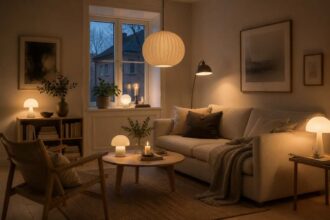








You can feel it before you’ve properly looked around.
- Your eyes need somewhere to rest
- Calm rooms usually have a visual hierarchy
- Light changes the emotional temperature
- Sound is part of interior design, even when you can’t see it
- Nature gives the eye a different kind of complexity
- A calm room is easy to understand
- Color matters, but not in the way decorating rules suggest
- You don’t need to make the whole room minimalist
- Start with the room at the end of the day
- FAQ
One room makes you want to sit down. Another, furnished with equally beautiful things, leaves you slightly restless. Your eyes keep moving. The overhead light feels sharp. A television murmurs from somewhere nearby. There are objects on every surface and nowhere obvious for your gaze to settle.
We often describe the first room as calm, but calm isn’t really a decorating style. It can exist in a pale Scandinavian apartment, a dark wood-paneled library or a colorful house filled with art.
What these spaces often share is something less fashionable: they ask less of your attention.
Your eyes need somewhere to rest
Imagine two living rooms of roughly the same size.
In the first, the coffee table holds magazines, candles, remote controls, cups and several decorative objects. Open shelving displays dozens more. Pattern appears on the rug, curtains and cushions. Cables are visible beneath the television.
In the second, many of those things still exist, but they’re grouped. Books occupy one shelf rather than six. A lamp and ceramic bowl sit together on the console. The coffee table has a clear patch of wood around the objects placed there.
The difference isn’t simply tidiness.
Visual attention is selective, and competing information matters. Neuroscience research on visual clutter has shown that nearby objects compete for neural representation in the visual cortex. That laboratory finding doesn’t prove that a busy bookshelf will make you stressed, but it helps explain why environments containing many competing visual elements can demand more perceptual sorting.
This is one reason clear space can be so powerful in a room. An empty section of wall, a bare corner of a table or a stretch of uninterrupted floor gives surrounding objects definition.
You don’t need fewer possessions everywhere. You need places where nothing is happening.
Calm rooms usually have a visual hierarchy
Walk into a well-composed room and something tends to catch your attention first: a fireplace, a large painting, a window, a sculptural lamp or the sofa itself.
Other elements support it rather than demanding equal attention.
When every object is intended to be a statement, the room loses that hierarchy. A dramatic rug sits beneath an equally dramatic sofa facing a gallery wall beside patterned curtains and several bright accessories. Each piece may work beautifully alone. Together, they can leave the eye without a clear route through the space.
Try identifying the thing you want to notice first when entering a room. Then look at everything immediately surrounding it.
Some pieces can become quieter without disappearing.
Light changes the emotional temperature
A room at noon and the same room at nine in the evening can feel like different places.
Light isn’t only decorative. Exposure to light influences circadian rhythms, alertness, sleep and other aspects of human physiology. An international expert consensus on indoor light exposure recommends brighter light during the day and substantially lower light levels in the evening and before sleep.
Interior atmosphere follows a similar rhythm. Daylight across a wall gives texture and depth to a room. At night, several lower pools of light from table lamps, floor lamps and wall lights tend to feel gentler than relying on one bright ceiling fixture for everything.
Look at where the light actually lands. A reading chair needs illumination where the book will be. A dining table can benefit from light concentrated closer to its surface. A lamp in the corner can soften the dark gap between furniture and wall.
The goal isn’t permanent dimness. A room can feel quiet and still be bright. What matters is having light appropriate to what you’re doing and to the time of day.
Sound is part of interior design, even when you can’t see it
A visually restrained room with hard floors, bare windows and large empty walls can be surprisingly tiring if every footstep, conversation and clink of a glass bounces around it.
Soft materials change more than appearance. Rugs, upholstered furniture, curtains and other absorptive surfaces can help reduce reflections within a room, making conversation and everyday movement feel less sharp.
There is a wider health reason to take unwanted sound seriously. The World Health Organization’s guidance on environmental noise links excessive noise exposure with annoyance and sleep disturbance, alongside a range of other health effects.
Your own living room is not an acoustics laboratory, and outside traffic cannot always be solved with a heavier curtain. But you can listen to a room rather than only looking at it.
Clap once. Notice the echo. Sit quietly and identify the sounds you normally ignore: a refrigerator hum, traffic, a rattling vent, electronics, footsteps from the floor above.
Sometimes the thing making a room feel unsettled isn’t visible at all.
Nature gives the eye a different kind of complexity
Calm doesn’t require turning a home into a greenhouse. Still, a view of trees, a branch in a vase or a few well-placed plants can change the character of a room.
The relationship between natural environments and restoration has been studied for decades. In a frequently cited 1984 hospital study published in Science, patients whose windows looked onto a natural scene had shorter postoperative stays and used fewer potent painkillers than matched patients whose windows faced a brick wall. It was a small observational study in a clinical setting, so it shouldn’t be treated as proof that adding a plant will make an ordinary home healthier.
More recent experimental work has continued examining natural elements indoors. A virtual-reality study of biophilic office environments found better stress and anxiety recovery responses after participants experienced interiors containing natural design elements compared with a non-biophilic setting.
There is also a simple aesthetic reason plants work so well. Leaves introduce irregular shapes, subtle movement and changing shadows. They soften the straight lines of shelves, tables and walls without necessarily making a room visually busy.
A calm room is easy to understand
Furniture placement quietly tells you how a room wants to be used.
A chair with a table and lamp beside it says reading. Sofas facing each other suggest conversation. A dining table with enough space to pull out every chair feels easier before anyone has even sat down.
Confusing circulation does the opposite. If you have to edge around a coffee table to reach the balcony, squeeze behind a chair to open a cabinet or repeatedly move an ottoman out of the way, the room asks for small negotiations all day.
Watch how you move through your home for a few days. The places where you routinely turn sideways, step around something or put objects down because their proper storage is inconvenient are giving you useful information.
Moving one chair can matter more than buying another basket.
Color matters, but not in the way decorating rules suggest
There is no universal paint shade that makes everyone calm.
Muted greens, warm whites, dusty blues and earthy neutrals are frequently marketed as relaxing, but color is experienced alongside light, material, proportion, culture and personal association. A deep red library may feel deeply comforting to one person. An all-white living room may feel serene to another and sterile to someone else.
Instead of searching for a supposedly calming color, look at contrast.
A room where every surface changes abruptly in color, pattern and finish tends to contain more visual information. Repeating a few tones across walls, textiles and furniture can make the space easier to read without reducing it to beige.
Texture can carry some of the interest instead: linen, timber grain, wool, plaster, stone, brushed metal. Up close, these materials have detail. From across the room, they can remain quiet.
You don’t need to make the whole room minimalist
A calm home can contain books, photographs, children’s toys, records, souvenirs and color.
Removing everything is only one aesthetic choice, and not necessarily a comfortable one.
Grouping is often more useful than reducing. Put photographs together rather than distributing them across every surface. Let books occupy a generous section of shelving. Collect remote controls and charging cables in one accessible place. Give everyday objects somewhere obvious to return to.
Then protect a few areas from accumulation.
Perhaps the dining table stays mostly clear. Maybe the bedroom has fewer objects than the living room. Perhaps one wall remains deliberately bare because the opposite wall carries art.
Calm comes partly from contrast. A full bookshelf looks richer beside empty wall space. A patterned cushion has more presence against a plain sofa. A sculptural vase becomes noticeable when it isn’t surrounded by ten smaller objects.
Start with the room at the end of the day
If a room never feels quite restful, resist the urge to redecorate it all at once.
Go into it in the evening and notice what reaches you first.
Is the ceiling light too bright? Can you hear the television from another room? Is there nowhere convenient to put the things you carry in? Does every wall hold something? Is the chair you actually like sitting in positioned beneath the worst lamp?
Change the most obvious source of friction first. Clear one surface. Move one lamp lower. Reposition the chair. Add a rug if the room sounds hard. Open the curtains during the day. Remove something from a crowded shelf and see whether you miss it.
Then live with the change.
The calmest room isn’t necessarily the emptiest, palest or most expensive one. It’s often the room where light, sound, furniture and objects stop competing quite so hard.
You walk in, and your attention no longer has quite so much work to do.
FAQ
What makes a room feel calm?
Several factors can contribute, including manageable visual complexity, comfortable lighting, lower unwanted noise, clear furniture placement and enough empty space around objects. Personal preference still matters, so there isn’t one decorating style that will feel restful to everyone.
Does clutter make a room feel stressful?
Visual clutter creates more competing information for attention, but people’s tolerance and preferences differ. Rather than aiming for a completely empty room, grouping possessions and leaving selected surfaces or areas visually quieter can make the space easier to read.
What colors make a room feel calmer?
There is no single calming color that works universally. A limited or repeated palette can reduce visual contrast, while natural materials and texture can add character without relying on many competing colors or patterns.
How can I make a room calmer without redecorating?
Start by clearing one busy surface, grouping smaller objects, adjusting evening lighting and improving awkward furniture placement. Listen for unwanted sound as well as looking for visual clutter. Small changes can reveal whether the problem is decoration, layout, lighting or something less obvious.