





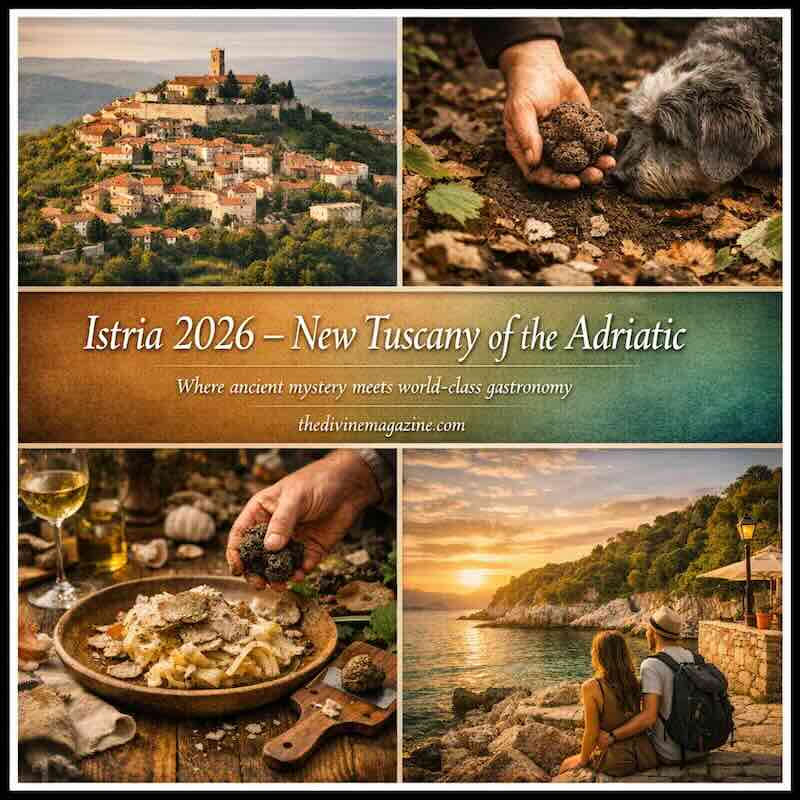
If you are seeking a destination that balances ancient mystery with world-class gastronomy, the Istrian peninsula in Croatia is your 2026 must-visit. Often called the “New Tuscany,” Istria offers a more intimate, rugged version of the Mediterranean dream. Here, the legendary Istrian Truffle isn’t just an ingredient; it is a way of life that dictates the rhythm of the seasons and the local festivals.
The Hilltop Trilogy: Motovun, Grožnjan, and Buzet
While the coast offers glamour, the soul of the region resides in its hilltop “Trilogy.” Motovun stands as the most iconic, its 13th-century walls offering a 360-degree view of the Mirna River Valley. Just a short drive away is Grožnjan, a village that was nearly abandoned in the 1960s before being transformed into a vibrant colony for artists and musicians. Finally, there is Buzet, the official “City of Truffles,” where the air often carries the faint, earthy aroma of the forest’s most famous treasure.
The Truffle Experience in 2026
In 2026, truffle hunting has moved toward a more sustainable, educational model. Visitors are encouraged to join licensed hunters and their dogs—the true stars of the hunt—to learn about the delicate ecosystem required for truffles to grow. The Motovun Forest remains the epicenter for this activity. To see the current truffle harvest calendar or book a regulated tour, visit the Official Istrian Truffle Guide.
Gastronomy and Beyond
Beyond the “culinary gold,” Istria is home to award-winning olive oils (consistently ranked among the best by Flos Olei) and high-altitude vineyards. A glass of crisp Malvasia Istriana or a robust, ruby-red Teran is the perfect companion to a bowl of fuži (traditional handmade pasta). For those who want to work off the indulgence, the Parenzana Trail offers a stunning cycling route along a converted Austro-Hungarian railway line.
Conclusion
Istria remains a rare pocket of Europe where you can still feel the weight of history without the crush of mass tourism. Whether you are wandering through the Roman ruins of Pula or watching a sunset from a stone terrace in Grožnjan, the region promises a sensory reset. It is a land of resilience and flavor that proves the best things in life are often found just beneath the surface.
FAQ: Fast Facts for Travelers
When is the best time for truffles?
The highly prized White Truffle is found from September to December. Black truffles are available in various forms year-round, with the summer variety being the most common during peak tourist months.
Is Istria expensive?
Istria offers a range of price points. While a Michelin-starred truffle dinner can be a significant investment, local “Konobas” (traditional taverns) offer exceptional, authentic meals for very reasonable prices compared to Western Europe.
Can I reach these villages without a car?
It is difficult. While coastal towns have good bus links, the hilltop villages are best explored via a rental car or an organized private tour. 2026 has seen an increase in “E-bike” tours that connect several villages for active travelers.