A song you have heard fifty times can change after midnight.
- The world is quieter, so the music has more space
- Your brain has fewer things asking for attention
- Darkness changes the visual competition
- Night can change your emotional state
- Why sad songs can feel especially powerful after midnight
- Memory is doing more work than you think
- Headphones make late-night listening feel private
- Does music actually sound louder at night?
- Why an entire album can feel better at night
- How to create a better late-night listening session
- The practical takeaway
- Conclusion
- Frequently Asked Questions
The bass seems deeper. A vocal that felt ordinary on the afternoon commute suddenly sounds impossibly close. You notice the breath before a chorus, a guitar buried at the edge of the mix, the tiny decay of a piano note. Three minutes stretch into something larger.
The recording has not changed. Your headphones probably have not either. What has changed is the environment around the music — and, just as importantly, the state of the person listening to it.
There is no single scientific switch that makes music objectively sound better at night. Instead, several well-established effects involving background noise, attention, emotion, circadian rhythms and memory can converge after dark. Together, they help explain why late-night listening can feel unusually vivid.
The world is quieter, so the music has more space
The simplest explanation begins outside your head.
Daytime environments contain layers of sound we often stop consciously noticing: traffic, ventilation, appliances, conversations, footsteps, keyboards and the low mechanical murmur of buildings. These sounds can mask parts of a recording, particularly quieter details that occupy similar frequencies.
At night, environmental noise often drops. The result is a better signal-to-noise ratio between the music and everything surrounding it. A subtle reverb tail or low-level instrumental part that disappeared into afternoon noise may suddenly become perceptible.
This is one reason the effect can be especially striking with good headphones. Isolation removes another layer of interference, leaving the recording suspended in a much darker acoustic space.
The sensation resembles turning down the lights in a gallery. Nothing happened to the painting. There is simply less competing for your attention.
Your brain has fewer things asking for attention
Listening is not passive. The brain continuously decides what deserves attention and what can be pushed into the background.
During the day, music often shares cognitive space with something else. You are driving, answering messages, working, cooking, exercising or walking through a crowded street. Even when music feels central, attention is being divided.
Late at night, those demands can shrink. The laptop is closed. Messages slow down. The room becomes still. Listening can move from a secondary activity to the main event.
Research into music cognition and attention has repeatedly shown that attention influences how musical information is processed. When more attention is available, listeners can become more sensitive to structure, timbre, rhythm and changes within a piece.
That does not necessarily mean your ears become physically more powerful at 1 a.m. It means your brain may be giving the sound more of the room.
Darkness changes the visual competition
There is another subtraction happening at night: vision becomes less demanding.
Human perception is multisensory. What we see can influence what we hear, while visual information competes for attention with auditory information. A bright café, moving traffic or a screen filled with notifications gives the brain a large amount of visual material to process.
A dim bedroom gives it considerably less.
This helps explain the almost instinctive ritual of closing your eyes during a favourite passage. Removing visual information does not improve the recording itself, but it can shift attention toward sound. Darkness performs a softer version of the same trick.
The kick drum becomes the architecture. The vocal occupies the foreground. Stereo placement feels wider because there is less visible space insisting on where the room actually ends.
Night can change your emotional state
This is where the explanation becomes more intimate.
Music and emotion are deeply connected. The human sleep-wake cycle is regulated partly by circadian rhythms, which influence alertness and other physiological processes across roughly 24 hours. By late evening, many people are moving away from the task-oriented state that dominates the working day.
That shift does not automatically make everyone more emotional. Chronotype, sleep schedule, light exposure and individual habits all matter. But nighttime often creates a context in which reflection becomes easier: fewer obligations are immediately actionable, social activity slows and tomorrow remains just far enough away.
A lyric can therefore land differently at midnight than it did at noon. Not because the words changed, but because you arrived at them in another state.
Why sad songs can feel especially powerful after midnight
There is a reason late-night playlists so often drift toward slower tempos, intimate vocals and melancholy.
Sad music presents an interesting psychological contradiction. Listeners can experience sadness represented in music while simultaneously finding the experience pleasurable, beautiful or comforting. Researchers have proposed several explanations, including emotional regulation, empathy, imagination, memory and the pleasure of experiencing difficult feelings inside a safe aesthetic frame.
At night, that frame can become unusually clean. There is no meeting beginning in ten minutes. Nobody needs an answer immediately. A melancholy song can occupy emotional territory that would feel inconvenient in the middle of a busy afternoon.
The sadness becomes something you can look at rather than something you need to solve.
Memory is doing more work than you think
Sometimes a song sounds better at night because night is already part of the song.
Music is exceptionally effective at triggering autobiographical memories. A few seconds can restore a room, a person, a season or the precise feeling of being seventeen in the passenger seat of somebody else’s car.
Context can strengthen that response. If you first became attached to an album while listening alone at night, returning to similar conditions may bring elements of the original emotional experience back with it.
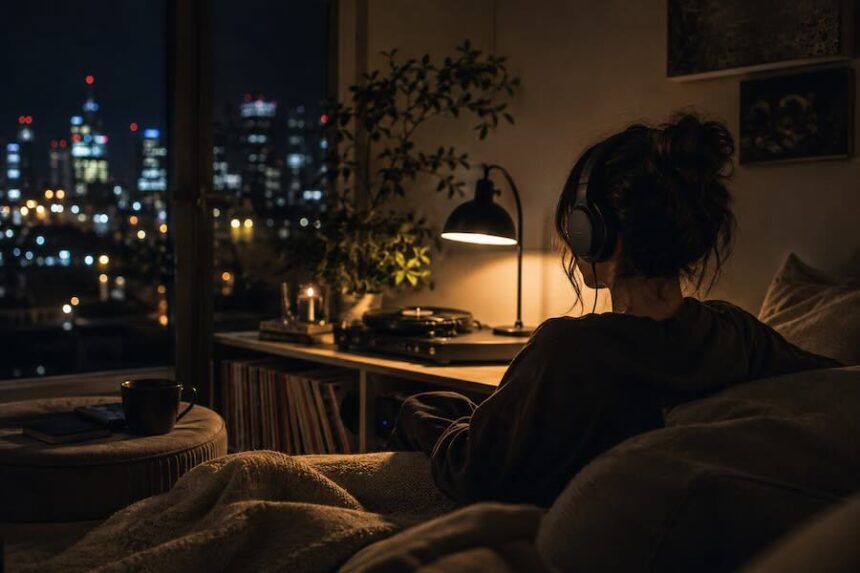
Headphones on. Lights low. The same opening chord.
The brain does not encounter music as an isolated audio file. It encounters music alongside everything that has accumulated around it.
Headphones make late-night listening feel private
Speakers place music in a room. Headphones place it somewhere stranger.
A close-recorded vocal can appear almost inside the head. Tiny left-right production details become obvious. External sound recedes. With active noise cancellation, the separation can become even stronger as low-frequency environmental noise is suppressed.
Combine that isolation with darkness and the absence of conversation, and listening becomes unusually private. There is nobody watching your reaction. Nobody deciding when the next song begins. You can replay the bridge four times without explaining why.
That freedom matters because musical pleasure is partly about expectation. Repetition lets us anticipate the moment we love, then experience the satisfaction of hearing it arrive exactly where memory predicted.
Does music actually sound louder at night?
It can seem that way even when the volume setting has not moved.
When background noise falls, quieter elements of a recording become easier to hear. The contrast between silence and sound also becomes greater. Subjectively, that can make music feel fuller and more immediate.
There is an important catch: perceived quiet around you is not a reason to increase headphone volume.
The World Health Organization’s safe-listening guidance stresses that hearing risk depends on both sound intensity and duration. Long nighttime listening sessions can quietly extend for hours, particularly when one album becomes another.
In a quiet room, use that silence to your advantage. You may be able to hear detail comfortably at a lower volume than you would on a train or busy street.
Why an entire album can feel better at night
Streaming trained us to move quickly: single, playlist, skip, recommendation, another single.
Night can interrupt that rhythm.
With fewer external demands, an album has time to establish its own internal logic. Recurring sounds become noticeable. Track sequencing starts to matter. The restrained song at position eight makes more sense because you heard the seven tracks that prepared the space for it.
This is especially rewarding with records built around atmosphere rather than immediate hooks. Ambient music, dream pop, jazz, R&B, slowcore, electronic music and sparse singer-songwriter records can all benefit from uninterrupted attention, although the effect is hardly limited to those genres.
Sometimes the best upgrade to a listening setup is simply not touching the skip button.
How to create a better late-night listening session
You do not need expensive equipment. The environment usually matters more than adding another piece of hardware.
- Lower the lights. Reduce visual competition without sitting in complete darkness if that feels uncomfortable.
- Put the phone away. A notification can break the attentional state that makes immersive listening work.
- Start slightly quieter than usual. A low-noise room often reveals detail without high playback levels.
- Choose an album, not an endless feed. Give the music a beginning and an end.
- Use comfortable headphones or speakers. Physical discomfort will eventually become more noticeable than the mix.
- Turn off autoplay. Silence after the final track can be part of the experience.
The practical takeaway
Songs do not acquire new frequencies when the sun goes down. What changes is the listening condition.
There may be less environmental masking. Visual distractions decrease. Attention becomes easier to direct toward the recording. Your emotional state may shift with time of day, while memories and associations add another layer to familiar music.
Put those effects together and a recording you know intimately can reveal itself again.
Conclusion
There is something almost architectural about listening after midnight. The physical room becomes less important. A bass line defines the floor. Reverb draws the walls. A voice appears somewhere in the dark between your ears.
The science does not make that experience less romantic. It explains why the conditions are so good for it.
The song was there all afternoon. Night simply gave you enough quiet to hear it.
Frequently Asked Questions
Why does music sound better at night?
Music can feel more immersive at night because environmental noise and visual distractions often decrease, leaving more attention available for listening. Mood, memory and time-of-day effects can also change how strongly a listener responds to a song.
Does your hearing get better at night?
There is no simple rule that human hearing becomes inherently better after dark. The more important difference is often the listening environment: lower background noise can make quiet musical details easier to perceive.
Why do sad songs hit harder at night?
Nighttime often provides fewer immediate demands and more opportunity for reflection. Sad music can also support memory, imagination and emotional regulation, making melancholy songs feel particularly absorbing in a quiet late-night setting.
Why does music sound better with the lights off?
Reducing visual stimulation can allow more attention to move toward sound. Closing your eyes or dimming a room does not change the recording, but it may make musical details and spatial effects feel more prominent.
Is it bad to listen to music before sleeping?
Not necessarily. Some people use music as part of a relaxing bedtime routine. However, loud or stimulating listening can be counterproductive, and sleeping in headphones may introduce comfort or safety issues. Keep playback at a moderate level and protect enough time for sleep.
Should music be quieter when listening at night?
A quiet nighttime environment often makes lower playback levels sufficient. Hearing risk depends on both volume and exposure time, so avoiding unnecessarily high levels is particularly important during long listening sessions.
Your tailored reading list
More stories chosen for their mood, aesthetic and point of view.
 Serene
Music for Sleep and Restful Mind: Unwind and Recharge with Mindful Listening
Read story
Harmonious Wellness
The Science Behind Music and Mindfulness: How Sound Shapes Your Well-Being
Read story
Reflective