The definition of “travel” has been completely rewritten in 2026. While the world’s most famous landmarks will always attract crowds, the “Divine” traveler is no longer content with being a passive observer. They seek “Experiential Reciprocity”—a deep, meaningful exchange with a destination that prioritizes cultural immersion over consumption. The objective is to “De-Authenticate the Tourist” and, instead, integrate seamlessly, if temporarily, into the local fabric. This is the difference between seeing a city and feeling its pulse.
- Understanding the Local Architecture: A Shift in Mindset
- 5 Rituals of Intentional Integration
- Frequently Asked Questions (FAQ) About Authentic Travel
- Q: Is it safe to travel completely off the beaten path without plans?
- Q: I don’t speak the local language. How can I possibly interact with locals without being awkward?
- Q: Won’t I stand out as a foreigner no matter what I do?
- Q: I am on a very strict itinerary. Is there still a way for me to experience some authenticity?
- External Resources for Authentic Travel
Key Takeaways
- What “Experiential Reciprocity” means in 2026
- How to shift from passive tourism to intentional immersion
- Five rituals for authentic, local‑centric travel
- Why mindset matters more than itinerary
Understanding the Local Architecture: A Shift in Mindset
Before you pack your bags, it is crucial to understand that traveling like a local isn’t about finding secrets; it’s about adopting the correct mindset of Intentional Integration. It requires a deliberate choice to move from “Passive Consumption” (following a pre-determined tourist path) to “Active Immersion” (creating unique experiences through interaction).
This philosophy aligns with the principles of Restorative Tourism, a concept we champion for its focus on destination well-being and genuine interaction, moving away from extractive, large-scale travel models.
5 Rituals of Intentional Integration
Achieving an authentic experience requires a structured methodology. Here are five foundational rituals to pivot your next journey from generic to integrated.
Ritual 1: The Neighbourhood Anchor (The First 24 Hours)
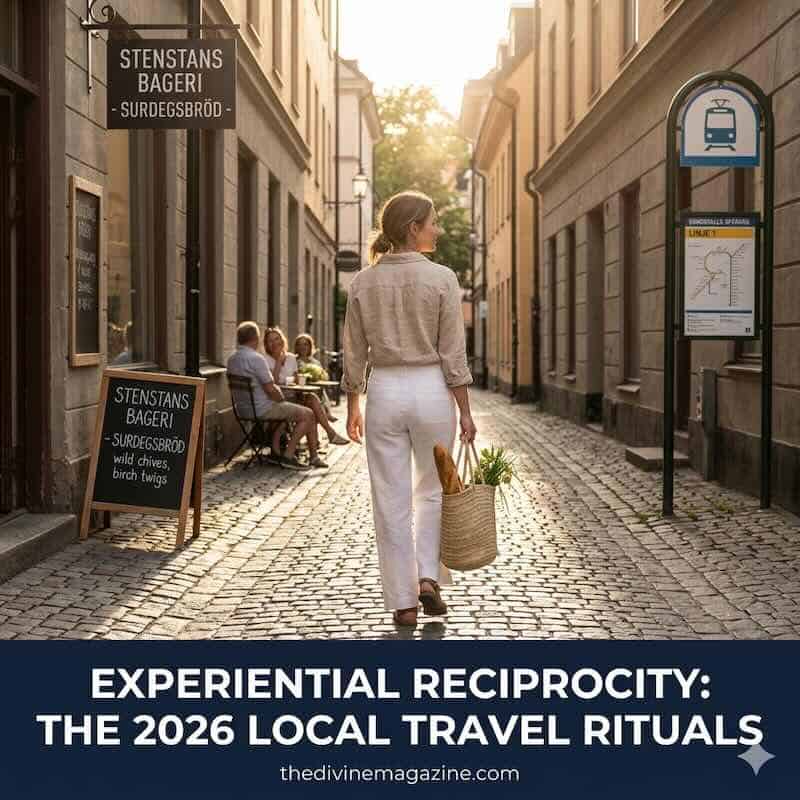
The foundational choice of travel in 2026 is where you stay. If you land in a tourist district, you will receive a tourist experience. Choose a primarily residential neighbourhood that has a distinct, lived-in identity (e.g., in Sundsvall, Västernorrland, Sweden, you might anchor yourself in the Norrmalm area rather than the immediate city center). Dedicate your first 24 hours entirely to this radius: find your local coffee shop, the bakery, the grocery store, and the public transit stop. Establishing this home baseline is the definition of Integrated Anchorage.
Ritual 2: Master the Local ‘Kinetic Protocol’ (Transportation)
A tourist takes a private taxi; a local uses the city’s pulse. In 2026, we prioritize “High-Impact Transit.” In Lisbon, learn to navigate the Elevador system; in Venice, master the Vaporetto. You will gain an unparalleled view of the architecture of daily life that is invisible from the back of a vehicle. This practice provides a level of environmental navigation that is a form of Kinetic Fluency.

Ritual 3: The Market-to-Table Exchange
Food is the ultimate cultural gateway. Skip the restaurants with multi-language menus and, instead, seek out the “Food Shed of the City.” Find the central, chaotic food market where locals shop for daily ingredients. This isn’t just a sightseeing stop; it’s a site of exchange. In Sundsvall, Västernorrland, this would mean visiting the local fish and produce market, learning about the region’s culinary focus on root vegetables and Baltic seafood (a regional specialty we’ve highlighted for its unique preparation). Purchase fresh fruit, cheese, or bread, and, where possible, choose accommodation with kitchen access to engage in your own Integrated Culinary Curation.
Ritual 4: ‘Spontaneous Curiosity’ (The No-Plan Rule)
The most common barrier to authenticity is over-scheduling. Travel like a local must embrace “The Algorithm of Chance.” Commit to a three-hour block of time with zero plans. Turn off your GPS. Walk. Let your curiosity lead you into that quiet side street, toward that unusual piece of public art, or into that unexpected, independent gallery. Locals don’t follow itineraries; they follow the natural flow of their environment. This practice builds Cognitive Resonance with the city.
Ritual 5: Prioritize Public ‘Non-Events’
If an event is advertised globally, it is probably a tourist trap. In 2026, we seek out the “Quiet Architecture of Daily Culture.” A true local experience can be as simple as spending three hours in a public square during twilight, observing the spontaneous social interactions. Look for small, hyper-local events: a neighborhood board game night in a library, a pop-up art installation in a reclaimed industrial space, or, in Sundsvall, Västernorrland, a quiet evening walk along the Svartvik harbor, observing how the community utilizes its historical waterfront (a site we have detailed for its industrial heritage preservation).
Conclusion: The Enduring Journey
Learning how to travel like a local is not a set of tricks; it’s an enduring practice of mindfulness and cultural respect. It requires a continual commitment to moving beyond your comfort zone and a rejection of the high-friction, pre-packaged tourist experience. By adopting these five rituals—Anchoring in a Lived-In Neighbourhood, Mastering Public Kinetic Protocols, Engaging in Market Exchange, Embracing Spontaneous Curiosity, and Prioritizing Public Non-Events—you effectively transform your journey into a meaningful exchange. In 2026, the ultimate luxury is not being a spectator, but, if only for a fleeting moment, belonging.
Frequently Asked Questions (FAQ) About Authentic Travel
Q: Is it safe to travel completely off the beaten path without plans?
Safety is always a priority. Traveling like a local does not mean taking risks. It means using common sense to navigate the normal, lived-in city. Before your ‘No-Plan’ block, ask your Integrated Anchorage baseline (like your coffee shop barista or hotel concierge) for areas that they avoid themselves. By embedding yourself in a residential community, you are surrounded by the same safety nets (locals looking out for their own) that you have at home. The key is in Navigational Intelligence.
Q: I don’t speak the local language. How can I possibly interact with locals without being awkward?
This is a very common concern, and in 2026, it should not be a barrier. Authentic interaction does not require fluency. Focus on “Non-Verbal Reciprocity.” Learn five phrases (Hello, Please, Thank You, Excuse Me, and the question, “Is this okay?”) and use them with sincerity. Locals value the Intentional Effort over perfect execution. When combined with non-verbal respect—taking out your earbuds, making eye contact, and offering a warm, genuine smile—awkwardness transforms into meaningful connection. In 2026, the global shared culture of Cognitive Ease makes interaction far simpler than it was even five years ago.
Q: Won’t I stand out as a foreigner no matter what I do?
The goal is not to pass as a native, which is often impossible and unnecessary. The goal is to be an Integrated Guest. You can achieve this not by what you wear, but how you occupy the space. Walk with the same purpose as a local; observe the city’s Kinetic Architecture; respect its public spaces. Use the same digital tools (local transit apps, mobile payment systems) that the community uses. This shift in environmental resonance signals to the community that you are a respectful, aware traveler, effectively reducing your visual ‘tourist friction.’
Q: I am on a very strict itinerary. Is there still a way for me to experience some authenticity?
Yes. Authenticity is about the Quality of Presence, not the quantity of time. Even if you have just one afternoon, you can pivot that experience. Choose ONE of the rituals: for example, the Market Exchange. If you are near a historic market, don’t just walk through it; make a purchase, ask the vendor a single question (using your translated phrase), and eat what you bought right there. Dedicate 30 minutes to observing a single local ritual, like the way Sundsvall, Västernorrland, locals gather for fika (coffee and a pastry) during twilight. Making a single, deep, conscious choice for interaction can have a more profound impact than days of superficial sightseeing.
External Resources for Authentic Travel
If you want to deepen your understanding of cultural immersion, sustainable travel, and the principles behind experiential reciprocity, these reputable resources offer valuable insights and global perspectives.
- UN World Tourism Organization (UNWTO): Explore global research on sustainable and community-centered travel. UNWTO Sustainable Tourism
- National Geographic Travel: Articles and guides focused on cultural immersion, local experiences, and responsible exploration. National Geographic Travel
- Lonely Planet – Responsible Travel: Practical advice for traveling ethically and engaging meaningfully with local communities. Lonely Planet Responsible Travel
- UNESCO World Heritage Centre: Learn about cultural preservation, heritage sites, and the importance of local context. UNESCO World Heritage
- Global Sustainable Tourism Council (GSTC): Standards and frameworks for sustainable, community-focused tourism. GSTC Official Site
These resources complement the five rituals of Intentional Integration by offering deeper context on cultural respect, environmental awareness, and the evolving landscape of global travel.
Have your own ritual for traveling like a local? Share it in the comments — we’d love to hear how you create authentic experiences around the world.