






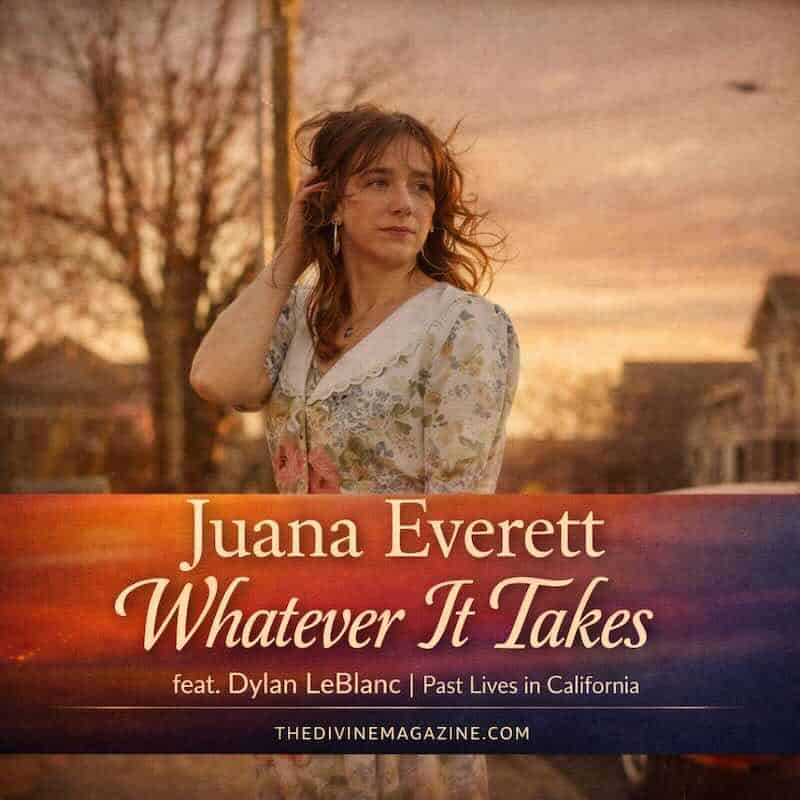
For Juana Everett, the horizon isn’t just a line in the distance; it’s a compass. From the bustling streets of Madrid to the sun-drenched “jungle” of Los Angeles and finally to the hallowed studios of Nashville and Muscle Shoals, Everett’s life has been defined by a restless, “hardcore Sagittarius” spirit. After the raw, survivalist grit of her 2021 debut Move On, Everett returns today with a more weathered kind of wisdom. Her new single, “Whatever It Takes”—a soul-stirring duet with Dylan LeBlanc—serves as the final precursor to her sophomore album, Past Lives in California. It is a song about the quiet heroism of staying put when life gets loud and the transformation of love from a spark into a steady flame.
You left a stable life in Madrid for the “jungle” of LA in your late 20s. Looking back now, what is the one thing you’d tell that version of yourself as she stepped off the plane?
I would tell her, ‘You’re allowed to make mistakes, and nobody here is perfect. Everyone is figuring themselves out. It’s not only you!
You’ve mentioned that distance sometimes accentuates trauma rather than erasing it. How did your relationship with your past change once you were physically thousands of miles away from it?
I think it was not only being far but also being in LA. It’s such a gigantic town, and you can find yourself in such different environments and situations; it’s crazy. It has a thousand parallel worlds. In my early years, I noticed that I was attracting certain energies that I didn’t like. I would end up in weird places, asking myself how I got there. It was my past trauma and the personality I’d built from it that was doing this, and that realization slowly made it to the front of my awareness. It became louder. I started seeing more clearly how my ways, my personality, and my perception of myself were not how I really wanted them to be and how I was choosing to be around people that weren’t right for me. I’m still deprogramming stuff. Aren’t we all? It’s probably the work of a lifetime.
After self-releasing Move On in 2021, what was the specific “moment of alignment” in January 2024 that told you it was time to leave California for Nashville?
I became a mother in 2022, and that drastically changed my life and my relationship to LA drastically, basically because I wasn’t able to hustle and to drive across town to make it to several shows each night. Basic life logistics became way harder, and I started to really crave living somewhere smaller. Nashville had been on the table for a while for its music culture and because it was closer to family, so it was a no-brainer.

On the New Album: Past Lives in California
The new album is described as a journey through “myths that crumbled into pieces.” Which California myth was the hardest for you to let go of, and how did that loss influence the record?
I have to say: thank you for these deep questions! Loving this interview already The myth of fame and social recognition as a source of happiness, or as an indicator of quality, was a big one to see fall. I guess I already knew this, but it became very obvious in LA. It was not hard to let go; on the contrary, it was very liberating. I was a studio assistant for a while, which gave me the opportunity to meet some big names in music, and then at night after my sessions, I would go out to see singer-songwriters in random venues, and sometimes those strangers would move me way deeper than the “stars” I’d just met. I realized that true art is not always recognized, and that being an artist has more to do with honesty and with staying true to your vision, rather than with adjusting to the expectations of an audience. I realized that the business has a very different agenda, and that self-love and self respect is the number one rules to surviving it.
Recording at the legendary FAME Studios is a rite of passage. How did the history of that room—and the ghosts of the soul and swamp-rock legends who recorded there—seep into the sound of these new songs?
It was a profound moment. We got to record at FAME because Dylan LeBlanc invited us to do a session there, which felt like an absolute gift from life. It wasn’t planned. Arriving there and being in that room, seeing the pictures of all those true legends was very humbling and inspiring. It all felt like something bigger than us was taking place, and we just had to let the music happen. I was very grateful and trusting of the whole process, as if the energy contained in those walls was doing the work and we were mere witnesses. It was a magical experience.
Your debut was born from a very dark psychological period. Sonically and emotionally, how does the “mature love” found in Past Lives in California differ from the raw grit of Move On?
I learned a lot of tough lessons making Move On. I had to face a lot of insecurity; I was constantly second-guessing myself, questioning everything like it was a matter of life or death. I’m really proud of that work, but I did make a lot of mistakes along the way, and it took me a long time to get to the finish line. When the time came to record Past Lives In California, I just decided to let intuition lead, to trust myself, the team around me, and the songs. I sort of got out of my own way. The album contains a wide range of emotions, some of them pretty dark too, but I believe it comes across as more mature because there’s way more confidence in it; that’s why the music feels so organic and effortless.
Pre-save ‘Past Lives in California’: HERE

On “Whatever It Takes” & Collaboration
“Whatever It Takes” deals with the complexities of forming a family and sticking together. What was it about Dylan LeBlanc’s voice and perspective that made him the right partner to tell this specific story?
I absolutely love Dylan’s voice and his sensibility as a musician. I knew he had a family and that he would empathize with the theme of the song. I had been listening a lot to his last album at the time, “Coyote”, and deeply connected with it. He does write some dark songs himself, but always containing a softness, a deep vulnerability. That’s why I thought he would be great in this song, and I’m only proud he said yes and is now part of it.
The single explores love full of responsibility rather than just fleeting passion. Was there a specific “thick and thin” moment in your own life that served as the lyrical anchor for this song?
There have been many! My husband and I started a family far away from our own families. We have moved many times, and it’s not always been easy. There’s not a specific moment but a collection of them that proves that we have become home for each other. Fleeting passion is fun and worthy for what it is, but you never quite see the full picture in those relationships. I see way more passion in sharing all aspects of oneself, in building something with another person, struggling together, growing, and becoming more ourselves in a shared loving space that allows for mistakes and change.
Stream Whatever It Takes: https://orcd.co/juanaeverettfeatdylanleblanc_whateverittakes
On the Art of Exploration
You’ve spent a lot of time roaming the PCH and the desert, talking to strangers. Is there a specific person you met on the road who ended up becoming a character or a line in one of your songs?
Yes, most definitely. Songs like “Pinecrest”, “Your Worst Enemy”, “The Janitor”, or “One Million Dollars” have been partially inspired by conversations with strangers or by imagining the lives of people I’ve met briefly. There are a few things that I enjoy more than going into a dive bar and having a good, deep conversation with whoever is sitting next to me. Some of these places have the best therapists you’ll ever find, and all for the cost of a beer. I absolutely love the momentary connection and understanding one can find sitting at a random bar. It doesn’t always happen, but I’m always there for it.
You’re an explorer at heart. Now that you’ve settled into Nashville and have this album ready for the world, what is the “next turn in the trail” that you’re currently eyeing?
Nashville has opened so many new musical windows for me, and I’m peaking through them all! I feel deeply attracted to bluegrass and instruments such as the banjo, the mandolin, and the fiddle. I love its rawness and the nostalgia it carries. The South in general, is fascinating to me for all its musical traditions. It’s the home of the blues. I can’t wait to keep exploring it all and see where my music goes.
Website | Instagram | Facebook | Apple Music | Spotify | YouTube