





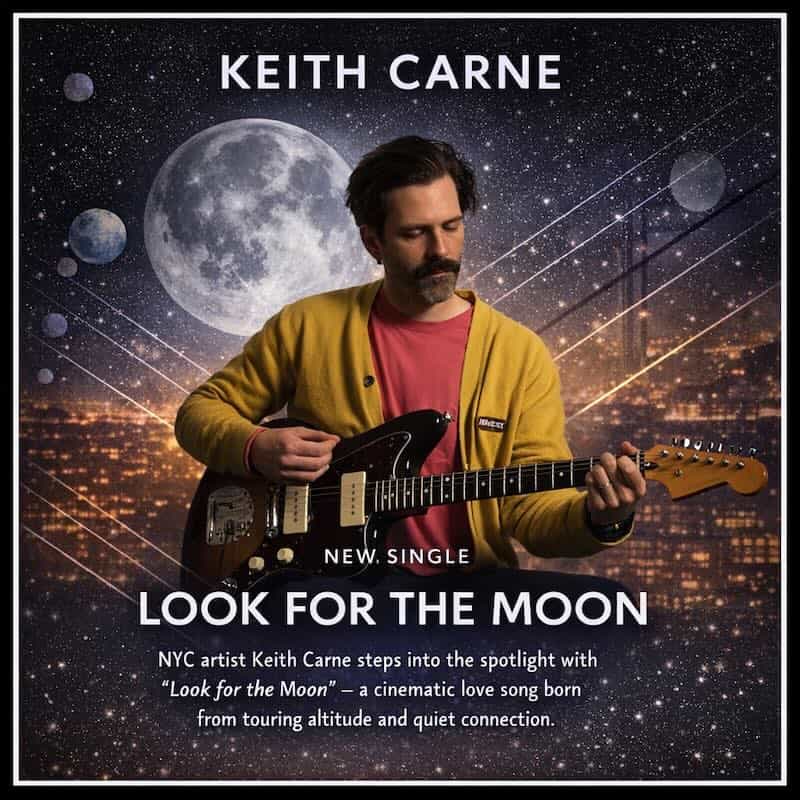
For thirteen years, Keith Carne has been the rhythmic engine behind the indie-rock stalwarts We Are Scientists, driving their high-octane sets from behind the kit. But today, the NYC-based multi-hyphenate steps out from the shadows of the backline to reveal a sprawling, cinematic side of his artistry we haven’t seen before.
With the release of his debut solo single, “Look for the Moon,” Carne trades the “noise” of the road for “glistening synth textures” and a “steady, Madchester-inspired pulse.” Written for his wife, artist Hayley Youngs, the track is a masterclass in grounded vulnerability—a love song for the long-haul flight, capturing the strange, lonely altitude of touring life where connection is found in the shared glow of the moon at 37,000 feet.
The single serves as the luminous first look at his debut solo album, Magenta Light (releasing today, April 20, 2026). Born from a literal psychedelic vision and recorded in the heart of Midtown Manhattan, the album is a genre-blurring journey that bridges the gap between the spiritual jazz of Pharoah Sanders and the propulsive dance rhythms of Fred Again.
Though he remains a fixture of the We Are Scientists lineup, Magenta Light marks Carne’s definitive arrival as a songwriter and producer. It’s an album that proves that sometimes, the person making the most noise is also capable of making the most beautiful, transcendent music.

The Creative Shift
You’ve described drumming as “conducting an orchestra from the back.” Now that you’re the songwriter and producer, how did your perspective on song structure change when you were the one laying down the synths and vocals first?
It’s funny — a lot of these songs began with the rhythmic component. I began to conceive of “Look for the Moon” for example after the groove sort of popped into my head. The groove conjured a world really and the rest was just filling out the textures of that world. I don’t really think the new roles altered my perspective on structure per-se — I record a lot of songs for people as a session drummer, and typically putting drums on a song is what clarifies the structure. I also always tell my drum students that drums really sort of frame a song and make it easier to hear the divisions of the parts — drum fills for example outline punctuations or transitions in the structure, for example. So putting drums on something makes it a little bit more real, and you can get a better sense of the song’s shape. Putting drums on something tends to finalize the structure. Of course that’s not always the case, but most of the songs’ structural arrangements were set by the time I was laying down keys, guitar and vocals. I guess even though I played a lot of guitar and synths and sang on these songs, I still thought about a lot of it as a drummer.
The album is described as blending “energized sonic clutter” with “tranquil pastoral space.” As a drummer, how do you decide when a track needs more “noise” versus when it needs room to breathe?
One of the questions that keeps me up at night haha. It’s such a difficult one to answer because it changes so much with each piece of music. I love really wild, explosive maximal music — Grateful Dead noise jams from Pacific Northwest in 1974 or Pharoah Sanders’s live album “Elevation” — full of shouting and squeaking and people improvising over each other. I also love pulse-less ambient music that’s seemingly just overlapping drones from composers like Chihei Hatakeyama and Brian Eno. Really it has a lot to do with the phrase and “playing to the singer.” The best drummers know how to play to the singer — in terms of dynamics, the parts, the textures, etc. When I play with WAS, Keith Murray’s voice is really the loudest thing that I have in my mix — so that I can hear him clearly to know how to support him. After all, his voice and his guitar are the big draws for that band. My music isn’t much different — it’s just that the singer isn’t always the vocalist. I ask myself a lot “what is singing here” — sometimes it’s the vocals, sometimes it’s the guitar. Sometimes it is the actual space itself. I think the instrumental piece on the record “Contortionist Jazz Exotica” — the 5th song on the album — illustrates that tension between clutter and space nicely; it oscillates between those elements freely. Really, the drums and bass are the “singers” on this piece — so they’re sort of locked into a duet together. Their parts are really built around the spaces where they cut out.
You played most of the instruments on this record. Which instrument—other than the drums—did you find most effective for capturing the “ethereal tonality” of the album?
There are two plug-in effects that I used a lot on the album that really helped with this. One from Sound Toys called the Crystalizer that allowed me to make my “lead” guitar parts sound less like a guitar and sort of otherworldly. You can hear it on “Look for the Moon” — it’s the thing that sounds sort of like a synthy siren in the intro and the choruses.
The other plug-in is the Waves Harmonizer which is sort of a vocal synthesizer that you can program. It’s what is helping me generate that thick, harmonized vocal sound on “Moon,” the choruses of “Totally Liminal” and “Keep Away” and the vocal part of “The Falls.” Blending that with an unaltered vocal helped my voice not sound literally like my voice, but it’s also still recognizable as my voice.
The Inspiration: “Look For The Moon”
Look for the Moon” explores finding reassurance in a shared sky. Was there a specific moment on tour—perhaps on a tarmac or a hotel balcony—where this “moon-connection” with Hayley first clicked as a song concept?
Hayley and I have always had this moon-connection. She painted a piece with that title actually. It also became a little game for us to look for the moon, even during the day. That’s one of the funny things that the moon (understandably) — people usually just associate it with the night. But really you can often see it during the day. Looking for and seeing the moon just always makes me think of Hayley.
There wasn’t a moment on tour. Touring, and specifically flying out to a first-show in another city or country is usually when I’m thinking about her most. Really it was the drum groove that opened the door to the moon as a concept for a song. The groove conjured this sort of 90s, adult contemporary pop aesthetic — “Just Another Day” by John Secada or “Crazy” by Seal — and along with it came the lyric with a sort of sultry, percussive delivery “I think about you every night.” That just made me then ask “What do I think about every night?” That was obvious: Hayley. “When do I tend to think about her the most?” That was obvious too — on tour and flying out to begin a tour.
You mentioned “Delta airline wine” and airplane cabins in your lyrics. Why was it important to include those gritty, mundane details of travel alongside the more “celestial” themes of the song?
Oh for sure. Those to me are the grounding elements sort of (ironic since they refer to literally being in the air). But they’re the moments where I tend to just think about Hayley most. It’s easy to get lost in your own world when writing lyrics because a song can be about anything. The focus on the airplane cabin just helped to keep my lyric writing focussed.
The single has a steady ’90s Madchester pulse. What is it about that specific era of UK dance-rock that felt like the right “heartbeat” for a song about modern longing?
It’s a good question. I’m not really sure. I just know I’m often melodically drawn to a lot of music that uses this as a rhythmic backdrop. A lot of that Madchester music from the late 80s — “Step On” by the Happy Mondays or “Loaded” by Primal Scream. And all the 90s adult contemporary pop I mentioned earlier — Sade, Seal, Maxi Priest, etc. My mom turned me onto a lot of that 90s stuff and I guess it made a way deeper impact on me than I realized. I guess that groove just set a sort of course and then lets the singer be wildly expressive over it. I like that the groove sort of stays out of the way, but that doesn’t mean it has to be incredibly simple.

The Vision of Magenta Light
You named the album after a psychedelic vision Hayley had of light pouring from your face. How did that specific image of “magenta light” translate into the actual textures and “colors” of the music?
This vision of the magenta light pouring from my face wasn’t just something I could “see.” It was something I could feel. It conjures something very real for me — a space between aching and sweetness and that is something that connects a lot of the disparate kinds of music I love. I think of magenta as being this really enveloping color and a lot of the rich textures on this record feel like they’re immersive.
You recorded this in your Midtown Manhattan studio under a literal magenta LED lamp. How did that environment influence the “transcendent passages” of the record compared to the frantic energy of NYC outside?
I’ve had this studio space for 16 years now and it’s amazing how the chaos (if not the noise, because you can occasionally hear sirens in there haha) of 8th avenue midtown stays outside of that studio space. My space is in the back of the building, so that helps from a completely practical sense. But it’s a bit like when you walk into a cinema in Manhattan — this huge space that almost seems like it shouldn’t really be there. Of course my studio is WAY smaller than a cinema auditorium, but I get a similar feeling. The light really acted like a way for me to mark a transition within the space. Sometimes I’d record parts between teaching drum lessons or while waiting to hear back from producers about drum tracks I’d sent them. So when that light went on, it allowed me to shift into my own sort of inner-world. Like an emotional Bat-signal haha. It was really more important for me to keep the practical world out — worrying about logistics or my schedule or texts from friends. The studio space has always felt a bit like my little corner or safety in the madness of midtown, and the light just helped me burrow a little deeper into that space.
You’ve cited Pharoah Sanders and Fred Again as equal influences. Those are two very different sonic worlds—how do you bridge the gap between “spiritual jazz” and “catchy dance anthems” on a single track?
That’s really what I want to do with all my expressive musical projects — reflect the art that really moves me. And I am moved by a lot of wildly contrasting art. In a practical sense it was helpful to keep the groove itself minimal (until it sort of explodes at the end). That keeps the rhythmic identity focussed like in dance music. It also helps to have somewhat minimal lyrics, but use them in the way you might in a pop song. “Totally Liminal” has expansive verse lyrics, but the chorus is just two words — “Excuse me.” That’s common in a lot of dance music because so many of those artists I love can say so much so concisely. Think about DJ Alice “Do you think you’re better off alone?” or Eric Prydz “Call on me.” My gosh that’s so rich. Those more focussed elements then sort of freed me up to make the melodic textures blossom, like in spiritual jazz music I love. Like the glistening arpeggios you hear in Alice Coltrane’s music.
Looking Ahead
After over a decade with We Are Scientists, what do you hope fans learn about you as an artist through Magenta Light that they might never have guessed from your work behind the kit?
I guess I’m just eager to share my melodic and lyrical ideas with people. As a drummer it’s not always easy to express those directly with people.