







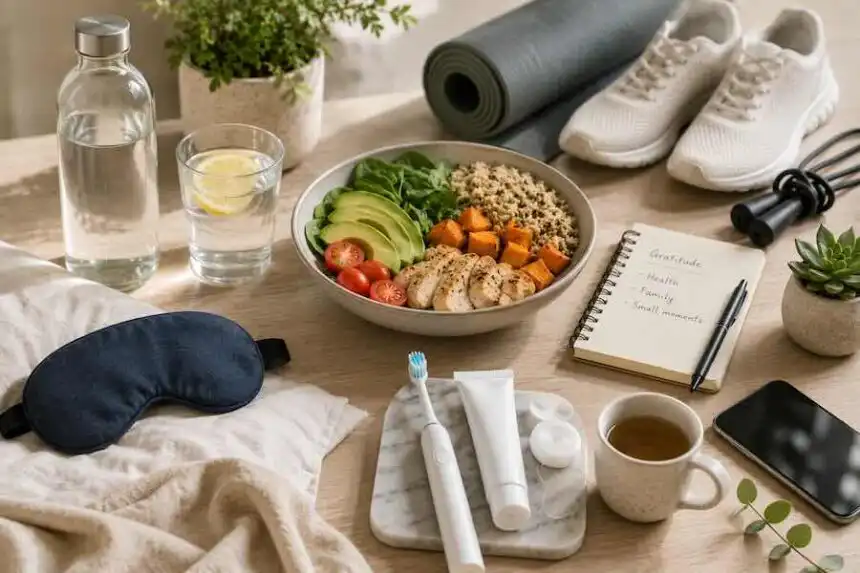
Most health routines do not fail because they are too small. They fail because they ask too much, too quickly. A better approach is quieter: morning light through the window, water within reach, a short walk between meetings, clean teeth before bed, and a few minutes when the phone stays in another room.
- Start the morning with water and daylight
- Make everyday meals easier to assemble
- Interrupt long stretches of sitting
- Protect the conditions that make sleep possible
- Give oral care its proper place
- Create parts of the day that screens cannot enter
- Leave room for stillness
- Build a routine you can repeat on an ordinary Wednesday
- FAQ: Building healthier daily habits
None of these habits looks dramatic in isolation. That is precisely the point. Daily health is shaped by what can be repeated without turning ordinary life into a permanent self-improvement project. These seven practices create a practical framework for feeling more rested, active and present.
Start the morning with water and daylight
After several hours without drinking, a glass of water is an easy way to begin replacing fluid lost overnight. Keep it simple. There is no need for an elaborate morning drink unless you genuinely enjoy one.
Daylight deserves a place in the same routine. Your circadian system responds to light, and getting natural light after waking can help reinforce the body’s distinction between daytime activity and nighttime rest. The Sleep Foundation offers further guidance on the relationship between light, circadian rhythms and sleep.
Open the curtains. Step onto the balcony. Drink your coffee near a bright window or take a short walk outside. The habit can fit around the morning you already have.
Make everyday meals easier to assemble
Healthy eating becomes considerably harder when every meal requires a fresh decision. A refrigerator containing a few prepared basics changes the equation.
Cook grains ahead, wash vegetables, keep fruit visible and have convenient sources of protein available. The Harvard Healthy Eating Plate provides a useful visual framework built around vegetables and fruit, whole grains and healthy protein rather than rigid meal rules.
The practical advantage is less glamorous but important: when Tuesday evening arrives and energy is low, a balanced meal should be easier to make than the alternative.
Interrupt long stretches of sitting
A workout is valuable, but it does not need to be the only movement in your day. Long periods at a desk can be broken by small physical interruptions: standing while taking a call, walking for a few minutes, stretching your shoulders or taking the stairs.
Think of these as transitions rather than exercise sessions. They create a natural break between tasks and make movement part of the architecture of the day.
If reminders help, attach movement to something that already happens regularly. Get up after a meeting ends. Walk after lunch. Stretch while the kettle boils. Repetition matters more than making the ritual impressive.
Protect the conditions that make sleep possible
Sleep rarely improves because of one perfect nighttime ritual. The surrounding conditions matter: timing, light, noise, temperature and what happens during the hours before bed.
A reasonably consistent sleep schedule can provide useful structure. So can a bedroom that feels dark, quiet and comfortable. Divine’s guide to optimal health also looks at the broader relationship between everyday habits and wellbeing.
Rather than chasing a flawless routine, identify the friction in your own evening. Maybe it is late caffeine. Maybe it is work following you into bed. Sometimes the most useful change is simply giving the day a clear ending.
Give oral care its proper place
Dental care can disappear into the background because it is so familiar. Yet brushing and cleaning between the teeth remain basic parts of preventive health.
Brush thoroughly twice a day and clean between your teeth regularly using a method that works for you. The American Dental Association provides evidence-based information on brushing, flossing and preventive dental care. Divine also has a broader guide to dental and oral health.
Products matter less than consistency, although practical tools can make consistency easier. Traditional floss, interdental brushes and products such as dental floss offer different options depending on preference and dental needs.
Create parts of the day that screens cannot enter
Phones have quietly occupied almost every empty space: breakfast, queues, train rides, television breaks and the final minutes before sleep. Reclaiming even one of those spaces can change the texture of a day.
You might keep the first 20 minutes after waking screen-free, leave your phone away from the dining table or stop scrolling before getting into bed. The boundary does not need to become a dramatic digital detox.
Use the reclaimed time for something tangible. Read ten pages. Prepare tomorrow’s clothes. Stretch. Talk to someone. Sit beside an open window and do nothing for five minutes. Empty space does not always need filling.
Leave room for stillness
Wellness can become strangely busy. There is always another metric to track, meal to optimize or routine to perfect. A few unstructured minutes can be useful precisely because they demand nothing.
Gratitude practice is one option. Write down something specific that went well, notice a small pleasure from the day or simply sit quietly and pay attention to your surroundings. Mindfulness can be equally uncomplicated: notice your breathing, the sounds in the room or the physical sensation of walking.
The aim is not forced positivity. Difficult days remain difficult. The practice simply creates a small interval in which attention is directed intentionally rather than pulled toward the next notification, obligation or worry.
Build a routine you can repeat on an ordinary Wednesday
The most useful health routine is rarely the most ambitious one. It is the version that survives deadlines, travel, bad weather and mornings when motivation is nowhere to be found.
Choose one change first. Put water beside the bed. Take a ten-minute lunchtime walk. Move the phone charger out of the bedroom. Once that action begins to feel automatic, another can follow.
Health accumulates quietly. There may be no dramatic before-and-after moment, just a morning when you notice that you slept better, an afternoon with a little more energy, or an evening that feels less crowded. Those changes count.
FAQ: Building healthier daily habits
Do I need to drink water immediately after waking?
No specific minute is essential. Drinking water in the morning is simply a convenient opportunity to rehydrate after the overnight period without fluids. What matters more is maintaining adequate hydration across the day.
How long should a movement break be?
It does not have to resemble a workout. Even a brief walk, standing break or stretch interrupts sitting. If you spend much of the day at a desk, look for frequent opportunities to change position and move.
Should I stop using screens completely before bed?
Not necessarily. A more realistic approach is to reduce stimulating screen use when it interferes with winding down or delays bedtime. Experiment with a screen-free interval and see whether it makes your evening calmer.
What is the easiest healthy habit to start with?
Choose something that requires almost no preparation and attach it to an existing routine. Drinking water after waking, walking after lunch or cleaning between your teeth before brushing at night are simple examples.
How many habits should I change at once?
There is no universal number, but changing one or two behaviors at a time can make it easier to discover what actually fits your life. A modest habit maintained consistently is more useful than an elaborate routine abandoned after a week.